
You are currently browsing the category archive for the ‘History’ category.
Here’s hoping to making it through the next 75 years or so…
Jonathan Cook writes poignantly about the media situation a that is imposed on the West. The prism from which we view things, at the very base, is a flawed interpretation of the world. Obedience to the dominant hierarchy is expertly camouflaged within a supposedly free and democratic society. The question though is this, how free and democratic – even how just – is a system that promotes the withering of our empathetic selves and the systemic dehumanization of others?
“The reason the Great Western Narrative persists is because it is useful – to those in power. Humans may be essentially the same in our natures and in our drives, but we are very definitely divided by power and its modern corollary, wealth. A tiny number have it, and the vast majority do not. The Great Western Narrative is there to perpetuate power by legitimising it, by making its unbalanced and unjust distribution seem natural and immutable.
Once kings told us they had blue blood and a divine right. Today, we need a different kind of narrative, but one designed to achieve the same end. Just as kings and barons once owned everything, now a tiny corporate elite rule the world. They have to justify that to themselves and to us.
The king and the barons had their courtiers, the clergy and a wider circle of hanger-ons who most of the time benefited enough from the system not to disrupt it. The role of the clergy in particular was to sanction the gross imbalance of power, to argue that it was God’s will. Today, the media function like the clergy of old. God may be dead, as Nietzsche observed, but the corporate media has taken his place. In the unquestioned premises of every article, we are told who should rule and who should be ruled, who are the Good Guys and who the Bad.
To make this system more palatable, more democratic, to make us believe that there is equality of opportunity and that wealth trickles down, the western elite has had to allow a large domestic middle class to emerge, like the courtiers of old. The spoils from the rape and pillage of distant societies are shared sparingly with this class. Their consciences are rarely pricked because the corporate media’s function is to ensure they know little about the rest of the world and care even less, believing those foreigners to be less deserving, less human.
Nothing more than statistics
If western readers, for example, understood that a Palestinian is no different from an Israeli – apart from in opportunities and income – then they might feel sympathy for a grieving Palestinian family just as they do for an Israeli one. But the Great Western Narrative is there precisely to ensure readers won’t feel the same about the two cases. That is why Palestinian deaths are invariably reported as nothing more than statistics – because Palestinians die in large numbers, like cattle in an abbatoir. Israelis, by contrast, die much more rarely and their deaths are recorded individually. They are dignified with names, life stories and pictures.
Even when a moment arrives to single out a Palestinian from the mass of death, western corporate media show great reluctance to do so. Just take the case of Razan al-Najjar, the 21-year-old Palestinian medic executed by a sniper’s bullet as she tended to the unarmed demonstrators regularly being killed and wounded at the perimeter fence encaging them in the prison of Gaza.
Gaza is slowly sinking into the sea, but who cares? Those primitive Palestinians live like cavemen amid the rubble of homes Israel has repeatedly destroyed. Their women are hijabbed and they have too many children. They don’t look like us, they don’t speak like us. Doubtless, they don’t think like us. They cannot be us.
Even those young Palestinian demonstrators, with their faces covered with strange scarves, launching flaming kites and throwing the odd stone, look different. Can we imagine ourselves standing in front of a sniper to protest like that? Of course not. We cannot imagine what it is like to live in one of the most densely populated areas on the planet, in an open-air prison over which another nation serves as jailers, in which the water is becoming as saline as seawater and there is no electricity. So how can we put ourselves in the demonstrators’ shoes, how can we empathise? It is so much easier to imagine being the powerful sniper protecting the “border” and his home.
But al-Najjar undermined all that. A young, pretty woman with a beautiful smile – she could be our daughter. Selflessly tending to the wounded, thinking not of herself but of the welfare of others, we would be proud to have her as our daughter. We can identify with her much better than the sniper. She is a door beckoning us to step through and see the world from a different location, from a different perspective.
Which is why the corporate media has not invested al-Najjar’s death with the emotional, empathetic coverage it would if a pretty young Israeli female medic had been gunned down by a Palestinian. It was that double standard in his own newspaper, the Guardian, that outraged cartoonist Steve Bell last week. As he noted in correspondence with the editor, the paper had barely covered the story of al-Najjar. When he tried to redress the imbalance, his own cartoon highlighting her death – and its oversight – was censored.
The Guardian’s editors argued that his cartoon was anti-semitic. But the truth is that al-Najjar is dangerous. Because once you step through that door, you are unlikely to come back, you are unlikely ever again to believe the Great Western Narrative.
The true message of Israel
Israel-Palestine offered me that door, just as it has so many others. It is not, as Israel’s apologists – and the upholders of the Great Western Narrative – will tell you, because so many westerners are anti-semitic. It is because Israel lies in a grey zone of experience, one that is readily available to western tourists but at the same time gives them a chance to glimpse the dark underbelly of western privilege.
Israel is enthusiastically embraced by the Great Western Narrative: it is supposedly a liberal democracy, many of its inhabitants dress and sound like us, its cities look rather like our cities, its TV shows are given a makeover and become hits on our TV screens. If you don’t stand too close, Israel could be Britain or the US.
But there are clues galore, for those who bother to look a little beyond superficialities, that there is something profoundly amiss about Israel. A few miles from their homes, the sons of those western-looking families regularly train their gun sights on unarmed demonstrators, on children, on women, on journalists, on medics, and pull the trigger with barely any compunction.
They do so not because they are monsters, but because they are exactly like us, exactly like our sons. That is the true horror of Israel. We have a chance to see ourselves in Israel – because it is not exactly us, because most of us have some physical and emotional distance from it, because it still looks a little strange despite the best efforts of the western media, and because its own local narrative – justifying its actions – is even more extreme, even more entitled, even more racist towards the Other than the Great Western Narrative.
It is that shocking realisation – that we could be Israelis, that we could be those snipers – that both opens the door and prevents many from stepping through to see what is on the other side. Or, more troubling still, halting at the threshhold of the doorway, glimpsing a partial truth without understanding its full ramifications.”
Did you ever wonder why some of your acquaintances are so critical of the mainstream media; or why so quickly they roll their eyes when it comes to certain topics and ideas. I bet you a shiny loonie (One dollar coin in Canadian currency) that they have stepped through the doorway and are wondering when you will finally join them.
Exercising is weird. Everyday I see people running or jogging down the street and I wonder to myself why are they doing that? Imagine if they could ‘feel the burn’ by doing something productive while burning calories. Yard work, helping your neighbour clean their gutters, even collecting litter from the street are all physical activities that accomplish something and get you moving. I’m pretty sure if we just looked around our neighbourhoods we could see where we could put our desire for physical activity to good social use – I know I can always use a hand with some of the more labour intensive outdoor tasks (snow shovelling anyone?).
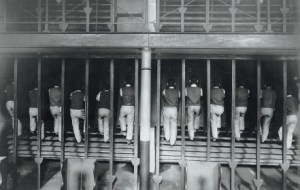 Questioning of the utility of jogging/running aside, the humble treadmill has a somewhat darker past than what I knew about. They were used as punishment for prisoners, sometimes being forced to work 10 hours a day to break down the ‘criminal spirit’ in them. Given that people tended to die on them quite regularly they were abandoned as a ‘reform’ method in Britain, but of course the US seeing some serious punishment potential, adopted treadmills to help with its criminal population.
I’m speculating here, but I notice that in the US the treadmills were not phased out primarily because of their inhumane nature, but rather the appeal of forcing convicts into slave labour where profit could be made. <Insert snark about ‘ethical capitalism’ here.>
The JSTOR article is quite interesting as is the excerpt:
“Inside of a century, the once-popular prison treadmill proved too cruel and pointless for its home nation [Britain], but that did not stop it from being imported to the U.S. The treadmill came to America in 1822, and was set up in four different prisons. It was briefly popular at the prison on East 26th Street in New York City. The first one installed there, which cost $3,050.99 to build, busied 16 prisoners at a time, who ground 40-60 bushels of corn a day. Within two years, the prison had built three more, two of them used by women. But, by 1827, the mills had fallen into only sporadic use and then were abandoned when the prison relocated. In Newgate, Charleston, and Philadelphia, treadmills were installed, used sparingly, and given up on in short order.
Just as in Britain, Americans were struggling with what to do with their criminals. Should they work alone, contemplating their former bad ways? If they worked while in prison, what was the purpose?
In America, it seemed, the answer could not be “toil for its own sake.” In 1827, the Prison Discipline Society of Boston wrote that “the treadmill… teaches the convict nothing that can be useful to him on his discharge. It is not a profitable employment of human power.”
At a prison opened in 1822 in Auburn, NY, a new approach emerged. Dubbed “collective industry,” prisoners sat together and worked, turning the prison into a factory, albeit a strict one. “The rules typically called for downcast eyes, lockstep marching, no talking, and constant work when outside the cells. The usual punishment for infractions was the lash.” This new system was considered both humane and, most importantly, highly industrious. Outside the prison walls, there was a labor shortage. Instead of milling a few dozen bushels of corn a day— work that an animal could do—these convicts were making shoes, clothing, hardware, furniture, rifles, and clocks. Private manufacturers brought raw materials or unfinished products into the prison and paid for the labor.
The idea soon spread, and prisoners all over the country were put to work—until concerns about prisons interfering with the open market surfaced, that is. Prevailing ideas about incarceration, work, and punishment continued to evolve, but the treadmill was long gone.”
A little historical perspective is always a good thing. My moralizing – maybe not so much – but I would suggest that rather than sweating on a torture device from the early 20th century, perhaps put your physical labour toward helping others and improving your community. Seems like a win for everyone.
It’s nice to get a overview of what we have done and where we might be going, and of course the final heat death of the Universe. :)
Why is Russia so involved in the conflict in Syria? Robert Fisk looks into some possibilities.
“There are, however, other small Chechen ghosts floating over Syria. A large number of Chechen Islamists, fleeing the forests of Chechnya after Russia’s victory, arrived in Syria to attack the regime.
One of the Syrian army’s most devastating setbacks occurred on a mountain top south of the Turkish border, when a Chechen jihadi suicide-bombed a military base by driving a captured armoured car into the compound. He killed every one of the Syrian defenders. The explosion was so vast that an eyewitness on a neighbouring hilltop told me he saw fire reaching into the clouds – and then continuing above the clouds into the empty sky.
The Russians know exactly who they are fighting in Syria, which is why Russian pilot Roman Filipov blew himself up with his own grenade rather than be captured by Islamists. For Putin, those Chechens who resisted his firepower inside Russia are merely continuing their struggle inside a Russian ally further to the south.
Eliminate them, Putin believes, and then make peace with your erstwhile enemies later. It’s been a policy maintained, up to a point, by Damascus. The earlier siege of Deraya on the edge of Damascus was ended in a series of “reconciliation” committees and mutual ceasefire promises.
The distance between Grozny and Damascus is less than 900 miles. From the Kremlin walls, the minarets of Damascus are not in the “Middle East”; they are due south. Russian power doesn’t end at its own frontiers – nor did it in Stalin’s day. His Red Army did not halt at the Soviet frontier in 1945. It pursued the “fascist beast” to its lair in Berlin. And Chechnya remains very much in Putin’s mind today.”
Fascinating points, and of course never once mentioned in the mainstream news…











 bleatmop
 Mystro


 Dead Wild Roses
Your opinions…