
You are currently browsing the category archive for the ‘History’ category.
Western public culture has no trouble speaking in the language of conquest, so long as the conqueror is European. We can list the crimes of empire in a catechism: invasion, extraction, settlement, forced conversion, slavery, and the slow grinding down of local institutions. We teach it. We ritualize it. We build moral identity around denouncing it.
But history did not outsource conquest to Europe.
From the 7th century onward, Muslim-ruled polities participated in a major, long-running arc of territorial expansion: the early Arab conquests across the Levant, Egypt, North Africa, and Persia; the push into Iberia; later Turkic and Ottoman expansion through Anatolia and into the Balkans; and, further east, Muslim dynasties consolidating power across parts of South Asia. This was not a tea party with trade agreements. It was war, regime change, tribute systems, and durable social hierarchies that reordered whole regions for centuries.
Even where rule was comparatively tolerant by the standards of its time, it was still rule. Non-Muslim populations were commonly governed as dhimmi, protected yes, but subordinate. They often paid special taxes, faced legal asymmetries, and lived under conversion pressures that, in some contexts, ranged from overt coercion to the long, quiet incentives of status and security. The story differs by place and century. The pattern does not disappear.
Then there is slavery, another topic where our moral accounting often becomes selective. The trans-Saharan, Red Sea, and Indian Ocean systems ran for many centuries and involved very large numbers, though estimates vary widely. They fed household servitude, military slavery, and sex slavery. In the Mediterranean, North African corsairing and “Barbary piracy” produced European captives well into the early modern era. Some historians argue for totals in the low millions across those centuries, though the higher figures are disputed and other scholars propose substantially lower estimates. Either way, the phenomenon is real, and it is rarely integrated into the default Western “slavery story,” which typically means plantations, the Atlantic triangle, and racial chattel bondage. The Ottoman system also included practices like devshirme, the levy of Christian boys for state service, and imperial governance across religious communities was often managed by layered legal categories. Stability was purchased with inequality.
None of this is a claim that Muslim-majority societies are uniquely violent. They are not. It is a claim that they were human societies with power, ambition, and the usual imperial toolkit. Sometimes it was tempered by pragmatism. Sometimes it was sharpened by ideology. It was always shaped by the incentives of rule.
So why does so much Western academic and activist discourse treat “colonialism” as if it is a European invention, or at minimum reserve the hottest moral language for European cases?
You can see the asymmetry in ordinary cultural output. A student can finish a humanities degree with a fluent vocabulary for “settler-colonialism,” “whiteness,” and “decolonization,” and still never be asked to apply the same conceptual machinery to the Islamization of North Africa, the Turkification of Anatolia, or the Ottoman imperial management of the Balkans. The knowledge exists. The integration often does not.
A few mechanisms are doing the work:
First: the moral map is drawn around modern Western guilt. Universities and NGOs in the West operate inside a story where the primary purpose of historical consciousness is to discipline our civilization. That can be valuable. Self-critique is healthier than propaganda. But it also creates a spotlight effect. If the goal is penance, you do not look for other sinners. You look for mirrors.
Second: postcolonial theory often frames power in a one-directional way. “Colonizer” and “colonized” become fixed identities rather than recurring historical roles. Once the roles harden into moral identities, describing conquest by non-Western empires becomes conceptually awkward. It scrambles the script.
Third: fear of misuse leads to silence. Many scholars and activists worry, often reasonably, that frank discussion of Islamic conquest will be weaponized by bigots. But the answer to bad faith is not selective amnesia. When institutions pre-censor reality to prevent “the wrong people” from citing it, they teach the public a fatal lesson. The gatekeepers do not trust the truth.
Fourth: selective “harm literacy” is now a career incentive. Some topics are safe, rewarded, and legible within current moral fashion. Others are professionally risky, easily smeared, or administratively discouraged. This does not require a conspiracy. It is simply an ecosystem where the costs and benefits are asymmetrical.
The result is not denial, exactly. It is a pattern of omission. Certain conquests are treated as the central moral lesson of history. Others are treated as context, complication, or footnote, no matter how long they lasted, how many people they reordered, or how durable their legal hierarchies proved.
If “colonization” is a real category, and if it means conquest, extraction, tribute, settlement, cultural subordination, and the restructuring of life under new rulers, then it has to apply wherever the pattern appears. Otherwise it is not analysis. It is choreography. 🎭

So here is the question Western institutions should be willing to answer plainly: Why is one empire’s violence treated as the moral template, while another empire’s violence is handled like a reputational hazard, especially when the same victims, religious minorities, conquered peoples, and enslaved captives, are supposed to matter in our universalist ethics?
Because the cost of selective memory is not merely academic. It trains citizens to distrust the referees. When respectable institutions signal, through omissions and asymmetrical moral urgency, that certain truths are too dangerous to say out loud, audiences will go looking for people who will say them. Often crudely. Often with their own distortions. And the gatekeepers will have manufactured the very problem they feared.
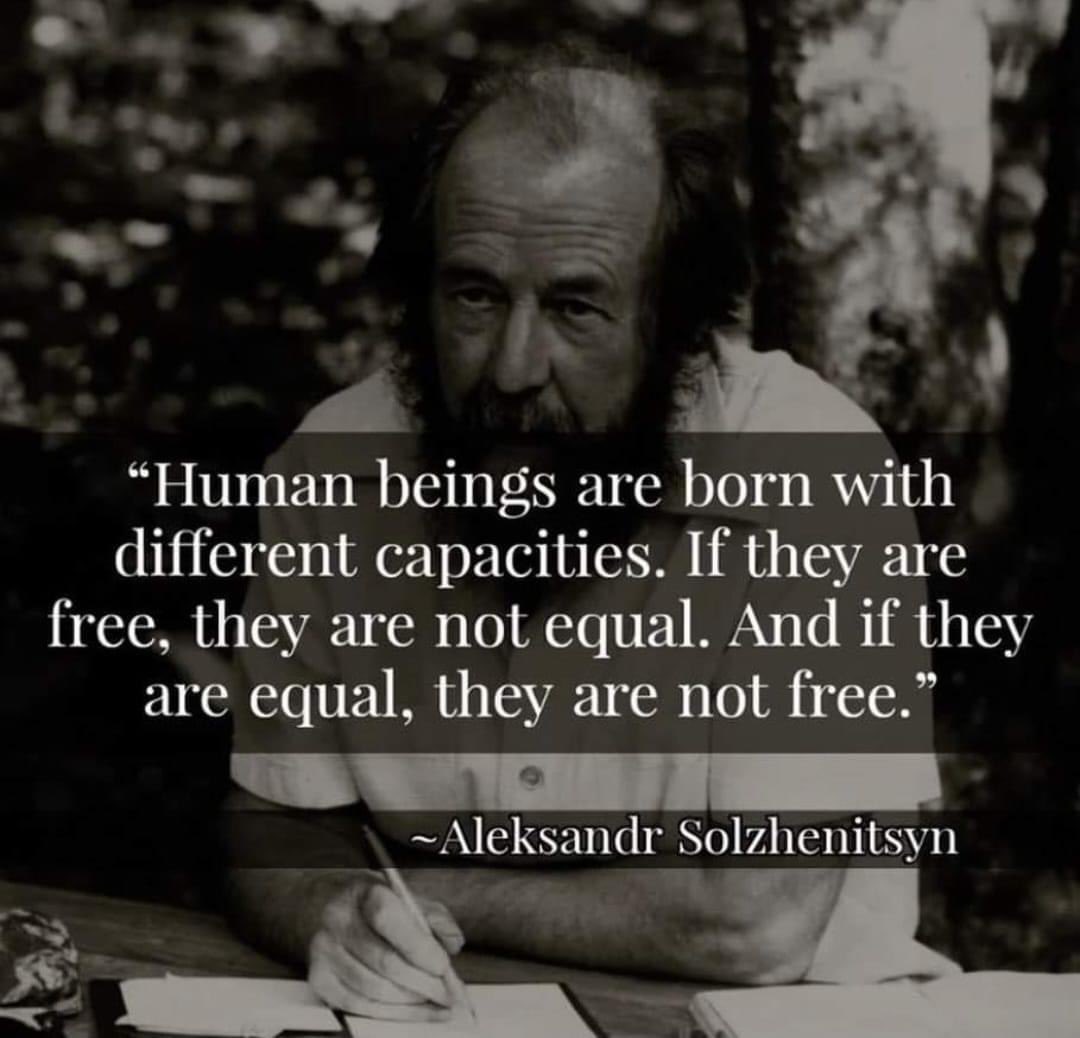
This meme only “works” if you stop letting equality smuggle itself in as a moral trump card.
Humans are born uneven. Not in worth—in capacity. Strength, IQ, impulse control, charm, health, family stability, appetite for risk, luck. You can pretend those differences don’t matter, but the moment people are allowed to act freely, they cash out into unequal outcomes. Some people build, some coast, some burn it all down. Freedom is a sorting machine.
So the first half is basically a description: if people are free, they will not end up equal. Not because someone rigged the game. Because the inputs aren’t equal and choices compound.
The second half is the warning: if you demand equality of outcomes, you don’t get it for free. You get it by force. There’s no other mechanism. Outcomes only converge when you stop people from doing the things that produce divergence: earning more, choosing differently, hiring freely, saying what they think, competing hard, associating with who they want, opting out. Equality-as-leveling needs an enforcer. And enforcers don’t show up with a gentle “please.” They show up with rules, penalties, and permission structures—what you’re allowed to do, to say, to keep.
That’s the core trade: freedom produces inequality; outcome equality requires coercion.
Now for the part people always dodge: there are different “equalities.” And conflating them is the whole scam.
- Equal dignity: every person counts as a person. That’s a moral claim. Compatible with freedom.
- Equality before the law: same rules, same due process, no caste exemptions. Also compatible with freedom—arguably required for it.
- Equality of outcomes: everyone ends up in roughly the same place. That’s the one that fights liberty, because it needs constant correction.
Most modern arguments cheat by pointing at the first two and then demanding the third. “If you deny outcome parity, you deny human worth.” No—what you’re denying is the claim that the state (or HR, or the university, or the tribunal) should get to manage adult lives until the spreadsheet looks morally satisfying.
You can have compassion without pretending outcomes should match. You can want upward mobility without confiscating difference. You can care about the bottom without pretending the top is illegitimate.
And yes: sometimes liberty creates ugly inequality. The honest response is to name the costs and argue about which constraints are justified—fraud laws, safety nets, antitrust, disability supports, basic education—without turning “equality” into a magic word that dissolves the question of coercion.
The meme’s point is simple and harsh: if you want equal outcomes, you’re volunteering everyone for supervision. And the people doing the supervising never start by supervising themselves.
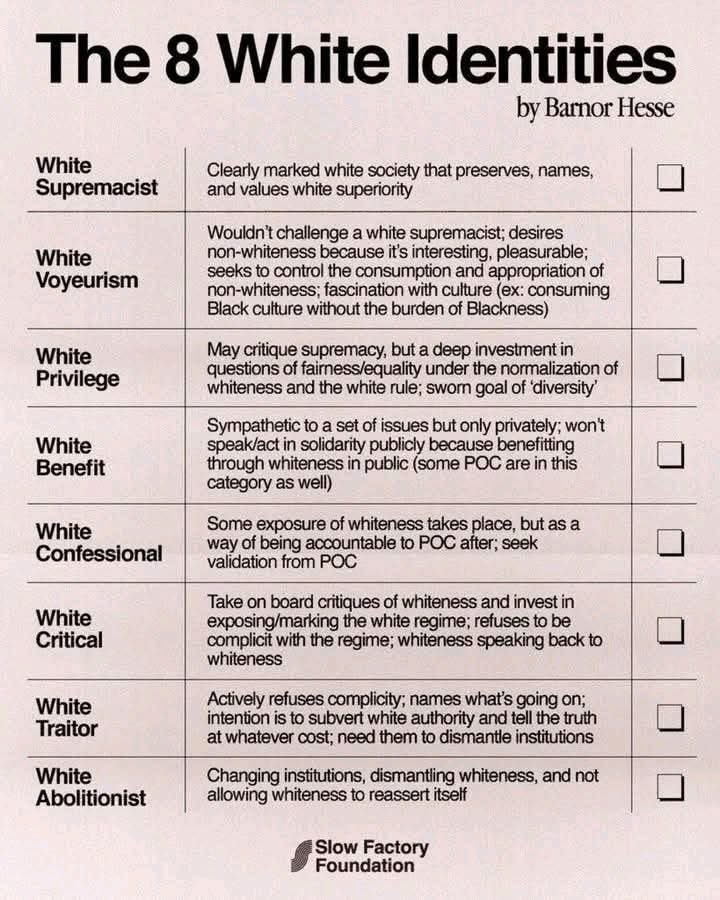
This “8 White Identities” chart (attributed to Barnor Hesse) looks like education, but it functions like a moral sorting machine. It offers eight labels that appear descriptive while quietly guiding you to one approved destination: “traitor/abolitionist,” meaning active participation in dismantling institutions so “whiteness” cannot “reassert itself.” That isn’t neutral analysis; it’s a disciplinary ladder. The key tell is the structure: most categories are not stable identities but staged accusations: if you don’t end at abolition, you’re still “benefiting,” “confessing,” “complicit,” or “voyeur.” It’s less “here are ways people relate to race” and more “here is your moral rank, move upward.”
Where does this method come from? In plain terms, it’s downstream of critical theory which is a family of approaches associated with the Frankfurt School, including Max Horkheimer, which treats social life as saturated with power and aims not merely to interpret society but to critique and transform it. Suspicion becomes the starting posture: norms, institutions, and “common sense” are read as mechanisms that reproduce domination. That posture can be illuminating when it identifies genuine structural incentives or hidden rules. The problem is what happens when the posture hardens into a closed moral cosmology: every institution is presumed guilty, every norm is presumed cover, and disagreement is presumed self-interest.
This particular pop-form is best described as CRT-style reasoning (even when it’s outside law schools): “whiteness” treated as an institutionalized advantage; disparities treated as presumptive evidence of systemic bias; “neutrality” treated as camouflage; and moral legitimacy tied to “anti-racist” alignment rather than truth-tracking. The flaw isn’t “not caring about racism.” The flaw is an a-historical compression: it collapses different eras, actors, and institutions into one continuous regime (“whiteness”) and treats complex tradeoffs as one moral story with one villain. You stop seeing plural motives, competing goods, and reformable failures; you see only complicity versus resistance.
The chart also relies on social coercion, not argument. It invites “accountability,” but what it means in practice is public performance under threat of moral demotion. Ask for evidence and you’re “centering yourself.” Disagree and you’re “invested.” Stay quiet and you’re “benefiting.” Even agreement becomes suspect if it’s the “wrong” kind (confessional, validation-seeking). That’s the unfalsifiable core: the framework is built so that any response can be converted into proof of guilt or complicity. A theory that cannot lose contact with counterevidence doesn’t guide understanding; it guides conformity.
If you actually want a model that helps rather than coerces, start with falsifiable claims and reformable mechanisms: identify specific policies, incentives, or gatekeeping practices; compare outcomes across institutions; test interventions; keep individual dignity intact; and treat moral status as something earned by conduct, not assigned by category. You can still talk about bias and history without turning identity into original sin. The danger of charts like this isn’t that they “teach empathy.” It’s that they train people to swap evidence for ritual, and dialogue for denunciation—and that trade makes every institution worse, not better.
The Age of Discovery was not a morality play. It was a capability leap. Between the late 1400s and the 1600s, Europeans built a durable system of oceanic navigation, mapping, and logistics that connected continents at scale. That system reshaped trade, ecology, science, and eventually politics across the world.
None of this requires sanitizing what came with it. Disease shocks, conquest, extraction, and slavery were not side notes. They were part of the story. The problem is what happens when modern retellings keep only one side of the ledger. When “discovery” is taught as a synonym for “oppression,” history stops being inquiry and becomes a single moral script.
What the era achieved
The Age of Discovery solved practical problems that had limited long-range sea travel: how to travel farther from coasts, how to fix position reliably, and how to represent the world in a form that could be used again by the next crew.
Routes mattered first. In 1488, Bartolomeu Dias rounded the Cape of Good Hope and helped establish the sea-route logic that linked the Atlantic to the Indian Ocean world. That made long voyages less like stunts and more like repeatable corridors.
Maps made it scalable. In 1507, Martin Waldseemüller’s map labeled “America” and presented the newly charted lands as a distinct hemisphere in European cartography. In 1569, Mercator’s projection made course-setting more practical by letting navigators plot constant bearings as straight lines. These were not aesthetic achievements. They were infrastructure for a global system.
Instruments and technique followed. Mariners relied on celestial measurement, and Europeans benefited from earlier work in the Islamic world and medieval transmission routes that carried astronomical knowledge and instrument development into Europe. This is worth stating plainly because it strengthens the real point: the Age of Discovery was not magic. It was the synthesis and scaling of knowledge into a logistical machine.
Finally, there was proof of global integration. Magellan’s expedition, completed after his death by Juan Sebastián del Cano, achieved the first circumnavigation. Whatever moral judgments one makes about the broader era, this was a genuine expansion of what humans could do and know.
What it cost
The same system that connected worlds also carried catastrophe.
Indigenous depopulation after 1492 was enormous. Scholars debate the causal mix across regions, but the scale is not seriously in dispute. One influential synthesis reports a fall from just over 50 million in 1492 to just over 5 million by 1650, with Eurasian diseases playing a central role alongside violence, displacement, and social disruption.
The transatlantic slave trade likewise expanded into a vast engine of forced migration and brutal labor. Best estimates place roughly 12.5 million people embarked, with about 10.7 million surviving the Middle Passage and arriving in the Americas. These are not “complications.” They are central moral facts.
And the Columbian Exchange, often simplified into “new foods,” was a sweeping biological and cultural transfer that included crops and animals, but also pathogens and ecological disruption. It permanently altered diets, landscapes, and power.
A reader can acknowledge all of that and still resist a common conclusion: that the entire era should be treated as a civilizational stain rather than a mixed human episode with world-changing outputs.
The Exchange is the model case for a full ledger
A fact-based account has to hold two truths at once.
First, the biological transfer had large, measurable benefits. Economic historians have argued that a single crop, the potato, can plausibly explain about one-quarter of the growth in Old World population and urbanization between 1700 and 1900. That is a civilizational consequence, not an opinion.
Second, the same transoceanic link that moved calories also moved coercion and disease. That is not a footnote. It is part of the mechanism.
The adult position is not denial and not self-flagellation. It is proportionality.
Where “critical theory” helps, and where it can deform
Critical theory is not one thing. In the broad sense, it names a family of approaches aimed at critique and transformation of society, often by making power, incentives, and hidden assumptions visible. In that role, it can correct older triumphalist histories that ignored victims and treated conquest as background noise.
The failure mode appears when the lens becomes total. When domination becomes the only explanatory variable, achievement becomes suspect simply because it is achievement, and complexity is treated as apology. The story turns into prosecution.
One can see the tension in popular history writing. Howard Zinn’s project, for example, explicitly recasts familiar episodes through the eyes of the conquered and the marginalized. That corrective impulse can be valuable. But critics such as Sam Wineburg have argued that the method often trades multi-causal history for moral certainty, producing a “single right answer” style of interpretation rather than a discipline of competing explanations. The risk is that students learn a posture instead of learning judgment.
A parallel point is worth making for Indigenous-centered accounts. Works like Roxanne Dunbar-Ortiz’s are explicit that “discovery” is often better described as invasion and settler expansion. Even when one disagrees with some emphases, the existence of that challenge is healthy. It forces the older story to grow up.
But there is a difference between correction and replacement. Corrective history adds missing facts and voices. Replacement history insists there is only one permissible meaning.

Verdict: defend the full ledger
Western civilization does not need to be imagined as flawless to be defended as consequential and often beneficial. The Age of Discovery expanded human capabilities in navigation, cartography, and global integration. It also produced immense suffering through disease collapse, coercion, and slavery.
A healthy civic memory holds both sides of that ledger. It teaches the costs without denying the achievements, and it refuses any ideology that demands a single moral story as the price of belonging.
References
Bartolomeu Dias (1488) — Encyclopaedia Britannica
https://www.britannica.com/biography/Bartolomeu-Dias
Recognizing and Naming America (Waldseemüller 1507) — Library of Congress
https://www.loc.gov/collections/discovery-and-exploration/articles-and-essays/recognizing-and-naming-america/
Mercator projection — Encyclopaedia Britannica
https://www.britannica.com/science/Mercator-projection
Magellan and the first circumnavigation; del Cano — Encyclopaedia Britannica
https://www.britannica.com/biography/Ferdinand-Magellan
https://www.britannica.com/biography/Juan-Sebastian-del-Cano
Mariner’s astrolabe and transmission via al-Andalus — Mariners’ Museum
European mariners owed much to Arab astronomers — U.S. Naval Institute (Proceedings)
https://www.usni.org/magazines/proceedings/1992/december/navigators-1490s
Indian Ocean trade routes as a pre-existing global network — OER Project
https://www.oerproject.com/OER-Materials/OER-Media/HTML-Articles/Origins/Unit5/Indian-Ocean-Routes
Indigenous demographic collapse (1492–1650) — British Academy (Newson)
Transatlantic slave trade estimates — SlaveVoyages overview; NEH database project
https://legacy.slavevoyages.org/blog/brief-overview-trans-atlantic-slave-trade
https://www.neh.gov/project/transatlantic-slave-trade-database
Potato and Old World population/urbanization growth — Nunn & Qian (QJE paper/PDF)
Click to access NunnQian2011.pdf
Critical theory (as a family of theories; Frankfurt School in the narrow sense) — Stanford Encyclopedia of Philosophy
https://plato.stanford.edu/entries/critical-theory/
Zinn critique: “Undue Certainty” — Sam Wineburg, American Educator (PDF)
https://www.aft.org/ae/winter2012-2013
Indigenous-centered framing (as a counter-story) — Beacon Press (Dunbar-Ortiz)
https://www.beacon.org/An-Indigenous-Peoples-History-of-the-United-States-P1164.aspx
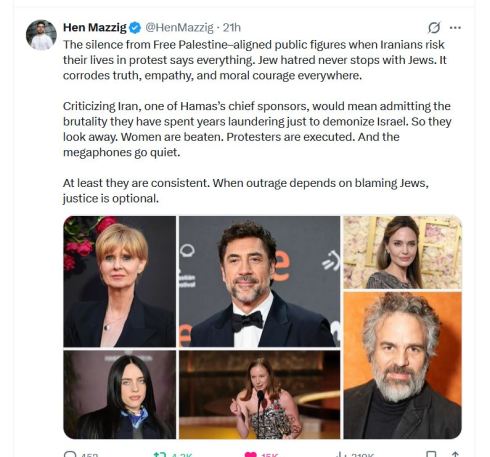
In the world of advocacy and human rights, consistency is more than just a virtue—it’s what gives our principles real meaning. Recently, a comment on social media highlighted a familiar pattern: certain voices who are vocal about one cause may fall silent when similar struggles appear in a different context. It’s a reminder that if we want justice to truly be just, it must be blind to who is involved—applying the same standards to all people, regardless of race, creed, or background.
This isn’t about slamming any particular group; it’s about encouraging all of us to reflect on the importance of consistency. When we advocate for human rights, it’s crucial that we do so across the board. If a group of protesters in one country deserves our solidarity, then those in another country risking their lives for similar ideals deserve it too.
In short, “justice” in quotes should indeed be blind. Not in the sense of ignoring the nuances of each situation, but in the sense of applying our moral standards fairly and universally. By doing so, we strengthen the credibility of our advocacy and remind the world that human rights aren’t selective—they’re for everyone.
Find that tweet inspiration for this post here.
– Evidence from the Harper Era in CanadaIn Canadian political discourse, it’s a common trope—often repeated in partisan debates—that “Conservatives hate the poor.” This accusation implies that conservative governments prioritize the wealthy at the expense of low-income families, offering little to no support for those in need. However, a closer look at the record of Stephen Harper’s Conservative government (2006–2015) reveals a different story: a series of targeted policies designed to put more money directly into the pockets of low-income Canadians, working families, and vulnerable groups.
This was powerfully illustrated in a recent X post by user@GreatBig_Sea, which directly refuted the claim in response to another user’s assertion that “Conservatives have always hated the poor and working class.” The post compiled a detailed, evidence-based list of 15 major Harper-era initiatives, backed by official records and Statistics Canada data showing measurable reductions in poverty and low-income rates during that period.Key Harper-Era Policies Supporting Low-Income CanadiansThe Conservative approach emphasized tax relief, direct cash transfers, and incentives to encourage work and family stability—rather than large-scale institutional programs. Here are some highlights from the post:
- Universal Child Care Benefit (UCCB, 2006; expanded 2015): Provided $100/month per child under 6 (later $160), plus $60/month for ages 6–17. This universal payment went to all families, delivering $1,200–$1,920 annually per young child to help with living or childcare costs—directly benefiting low-income households without means-testing stigma.
- Working Income Tax Benefit (WITB, 2007; precursor to Canada Workers Benefit): A refundable credit topping up earnings for low-wage workers (up to $1,000 for singles, $2,000 for families), reducing the “welfare wall” and making work more rewarding.
- Registered Disability Savings Plan (RDSP, 2008): Government matching grants up to 300% plus bonds up to $1,000/year for low-income families with disabled members.
- Tax-Free Savings Account (TFSA, 2009): Allowed tax-free growth and withdrawals, helping low-income Canadians build emergency savings.
- Children’s Fitness and Arts Tax Credits (2006–2014 expansions): Up to $500–$1,000 per child, made partially refundable for low-income families.
Other measures included enhanced GST/HST credits, public transit tax credits, caregiver credits, and increased funding for First Nations child welfare. These weren’t trickle-down theories—they were direct transfers and credits that disproportionately aided lower-income groups.Measurable Impact: Poverty and Low-Income Rates DeclinedStatistics Canada data corroborates the effectiveness of these policies:
- Child poverty under the Market Basket Measure (MBM, Canada’s official poverty line since 2018) showed improvement during the Harper years, with overall poverty at 14.5% in 2015 (the benchmark year for federal targets).
- Low-income rates using the after-tax Low Income Measure (LIM-AT) fell from around 13–14% in the mid-2000s to 11.2% by 2015.
- After-tax incomes for the bottom income quintile rose approximately 17% from 2006 to 2015, driven by tax cuts and benefits.
While poverty dropped more sharply after 2015 with the introduction of the Canada Child Benefit (which built on and reformed some Harper-era programs), the Harper government laid groundwork with direct supports that helped stabilize and reduce low-income rates amid the 2008 global recession.Why the Myth Persists—and Why It’s MisleadingCritics often prefer expansive government-run programs (e.g., national daycare) over direct cash to families, viewing the latter as insufficient.
Yet the Harper policies empowered parents to choose how to use the money—whether for childcare, essentials, or work incentives—while avoiding bureaucracy. As one reply to the X post noted, Conservatives focus on growing the economy and providing targeted relief to encourage participation, rather than broad welfare expansion.The original X post (available here: https://x.com/GreatBig_Sea/status/1982121517665137029) serves as a valuable, fact-checked resource in heated debates, reminding us that policy differences aren’t about “hating the poor” but about differing philosophies on how best to help them.

References:
- Original X thread and policy list: https://x.com/GreatBig_Sea/status/1982121517665137029
- Statistics Canada Dimensions of Poverty Hub (MBM and LIM trends): https://www.statcan.gc.ca/en/topics-start/poverty
- Government of Canada background on Harper-era family measures: https://www.canada.ca/en/news/archive/2015/07/today-parents-get-child-care-payments-harper-government-1003359.html
- Wikipedia summary of Universal Child Care Benefit (with sources): https://en.wikipedia.org/wiki/Canada_Child_Benefit
In the end, actions speak louder than slogans. The Harper record shows a commitment to practical support for low-income families—not indifference.
In British Columbia, a dangerous woke ideology masquerading as “reconciliation” is being weaponized by Premier David Eby and his inner circle to dismantle the foundations of Canadian society. As Caroline Elliott reveals in her piercing National Post opinion piece, Eby’s advisors—figures like Doug White and Dr. Roshan Danesh—promote a worldview that treats Canada’s formation as an “original sin” demanding atonement through “turbulent transition,” “rupture,” “sacrifice,” and the “utter transformation of human affairs.” This is not benign progressivism; it is extremist zealotry that views Western civilization as inherently oppressive, requiring painful societal upheaval to achieve absolution.
By framing non-Indigenous Canadians as “settlers,” “colonizers,” or “uninvited guests,” these ideologues sow division and guilt, paving the way for the erosion of property rights, economic stability, and democratic norms.
At the heart of this agenda lies the Declaration on the Rights of Indigenous Peoples Act (DRIPA), which mandates aligning B.C. laws with the United Nations Declaration on the Rights of Indigenous Peoples (UNDRIP), including taking “all measures necessary” to enforce it. Elliott highlights how this has led to precedents like the Haida agreement, which recognizes Aboriginal title over private property for the first time, and the B.C. Supreme Court’s Cowichan decision, creating profound uncertainty for landowners. Advisors like Danesh explicitly link this to colonialism’s “domino effect,” where ignoring Indigenous title “knocks down much of the foundation for certainty of fee simple property title.” What woke zealots celebrate as justice is, in reality, a calculated assault on private ownership—the bedrock of a free society—turning secure homes and businesses into contested territories subject to Indigenous jurisdiction.
This radical push extends to land-use and resource development, where officials demand Indigenous consent as the “rightful owners,” effectively halting projects and ceding control over vast public lands. NDP figures like Spencer Chandra Herbert and Christine Boyle openly advocate for the “LandBack” movement, criticizing government ownership and calling for jurisdiction to be handed over to Indigenous groups. Elliott quotes the advisors’ chilling vision of reconciliation as a “coming of age” process that renders “widely accepted practices and conventions, cherished attitudes and habits… one by one being rendered obsolete.” Such language betrays the true intent: not coexistence, but the deliberate obsolescence of Canadian traditions, values, and economic prosperity in favor of a reorganized society built on perpetual atonement.
The consequences of this woke extremism are already manifesting in an “ungovernable province,” where economic devastation looms from blocked development, property values plummet amid title uncertainty, and social cohesion fractures under the weight of imposed guilt. By prioritizing ideological purity over the public interest, Eby’s government treats disagreement as complicity in oppression, dismissing concerns as veiled racism. This is the hallmark of authoritarian zealotry: silencing opposition while pursuing a transformative agenda that benefits a narrow elite of activists and bureaucrats at the expense of ordinary citizens.
Ultimately, British Columbia’s radical reconciliation agenda exemplifies how woke ideology seeks the destruction of society as we know it—replacing merit, individuality, and rule of law with collective guilt, tribalism, and state-enforced rupture. If unchecked, this precedent will spread, undermining Canada’s sovereignty and prosperity nationwide. True reconciliation requires mutual respect and practical solutions, not the painful demolition demanded by these extremists. Citizens must resist this zealotry before the foundations of our civilized order are irrevocably shattered.











 bleatmop
 Mystro


 Dead Wild Roses
Your opinions…