
You are currently browsing the category archive for the ‘History’ category.
This quote is from Howard Zinn’s article called the Force of Nonviolence which appeared in The Nation in the 1960’s. Identifying one of the precursors to violent action is information useful in arming oneself in a myriad of situations – the process of rationalizing the unjust treatment of ‘those people’ happens in all of us, almost unconsciously most of the time. Hopefully we can arm ourselves against our violent tendencies toward others or at least be aware of the process and move to intercede before we act.
“The human ability to abstract, to create symbols standing for reality, has enabled man to compound his material possessions, to split the atom and orbit the earth. It also enables him to compound his hatreds, and expands his capacity for violence. But while there is no incentive to distort in the scientific process which changes reality to symbol for purposes of manipulation, and back to reality for purposes of realization, there is incentive, in social relations, for distorting the symbols of communication. With man’s use of symbols, the potentiality for hatred and therefore violence is enormously, logarithmically, magnified. And with word-symbols the possibility for distortion is infinite. In fact, distortion is inherent here, for while particles of light are sufficiently similar so we can express the speed of all of them in a useful mathematical equation, human beings are so complex and particular, and their relationships so varied, that no generalized world can do justice to reality.
War is symbolic violence, with all people who happen to reside within the geographical boundaries of a nation-state constituting “the enemy”. Race persecution is symbolic violence directed against all individuals, regardless of their specific characteristics, who can be identified with an abstracted physical type. In the execution chamber, the state puts to death anyone, regardless of individual circumstance, who fits the legal symbol: murderer. The law forcibly deprives of freedom everyone who falls within the symbolic definition of a criminal; sentences are sometimes meted out to individuals, but mostly to dehumanized lawbreakers whose acts match an abstract list of punishments. “
-Howard Zinn. Howard Zinn on War p.14-15.
Firstly, read what Shulamith Firestone has to say.
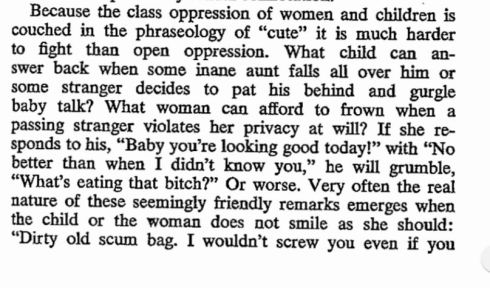
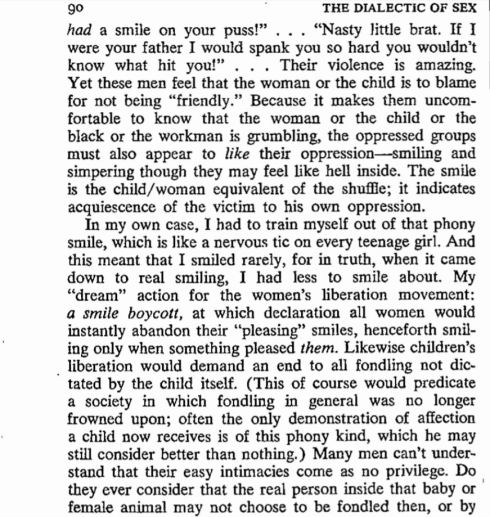
Secondly, recognize that this work was published in 1970.
Thirdly, become grandly and righteously pissed off that women’s intellectual history is carefully hidden from them and thus, each generation is forced to start from scratch in the struggle to raise their consciousness and name their oppression.
Fourthly, organize and lobby schools/school boards to have Firestone’s Dialectic of Sex become a part of the curriculum so we can arm the women in our society with the theory and knowledge that has already been demarcated, so the struggle can move onto new ground instead of reclaiming what has already been unearthed.
Fifthly, share widely at least this small part of Firestone’s work, so women in the struggle right now can see that they are not alone and that people have been exactly where they are right now, just that no one them about their foresisters work.
If I were to have just one wish to come true, it would be that people would take the time to think about the world they live in. I realize that reflection and critical something is not always possible, but if we’re in the wish zone I think it could happen. Noam Chomsky, prescient as usual, details exactly what is going on in the democratic West as we slide further down the slope into abject oligarchical rule.
“Functioning democracy erodes as a natural effect of the concentration of economic power, which translates at once to political power by familiar means, but also for deeper and more principled reasons. The doctrinal pretense is that the transfer of decision-making from the public sector to the “market” contributes to individual freedom, but the reality is different. The transfer is from public institutions, in which voters have some say, insofar as democracy is functioning, to private tyrannies — the corporations that dominate the economy — in which voters have no say at all. In Europe, there is an even more direct method of undermining the threat of democracy: placing crucial decisions in the hands of the unelected troika — the International Monetary Fund, the European Central Bank, and the European Commission — which heeds the northern banks and the creditor community, not the voting population.
These policies are dedicated to making sure that society no longer exists, Margaret Thatcher’s famous description of the world she perceived — or, more accurately, hoped to create: one where there is no society, only individuals. This was Thatcher’s unwitting paraphrase of Marx’s bitter condemnation of repression in France, which left society as a “sack of potatoes,” an amorphous mass that cannot function. In the contemporary case, the tyrant is not an autocratic ruler — in the West, at least — but concentrations of private power.”
The fight needs to come back to the people, to push back on so many levels. It is a large bill to fill, yet it is a goal worth struggling for, as our future and our children’s futures depend on taking back society from the moneyed interests and elites who care for nothing except their own self-enrichment.
“Imagine this: after a blistering hot day marching up and down mud slicked hills, or tramping wide open fields, or steamy jungle, imagine setting out booby traps on enemy trails, laying in wait, then ever so carefully, breaking them down.
At dusk, after planting trips and claymores round the NDP, after finding a spot for your pack and gear, after eating tinned c-rations of beans and franks, imagine curling up on the cold wet ground.
Now, fast asleep, being woken twice in the night by a man gently tapping your resting arm. “Your guard,” he whispers, for the first of two one hour shifts.
Leaving that foxhole the second time, grenades, machine gun, claymore detonators all in place, imagine two hours sleep, rising at dawn, shrugging off bugs and wet bamboo, rubbing rheumy eyes, brushing sticky teeth.
Before the grueling day begins, there is the welcoming taste of GI coffee. Here is how to make it:
Seated crossed legged, take a chunk of C4 the size of a thumbnail, shape it into a ball, set it carefully down.
Tear open the packet of instant coffee saved from last nights c-ration meal. Pour it into a canteen cup half filled with water.
Tap the brown powder over the cup, stir with a c-ration white plastic spoon.
Strike a GI match and light the C4. Do not breathe in the white smoke; the fumes, it is said, are harmful.
Hold the canteen cup over the burning explosive until the water boils, about thirty seconds.
Remove the cup from the bright yellow flames. Let the C4 burn itself out. Those who step on it risk losing a foot.
Tear open and pour in one or two packets of non dairy creamer. Repeat with sugar. Use the white plastic spoon to mix and stir. With eyes closed, inhale the savory vapours; cup to your lips, feel the hot inky brew flood your mouth, scourge your tongue, roll down your willing gullet. The taste is awful, but it will do.
Grunts savor this quiet time, before every inch of our bodies are salty with sweat. This quiet time before seething mosquitoes, snapping ants, creeping leeches bite or sting or drink our blood.
This quiet time before sudden shots fill us with dread that is always new. This quiet time before the shrieking air sings of the wounded, smells of the dead.
It is the all too fleeting quiet time, which ends with the softly echoed ‘zero two,’ followed by the dim rustling of one hundred packs, helmets, weapons reluctantly lifted, slung, shifted to place.
See how the flock of helmeted cranes slouch against their rifles, feel how the sweat drips down narrow cheeks, collects at the chin, free falls, forming small dark spots on half bent knees.
Listen, as moments after the hushed command, one hundred grudging soldiers, one by one, reluctantly trudge forward, into the grim unwinnable jaws of Vietnam.”
I value my quiet time, I think everyone does. Because silence time can mean peace and stillness, a time to be away from the thoughts that drive us.
The crimes humans commit against each other have numerous justifications and rationalizations, to most of us in North America, we hear more about the atrocities of our enemies, that we do of the ones we commit in our name. John Dower examines the Cold War period in history and concludes that our hands were just as bloody, if not more so, than our hated enemy.
“When the torture manuals refer to “neutralizing” targets, this was commonly recognized as a euphemism for killing. There is no evidence that cover US forces participated directly in the the grotesque torture, death squads, massacres, and “disappearances” characteristic of the dirty wars that ravaged Latin America, only that they promoted and supported them. At the same time, there i”s little or no evidence that, in taking sides in these wars and training and materially aiding “anticommunist” participants in them, the United States gave serious attention to human rights or the rule of law. In most countries south of the border, Washington supported right-wing regimes in their state terror. In Nicaragua, it abetted the Contras in pursing a murderous campaign of “guerrilla” terror against the government. Proxy war, surrogate terror, disdain for human rights and even for plain decency all came together.
As always, it is not possible to quantify the costs of this violence with any exactitude. For South and Central American societies, the political, cultural, and psychological costs were – and to some degree still are – enormous. Writing in Cambridge History of the Cold War, John Coatsworth observed that the Contra insurrection in Nicaragua devastated the economy, forced the government to abandon most of its social programs, and “cost th lives of 30,000 Nicaraguans, mostly civilian supporters of the Sandinista revolution.” He put the death toll in El Salvador between 1979 and 1984 at nearly forty thousand, most who were unarmed combatants murdered by the armed forces.
Coatsworth also noted in passing that President Reagan visited Guatemala City in December 1982 and praised the ruling military junta for its commitment to defend the country against the threat of communism. In 1982- 1983 alone, the government forced eight hundred thousand peasants into “civil patrols” ordered to uncover and kill insurgents or see their communities destroyed. It followed up on its threat by destroying an estimated 686 villages and hamlets and killing between fifty thousand and seventy-five thousand people.
All told, Coatsworth estimates that the Cold War in Central America saw nearly three hundred thousand deaths in a population of thirty million, plus a million refugees who fled the area, mostly for the United States. Based on examination of published CIA and State Department materials plus other reports unsympathetic to communist regimes, he reached this conclusion: “Between 1960, by which time the Soviets had dismantled Stalin’s gulags, and the Soviet collapse in 1990, the numbers of political prisoners, torture victims, and executions of nonviolent political dissenters in Latin America vastly exceeded those in the Soviet Union and its East European satellites. In other words, from 1960 to 1990, the Soviet Union bloc as a whole was less repressive, measured in terms of human victims, than many individual Latin American countries.”
This does not diminish the multiple horrors of Soviet violence and oppression, but helps place them in perspective.”
-John W. Dower. The Violent American Century. pp. 68 – 69.
I consider this text a long form of the very basic radical assumption – the Masters’s tools will never dismantle the Master’s house’. That is, working within the bounds of any oppressive system, one can only do so much and the chance of affecting meaningful structural change approaches zero. The People Centred Human rights approach realizes this axiomatic truth and works to expand the notion of what is to be done instead of working inside the system.
“The people-centered framework proceeds from the assumption that the genesis of the assaults on human dignity that are at the core of human rights violations is located in the relationships of oppression. The PCHR framework does not pretend to be non-political. It is a political project in the service of the oppressed. It names the enemies of freedom: the Western white supremacist, colonial/capitalist patriarchy.
Therefore, the realization of authentic freedom and human dignity can only come about as a result of the radical alteration of the structures and relationships that determine and often deny human dignity. In other words, it is only through social revolution that human rights can be realized.
The demands for clean water; safe and accessible food; free quality education; healthcare and healthiness for all; housing; public transportation; wages and a socially productive job that allow for a dignified life; ending of mass incarceration; universal free child care; opposition to war and the control and eventual elimination of the police; self-determination; and respect for democracy in all aspects of life are some of the people-centered human rights that can only be realized through a bottom-up mass movement for building popular power.
By shifting the center of human rights struggle away from advocacy to struggle, Malcolm laid the foundation for a more relevant form of human rights struggle for people still caught in the tentacles of Euro-American colonial dominance. The PCHR approach that creates human rights from the bottom-up views human rights as an arena of struggle. Human rights does not emanate from legalistic texts negotiated by states—it comes from the aspirations of the people. Unlike the liberal conception of human rights that elevates some mystical notions of natural law (which is really bourgeois law) as the foundation of rights, the “people” in formation are the ethical foundation and source of PCHRs.”
We are not taught radical history/analysis for a reason. The elites make sure that education doesn’t arm the people with the tools to change society, and really why would they?
[Source: Ajamu Baraka writing on Counterpunch]











 bleatmop
 Mystro
 The Arbourist


 Dead Wild Roses
Your opinions…