
You are currently browsing the category archive for the ‘Media’ category.
Damn youtube making me all warm and fuzzy on the inside.
Hey media friends, did you all just here that slight popping noise? That was my cerebral cortex disconnecting itself from all of its higher functions after viewing this lovely clip on CNN about the missing Malaysia Airlines flight. This is what happens when news is cobbled together out of speculation, innuendo and whatever the editors at CNN pull out of their ass.
Speaking of pulling things out of one’s anal sphincter, Fox News puts in a shiny second place performance by shamelessly fabricating nonsense about Noah’s Arc with regards to the important shipwrecked discoveries of humanity. It is nice that Fox services its base so adroitly with its biblical bullshit as opposed to the sciency-tinfoil hat bullshit that CNN recently extruded.
Manufactured stupid stories like this is why we need private and pubic broadcasters in the market.
Sometimes news just isn’t colourful or exciting. Those who relentlessly chase ratings will shamelessly confabulate stories in their never ending hunt for advertising dollars. This is where a pubic broadcaster can shine as it is still necessary to know what is going on in the world without having to chase flashy phantom stories that attract eyeballs, but not intelligence.
Media Lens is an invaluable source to in describing and measuring how far the “respectable media” kowtows to state and corporate interests. This excerpt from their latest media alert illustrates the mendacity that is common place in what is considered to be “acceptable journalistic practices”.
“The key to what is precisely wrong with corporate journalism is explained in this nutshell by the US commentator Michael Parenti:
‘Bias in favor of the orthodox is frequently mistaken for “objectivity”. Departures from this ideological orthodoxy are themselves dismissed as ideological.’
Examples of bias towards the orthodoxy of Western power are legion every day of the week. On January 30 this year, David Loyn reported for BBC News at Ten from Bagram airbase in Afghanistan as US troops prepared to withdraw from a blood-strewn occupation. Standing beside a large US military plane, he intoned:
‘For all of the lives lost and money spent, it could have been so much better.’
The pro-Nato perspective of that remark masquerading as impartial journalism is stark. By contrast, Patrick Cockburn summed up the reality:
‘After 12 years, £390bn, and countless dead, we leave poverty, fraud – and the Taliban in Afghanistan…60 per cent of children are malnourished and only 27 per cent of Afghans have access to safe drinking water…Elections are now so fraudulent as to rob the winners of legitimacy.’
The damning conclusion?
‘Faced with these multiple disasters western leaders simply ignore Afghan reality and take refuge in spin that is not far from deliberate lying.’
BBC News has been a major component of this gross deception of the public.”
Hmm. What is troubling is that many outside of the UK look to BBC as a “better” source of news that is more reliable that what is available in North America.
Admittedly, I would take BBC reporting hands down over anything from the propaganda mill known as Fox News, but how many people have the time to really sink their teeth into multiple news sources? How many people even care about the news that much anymore?
I’m shocked that so many people have consciously chosen ignorance as their strategy for dealing with the news and world events. Denial of the world ‘out there’ can only lead to insular thinking and simplistic interpretations of complex problems. We need more people, not less, grounded in rationality with a gist of how the world actually works. How can you effect change in the world if you know nothing of how it works?
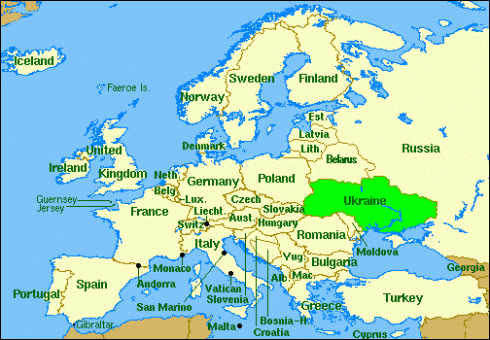
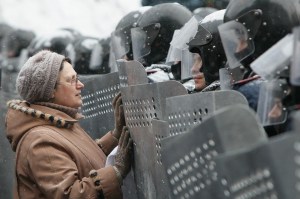 What is so not-awesome about our news media is its propensity to relay to us news and events without the background context necessary have said news event make sense. Go take a look at the CBC’s reporting on what is happening in the Ukraine. I’ll reproduce the headlines here for sake of argument.
- Parliament votes to oust President Viktor Yanukovych
- Security forces now declining to take part in conflict
- Jailed opposition figure Yulia Tymoshenko may be released soon
- President and opposition sign deal meant to end crisis
- President Yanukovych leaves capital for pro-Russian eastern Ukraine
- Yanukoych accuses opposition of conducting a coup
- MPs replace speaker, interior minister
Fascinating stuff. But what does it mean? I mean, who is Yanukovych and what does his party stand for? Heck, what sort of political economic system does the Ukraine possess for starters. You can read all of those articles on Auntie Ceebs and not have even a fog-eyed view of what the hell is actually going on. The reporting we get suffers from what I’ll call the ‘keyhole syndrome’.
 Keyhole Syndrome is when people watching the news are presented with a important event but not the details surrounding said event that would allow them to make a decision, critical or otherwise about said event. Wow there is a coup attempt in Ukraine – how about that. How do we get from the Orange revolution to here? Do you even remember the orange revolution?
What is needed, honest readers is context, and I strive to provide a slightly larger keyhole looking into the events happening in the Ukraine. Read more in the full report at the Council for Foreign Relations website.
Economic Structure and Policies
Ukraine has a classic rentier curse. Oligarchs and politicians, often one and the same, extract rents from the transit of energy and other scams. Some prices are market based and others controlled, creating huge opportunities for arbitrage. Various licenses and concessions depend on political favor, facilitating corrupt lobbying, and oligarchs have manipulated the political process to ensure a supply of subsidized gas, coal, and electricity. Bursts of market reform in 1994–95 and 2000–2001 were only the minimum necessary to prevent international lenders from withdrawing completely. After 2004, the Orange Revolution’s leaders enacted populist measures rather than tackling systemic problems.
Notwithstanding relatively liberal privatization laws, the process came to benefit oligarchs. Most big enterprises were sold by closed discount cash sales. Today, without an effective legal system, all property remains insecure. Violent corporate raiding is widespread; oligarchs use mafia muscle to take over each other’s firms and scare away most foreign investors. The black economy accounts for 40 to 50 percent of official GDP. Ukraine has received support from international financial institutions, but these funds have been small relative to Ukraine’s GDP. The country’s failure to enact reforms has repeatedly marred its relationship with the International Monetary Fund.
Civil Society and Media
Ukraine’s civil society, though stronger than other aspects of democratic governance, remains weak. After the Orange Revolution, cohesion and engagement quickly disintegrated as people grew disillusioned by elites’ broken promises. Today, only 5 percent of Ukrainians belong to nongovernmental organizations (NGOs). The current Yanukovych government has curtailed freedom of assembly and used the security and tax services to harass activists. Despite this (or perhaps because of it), however, NGO activities are rising. Some elites, exasperated by the divided political opposition, are organizing civil society groups instead of pursuing political power.
Ukraine’s media have generally functioned as an instrument of power rather than an independent force. Many media companies have long been left in private hands under “reliable” oligarchic control, fostering self-censorship. The Orange Revolution allowed a window of media freedom, but today many journalists face bullying and bribery. By contrast, the internet remains lively and free, with growing social media and anticorruption sites.
Legal System and Rule of Law
The law in Ukraine is deliberately capricious and its application arbitrary. Because the population must constantly break the law, authorities can decide whom to prosecute, and they wield this authority to consolidate power. Punishment is used to disable anyone who challenges the system; forgiveness is used as patronage. Most judges are holdovers from the Communist era and continue to respond to instructions from officials. Conviction rates top 99 percent.
Reforms passed in 2010 have increased executive control over the judiciary. Yanukovych created two new courts to bypass relatively independent ones and he purged the Supreme Court and Constitutional Court. Other executive bodies gained control over judicial appointments. The ease with which authorities launched political prosecutions in 2011 and 2012—most prominently against Tymoshenko—showed the new system’s weakness. Today, politicians routinely take bribes from oligarchs or are oligarchs themselves. Members of parliament are immune from prosecution, making public office a gravy train. A place on an electoral list is estimated to cost $5 million in bribes to party leaders.
Government Structure and Division of Power
Ukraine has made almost every mistake imaginable in its institutional design. In the 1990s, it built ministries that recreated bad habits of the Soviet command economy. Prosecutors, tax police, and the former KGB were given too much power. Kuchma also expanded presidential authority but used it to act as the oligarchs’ patron. The constitutional changes to weaken the presidency agreed to during the Orange Revolution were therefore not necessarily bad ideas. However, they were hastily drafted and poorly implemented, allowing oligarchs to build an alternative power center in parliament. Nonetheless, the reversal of these changes in 2010 was unwise. It restored the status quo ante, rather than keeping the best of the reforms, and its aim was not rebalancing the system but entrenching Yanukovych’s administration.
Oh. So the Ukraine, despite its residual media memory as a ‘democracy’ is actually a oligarchy that thrives on looting the country of its wealth and maintaining its power through any means necessary.
A brief aside:this is the kind of system we inhabit here in North America. When you finally come to this conclusion (or not, please continue to consume the bread and circuses arranged for your leisure) the decisions our respective governments make become much more understandable and do have a rational, just not the type this is going to benefit *you*.
Ah, so now we can begin to understand what is going on in the Ukraine and start asking more reasonable questions to further our analysis of what is transpiring over there.
Break out of your browser bubble. I suggest you use duckduckgo as your web browser as they claim it is more private and bubble free browsing experience.
(ed. *update* – added new Mahr video.)
Huh, as I was browsing the weeb, I ‘happened’ to find this video featuring Bill Mahr on the very same subject.
Mornin’ gentle readers. It’s movie Tuesday here on DWR, so lean forward find your favourite box of tissues and watch The War You Don’t See by John Pilger. If you are not up for violence and death, watch anyways because if you rely on the MSM for your view of our ‘benevolent’ foreign policy, you are tacitly what this documentary is against.
If we had a liberal media then it would look more like what this article from Alter.net describes. Fact check time. Are you seeing these types of stores in the bright vivid technicolour everyday, endlessly repeated so people know about them? Of course not, they what a liberal media would *actively promote*. What do we see? Sensationalism, sports and weather; the dross that is cheap to produce and perpetuates the status quo.
I’ve copy/pasted the first seven points, go to article itself to read the last eight and the conclusion.
If you know anyone who still believes in a “liberal media,” here’s 15 things everyone would know if there really were a “liberal media” (inspired by Jeff Bezos’ purchase of The Washington Post):
1. Where the jobs went.
Outsourcing (or offshoring) is a bigger contributor to unemployment in the U.S. than laziness.
Since 2000, U.S. multinationals have cut 2.9 million jobs here while increasing employment overseas by 2.4 million. This is likely just the tip of the iceberg as multinational corporations account for only about 20 percent of the labor force.
When was the last time you saw a front-page headline about outsourcing?

Source: Wall Street Journal via Think Progress.
2. Upward wealth redistribution and/or inequality.
In 2010, 20 percent of the people held approximately 88 percent of the net worth in the U.S. The top one percent alone held 35 percent of all net worth.
The bottom 80 percent of people held only 12 percent of net worth in 2010. In 1983, the bottom 80 percent held 18 percent of net worth.
These statistics are not Democrat or Republican. They are widely available to reporters. Why aren’t they discussed in the “liberal” media?

Source: Occupy Posters
3. ALEC.
If there was a corporate organization that drafted laws and then passed them on to legislators to implement, wouldn’t you think the “liberal” media would report on them?
The American Legislative Exchange Council (ALEC) is such an organization. Need legislation drafted? No need to go through a lobbyist to reach state legislatures anymore. Just contact ALEC. Among other things, ALEC is responsible for:
- Stand Your Ground laws
- Voter ID laws
- Right to Work laws
- Privatizing schools
- Health savings account bills which benefit health care companies
- Tobacco industry legislation
Many legislators don’t even change the proposals handed to them by this group of corporations. They simply take the corporate bills and bring them to the legislative floor.
This is the primary reason for so much similar bad legislation in different states.
Hello … “liberal media” … over here!
They’re meeting in Chicago this weekend. Maybe the “liberal media” will send some reporters.
4. The number of people in prison.
Which country in the world has the most people in prison?
You might think it would be China (with more than one billion people and a restrictive government) or former Soviets still imprisoned in Russia.
Wrong. The United States has the most people in prison by far of any country in the world. With 5 percent of the world’s population, we have 25 percent of the world’s prisoners – 2.3 million criminals. China with a population 4 times our size is second with 1.6 million people in prison.
In 1972, 350,000 Americans were in imprisoned. In 2010, this number had grown to 2.3 million. Yet from 1988 – 2008, crime rates have declined by 25 percent.
Isn’t anyone in the liberal media interested in why so many people are in prison when crime has dropped? WTF “liberal media”?

Source: Wikipedia/Justice Policy Institute Report.
5. The number of black people in prison.
In 2009, non-Hispanic blacks, while only 13.6 percent of the population, accounted for 39.4 percent of the total prison and jail population.
In 2011, according to FBI statistics, whites accounted for 69.2 percent of arrests.
Numbers like these suggest a racial bias in our justice system.
To me, this is a much bigger story than any single incident like Travyon Martin. Or, at the very least, why didn’t the “liberal media” ever mention this while covering the Martin story?
6. U.S. health care costs are the highest in the world.
The expenditure per person in the U.S. is $8,233. Norway is second with $5,388.
Total amount of GDP spent on health care is also the highest of any country in the world at 17.6 percent. The next closest country is the Netherlands at 12 percent.
As a liberal, I’d like to ask why the market isn’t bringing down costs. I’d think a “liberal” media might too.
7. Glass-Steagall.
Glass-Steagall separated risky financial investments from government backed deposits for 66 years.
The idea is simple. Banks were prohibited from using your federally insured savings to make risky investments.
Why is this a good idea?
Risky investments should be risky. If banks can use federally insured funds, there is no risk to them. If they win, they win. If they lose, we cover the cost.
Elizabeth Warren did a great job explaining this to the “liberal news” desk at CNBC.











 bleatmop
 Mystro
 The Arbourist


 Dead Wild Roses

Your opinions…