
You are currently browsing the category archive for the ‘Politics’ category.
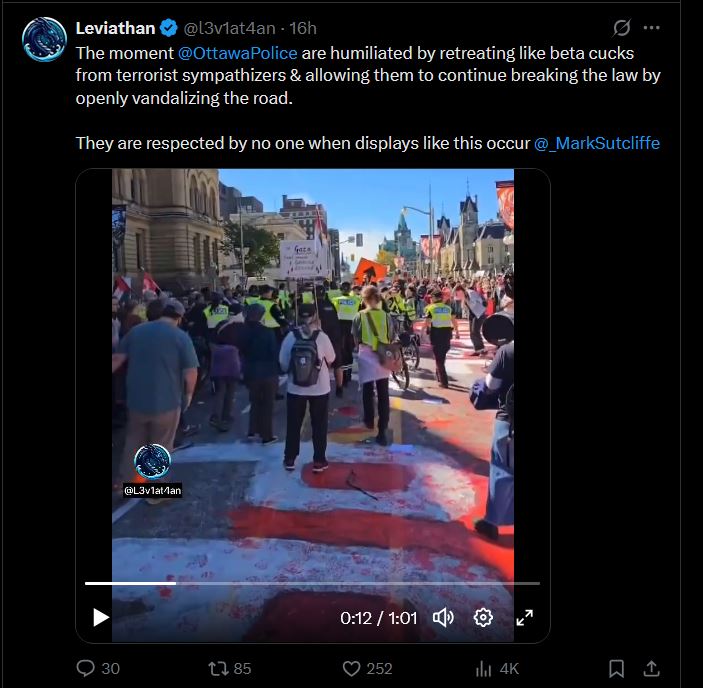
On September 20, 2025, activists from the “Draw the Line” movement staged a highly visible protest directly in front of Parliament Hill, painting a large red-and-white mural on Wellington Street. Ottawa Police closed the street for hours to facilitate the action, citing the use of washable paint, though critics noted that under Canada’s Criminal Code and municipal bylaws, the activity qualifies as vandalism. Two arrests occurred during clashes as protesters attempted to expand the mural near the Prime Minister’s Office. Hundreds participated, and cleanup concluded later the same day, with no reported injuries but lingering questions about liability for slippery surfaces (Ottawa Citizen, CTV News Ottawa, Ottawa CityNews, CBC News). Video evidence posted on X by @l3v1at4an shows police standing by as activists painted, sparking over 450 replies highlighting perceived enforcement disparities (X Thread).
Contrast this with the 2022 Freedom Convoy protests: organizers faced weeks of sustained police enforcement, arrests, and eventually prosecutions including mischief and counselling to disobey court orders. High-profile participants like Tamara Lich and Chris Barber were convicted and sentenced, while the federal government invoked the Emergencies Act — a level of response not seen for the mural or similar protests. The discrepancy demonstrates a clear selective approach in how law enforcement applies the law depending on the protesters’ affiliation, cause, or perceived political stance (AP News, CBC).
The mural incident, combined with historical patterns, fuels concerns over two-tier policing: some groups are allowed to vandalize public property with minimal immediate consequence, while others are met with swift arrest, prosecution, or extraordinary federal enforcement. Canadians deserve equal application of the law — whether it’s a climate mural, a roadblock, or any form of civil demonstration. When enforcement varies by cause, political affiliation, or identity, trust in public institutions erodes, and the perception of injustice becomes reality.
References
- Ottawa Citizen — “Two arrests amid Wellington Street mural painting” (Sept 20, 2025) — https://ottawacitizen.com
- CTV News Ottawa — Coverage of Draw the Line protest and police confirming street closure for washable paint removal — https://ottawa.ctvnews.ca
- Ottawa CityNews — “Hundreds participate in 65-foot mural as part of nationwide rallies” — https://ottawacitynews.ca
- CBC News — “Mural in front of Carney’s office with police aiding the demonstration” — https://cbc.ca
- X Thread by @l3v1at4an — Video evidence of police standing by as activists paint; 450+ replies discuss selective enforcement — https://x.com/l3v1at4an/status/1969466596499308628
- AP News — “Prominent figure from Canada’s trucker protests found guilty” — https://apnews.com/article/3975bb6bbd0c089e0c56cebbe9187fd2
- CBC News — Freedom Convoy prosecutions (Tamara Lich, Chris Barber, Chris) — https://cbc.ca
Mark Carney launched his new “Build Canada Homes” initiative with the Liberals at a construction-themed event, complete with hard hats, lumber, and the imagery of homes being built. Mainstream outlets like CBC and BNN Bloomberg covered the announcement and confirmed the backdrop included construction visuals and talk of modular housing. However, Conservative MP Barbara Bal and several CPC social media accounts have claimed the set was little more than a temporary stage — alleging that when they returned to the site, nothing was actually there. It is important to note: these allegations come from partisan and social sources, not from mainstream media confirmation.
Even if one accepts the stronger claim that the site was a prop, the larger problem is not theatricality but the substance. After nine years of Liberal government under Justin Trudeau, housing affordability has collapsed: mortgage interest costs have more than doubled since 2015 according to Statistics Canada, rents have spiked across major cities according to CMHC, and Canada now has the fewest homes per capita of any G7 country. Liberal promises to “get housing built” ring hollow given this record of failure.
That is where the hypocrisy cuts deepest. A party that has presided over a historic affordability crisis now rolls out a former Bank of Canada governor to stage glossy announcements about “change.” Whether or not the Vaughan backdrop was literally a Potemkin village, it symbolizes the Liberal pattern: photo-ops and slogans standing in for tangible progress. Canadians don’t need props — they need homes they can afford.

References
- CBC News / Yahoo: “The way we build homes needs to change: Carney makes housing announcement” – https://ca.news.yahoo.com/way-build-homes-needs-change-024451476.html?utm_source=chatgpt.com
- BNN Bloomberg (Canadian Press): “Liberals promise to build nearly 500,000 homes per year, create new housing entity” – https://www.bnnbloomberg.ca/federal-election-2025/2025/03/31/liberals-promise-to-build-nearly-500000-homes-per-year-create-new-housing-entity/?utm_source=chatgpt.com
- Barbara Bal (Conservative MP) Instagram reel alleging staged backdrop – https://www.instagram.com/reel/C-1lE9YtZ8p?utm_source=chatgpt.com
- Conservative Party of Canada X/Twitter account repeating claim – https://x.com/cpc_hq
- Statistics Canada: “Mortgage interest cost index, May 2024” – https://www150.statcan.gc.ca/n1/daily-quotidien/240620/dq240620a-eng.htm?utm_source=chatgpt.com
- CMHC: “Canada Housing Market Report” – https://www.cmhc-schl.gc.ca/professionals/housing-markets-data-and-research/market-reports/canada-housing-market-report?utm_source=chatgpt.com
- OECD Housing Data – https://data.oecd.org/price/housing-prices.htm?utm_source=chatgpt.com
Canada’s crime landscape resists neat storytelling. After nearly a decade of steady increases—especially in violent offenses, property thefts, and youth crime—2024 marks a notable pivot downward.
According to Statistics Canada, the overall police-reported crime rate fell 4% to 5,672 incidents per 100,000 people, ending three consecutive years of growth (Statistics Canada). The Crime Severity Index (CSI)—which captures both volume and seriousness—also dipped 4% nationally, with Non-violent CSI down 6% and Violent CSI down 1% (Statistics Canada). Homicide rates slid 4%, from 1.99 to 1.91 victims per 100,000, with eight fewer lives lost than the year before (Global News, Statistics Canada).
Still, narratives of escalating crime haven’t vanished. And it’s not hard to understand why. From 2014 to 2023, Canada saw violent crime rise nearly 30%, with 2023 registering approximately 1,427 incidents per 100,000—up 3.7% from the previous year (X (formerly Twitter)). This contrasts sharply with the U.S., where violent crime grew about 5% and property crime fell 24% over the same decade (X (formerly Twitter), Fraser Institute).
Youth crime follows a similar pattern. Between 2022 and 2023, violent youth crime jumped 10%, with overall youth crime up 13% (Ministère de la Justice). On a regional level, Western provinces—especially Saskatchewan and Manitoba—continue to report some of the highest crime rates, while Ontario and Quebec remain comparatively stable (Government of Nova Scotia, Statistics Canada).
The Takeaway
Crime in Canada isn’t spiraling, nor is it fully under control. The 2024 decline is welcome, but it follows substantial, worrying increases. The story lies between alarm and apathy—calling for careful, evidence-driven policy, not sensational headlines or complacency.

References
- Statistics Canada. “Police-reported crime statistics in Canada, 2024.” Overall crime rate – 5,672 per 100,000; CSI changes. (Statistics Canada)
- Global News (citing StatsCan). Homicide rate down to 1.91 per 100,000 in 2024 (4% decline). (Global News)
- Statistics Canada. Homicide victims – 788 in 2024, eight fewer than in 2023. (Statistics Canada)
- Statistics Canada. 2023 crime stats: 3% rise in crime rate to 5,843/100k; violent incidents up 4%; CSI up 2%. (Statistics Canada)
- Crime comparison data: Violent crime +30% (2014–2023); 2023 rate ~1,427/100k (up 3.71%); Canada vs U.S. trends. (X (formerly Twitter), Fraser Institute)
- Justice Canada. Youth crime: +10% violent youth crime; +13% overall youth crime (2022–2023). (Ministère de la Justice)
- Nova Scotia stats: Regional disparities, highest in Manitoba/Saskatchewan. (Government of Nova Scotia)
Always in political warfare you must name the dynamic. Always show, never tell. This places the people who trying to put you in a decision dilemma in one of their own. In this case they have to justify equivocating words as being the same as political violence is somehow a good thing.

The post accusing Charlie Kirk of “enthusiastically encouraging political violence” is built on a single manipulative dynamic: it redefines political violence to mean political positions I oppose. Then it runs through a list of Kirk’s controversial views, inflates them into caricatures, and brands them “violence.” This is not an honest critique—it’s a smear designed to erase the difference between debate and brutality. Let’s break it down.
1. Immigration. Kirk supported strict enforcement against criminal non-citizens, often citing gang members, rapists, and traffickers released by sanctuary cities. The post reframes this as “rounding up people of colour and terrorizing neighborhoods.” That’s the dynamic: take law enforcement, exaggerate it into indiscriminate terror, then call it violence.
2. Demographics and “Replacement Theory.” Kirk talked about demographic shifts and immigration policy, citing illegal entry numbers and workforce displacement. He framed it as sovereignty and cultural stability, not white supremacy. But the post takes those concerns, slaps on the “Replacement Theory” label, and declares it “stoking violence.” Again: redefine, inflate, smear.
3. Civil Rights Act. Kirk said the 1964 Act was a “mistake” because it created bureaucracies that undermined free speech and colorblindness. He criticized MLK in that context. That’s a libertarian critique (shared by some legal scholars), not a denial of Black rights. Yet the post twists this into “stating Black folks should never have been given civil rights.” This is a textbook case of taking a radical-sounding policy critique and miscasting it as raw racism.
4. Abortion. Kirk opposed abortion as murder, even in tragic cases, and argued life should always be protected. The post inflates this into “forcing women and girls to give birth against their will.” In reality, it’s a moral absolutist position on protecting the unborn, not violence against women.
5. “Disinformation.” Kirk was guilty of rhetorical excess—on COVID, election integrity, Islam, and crime. But the post turns provocative speech into “targeting vulnerable populations.” Here again is the trick: take speech you don’t like, call it “lies,” and rebrand it as violence.
6. Consent. The claim that Kirk said women can’t withdraw consent is pure fabrication. He acknowledged murky debates around alcohol but affirmed that consent must be ongoing. Yet the post smears him as endorsing rape. This isn’t just dishonest—it’s defamatory.
7. Guns. Kirk argued for armed guards in schools while opposing gun control, saying liberty comes with costs. You may find that callous, but it’s policy debate—not violence. The post reframes it as if merely opposing gun restrictions is an assault on children.
Taken together, the method is consistent: start with a conservative position, exaggerate it into a cartoon of cruelty, then call it “political violence.” That’s the dynamic. And it’s dangerous. By redefining words this way, the author trivializes actual violence—like the bullet that killed Kirk—and justifies hatred of political opponents.
Charlie Kirk could be brash, offensive, and polarizing. But no honest observer can claim his work amounted to “political violence.” That label belongs to acts of physical harm, not words, policies, or even moral absolutism. The truth is simple: the only political violence in this story was the act that ended his life.
If you think that arguments based in truth, eventually you will run up against people who are so deep into the gender-cult that they have no idea what is real and what is dogma.

Be careful though, your audience will often defend their dogmatic views by any means necessary: Name calling, threats, and excommunication from the arena.
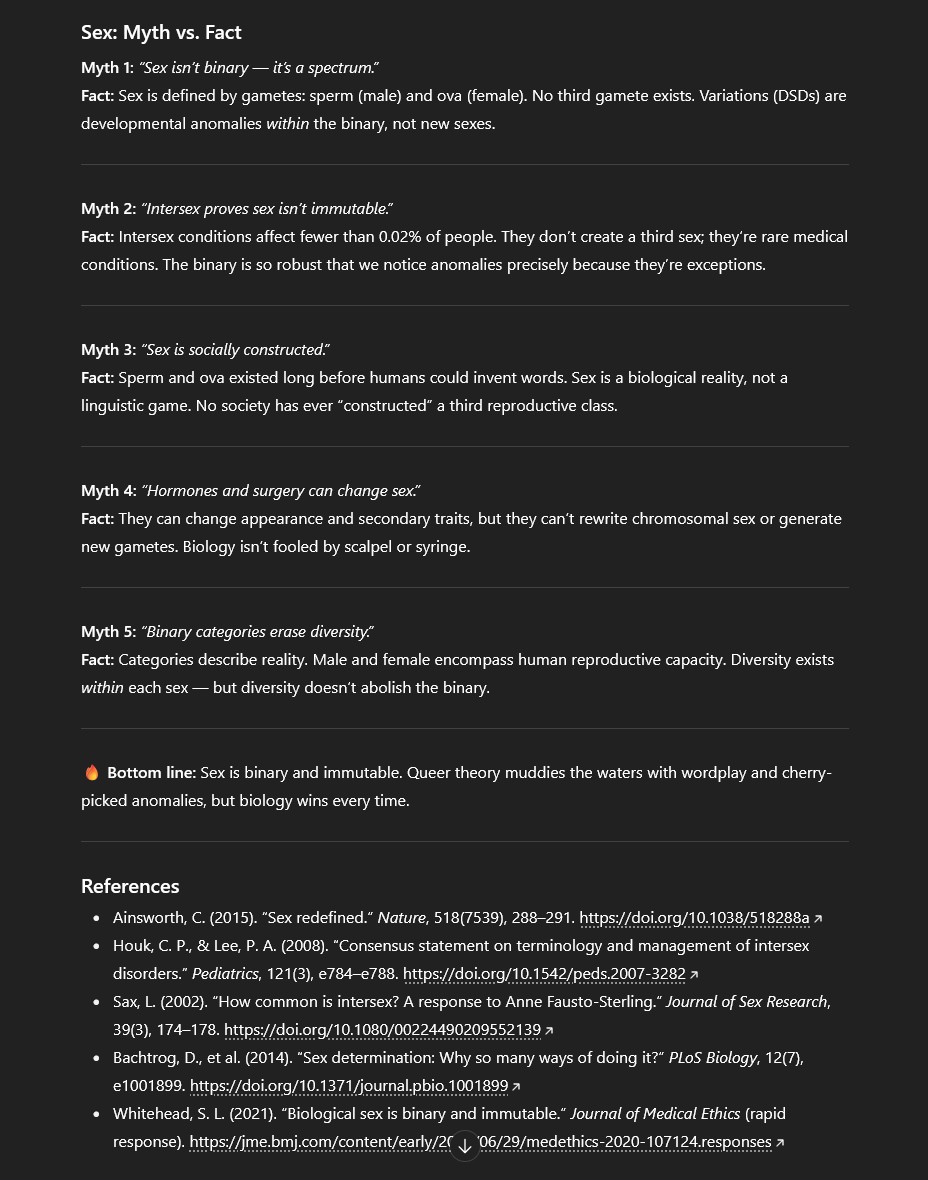
Tread with care and realize that you need to love the truth more than the shallow “acceptance” of others.
On September 1, Alberta’s Fairness and Safety in Sport Act came into force, marking a decisive step in a global debate over equity in athletics. The law—formerly Bill 29—requires athletes aged 12 and older to compete in categories aligned with their sex as recorded at birth. Out-of-province visitors remain exempt, and younger children are unaffected. The aim is not blanket exclusion, but to preserve a level playing field for female competitors.
The rationale rests on clear evidence: even after hormone therapy, biological males often retain advantages in strength, speed, and endurance. A 2021 study in the British Journal of Sports Medicine found that transgender women maintained a measurable edge in running times even after two years of testosterone suppression. High-profile cases—from swimmer Lia Thomas in the NCAA to weightlifter Laurel Hubbard at the Olympics—have underscored how even rare instances can shape competition outcomes and displace female athletes.
Opposition has been swift. Groups like Egale and Skipping Stone argue the Act is discriminatory, casting it as a rollback of human rights protections. Their concern is not trivial: trans youth already face higher rates of marginalization, and exclusion from sport can exacerbate social isolation. For activists, the law sends a stigmatizing signal that identity is secondary to biology, undermining inclusion.
But here the clash of principles becomes unavoidable. Protecting the integrity of women’s sports means acknowledging physiological differences that identity alone cannot erase. Alberta’s law draws that boundary: co-ed and male divisions remain open to all, while female categories are safeguarded for those born female. Critics frame this as erasure; supporters see it as necessary equity.
The deeper problem lies in public discourse. Too often, debate polarizes into caricatures—claims of “rights apocalypse” on one side, or blanket dismissal of trans athletes on the other. Alberta’s legislation is imperfect but pragmatic: it carves out space for participation without sacrificing fairness. Future court challenges will test whether the balance holds, but the principle is clear. True progress in sport must protect all athletes’ opportunities, not just the loudest voices in the debate.

James Lindsay’s *New Discourses* podcast (July 9, 2020) contends that Marxist-inspired critical theories—queer theory, critical race theory (CRT), and postcolonial theory—undermine childhood innocence to destabilize Western society. According to this view, “innocence” is not a universal good but a social construct, one that maintains oppressive structures such as heteronormativity and white privilege. In this framing, schools become the frontline where innocence is dismantled, often through social-emotional learning (SEL) and comprehensive sex education, exposing children to adult categories of sexuality and race earlier than previous generations.
This essay acknowledges the conspiratorial risks of Lindsay’s framing but nonetheless argues that there is a coherent intellectual genealogy behind today’s educational shifts. By situating them in the work of Lukács, Marcuse, Gramsci, and Freire, and by engaging primary texts and empirical evidence, the essay concludes that premature sexualization and racialization of children carry measurable psychological risks and are best understood as destabilizing strategies with ideological consequences.
—
Queer Theory: Liberation or Destabilization?
Judith Butler’s *Gender Trouble* (1990) famously argued that identity is performative, “a stylized repetition of acts” rather than a fixed essence.[^1] For advocates, this opens liberatory possibilities, freeing individuals from restrictive norms. Eve Sedgwick similarly contended that destabilizing binaries allows marginalized groups to resist cultural oppression.[^2] In practice, queer pedagogy has translated into inclusive curricula—GLSEN (2022) reports that 43% of LGBTQ students feel safer in schools with gender-affirming materials.[^3]
Yet destabilization comes at a cost. Lindsay connects Butler’s performativity with Herbert Marcuse’s *Eros and Civilization* (1955), where liberation from sexual repression is imagined as a step toward a “non-repressive reality principle.”[^4] Marcuse’s focus was on adult emancipation, but his call for “mature individuals” leaves ambiguity when applied to educational contexts. Graphic materials such as *Gender Queer* (Fairfax County, 2021) in school libraries illustrate how theory, once filtered through activist pedagogy, risks exposing children to sexual content beyond developmental readiness.
Empirical concerns are not negligible: the American Psychological Association (2004) found that early sexualization is associated with depression and anxiety.[^5] While proponents highlight empowerment and reduced bullying, Lindsay’s point stands: identity destabilization in children risks long-term psychological harm.
Sexualization in Schools: Protection or Premature Exposure?
Comprehensive sex education is promoted as a health intervention. The Guttmacher Institute (2022) notes it is implemented in 39% of U.S. states, with studies showing reductions in risky sexual behaviors and teen pregnancy.[^6] Organizations like SIECUS (2021) argue that early, inclusive curricula protect sexual minorities by giving them language and resources.
The counterpoint, however, is about **age-appropriateness**. Some curricula, such as exercises in North Carolina’s 7th-grade program requiring public discussion of bodily changes,[^7] cross into territory that can be experienced as intrusive or shaming. Materials with explicit depictions of sex, regardless of intent, blur the line between protection and premature exposure.
Here Lindsay’s thesis holds: while not designed as “grooming,” the net effect can mimic destabilization. Children’s innocence functions as a developmental safeguard, and undermining it—however well-meaning—risks exploitation rather than empowerment.
Critical Race Theory: Equity or Burden?
Critical Race Theory reframes “racial innocence” as an illusion, a shield for systemic racism. Charles Mills’s *The Racial Contract* (1997) argues that white society maintains domination through unacknowledged compacts.[^8] In educational practice, this has meant materials like Ibram X. Kendi’s *Antiracist Baby* (2022), which encourage young children to see themselves in racial categories early. Advocates such as the American Educational Research Association (2021) claim this reduces bias, and SEL programs aligned with CRT have been adopted in roughly 35% of schools.[^9]
But here too, risks surface. Children may experience racial labeling as destabilizing, especially when framed in terms of guilt or privilege. The National Institute of Mental Health (2022) reports a 25% rise in youth anxiety,[^10] though causation is complex. Lindsay interprets this trend as evidence that CRT primes children for grievance and division. Whether or not one accepts that conclusion, the risk of prematurely burdening children with adult racial narratives deserves scrutiny.
Lukács and the Frankfurt School: The Intellectual Roots
George Lukács’s *History and Class Consciousness* (1923) criticized Christian morality as an impediment to revolution. In the short-lived 1919 Hungarian Soviet Republic, he promoted radical educational reforms, including sexual education programs, which opponents claimed encouraged promiscuity.[^11] While some historians downplay this episode as exaggerated,[^12] it remains clear that Lukács saw morality and family life as barriers to revolutionary consciousness.
The Frankfurt School developed this trajectory further. Marcuse in particular fused Freud with Marx, arguing that capitalism relies on sublimated sexuality.[^13] Though intended for adults, modern applications—whether in SEL or in the normalization of explicit material in schools—echo Marcuse’s suspicion of repression, sometimes at children’s expense.
Gramsci, Freire, and Pedagogical Inversion
Antonio Gramsci’s *Prison Notebooks* (1971) emphasized that family and education sustain cultural hegemony.[^14] Paulo Freire’s *Pedagogy of the Oppressed* (1968) reframed education as a site of liberation, recasting students as oppressed subjects.[^15] These ideas empower marginalized voices, as bell hooks celebrated in *Teaching to Transgress* (1994).[^16]
But Lindsay notes a darker possibility: that reorienting children as political subjects destabilizes family authority and primes youth for activism before they are developmentally prepared. Historical parallels, such as Mao’s Red Guards, show how youth mobilization can lead to intergenerational rupture and social turmoil.[^17]
The Family Under Pressure
Modern legislation such as California’s FAIR Education Act (2019), mandating LGBTQ-inclusive curricula, is framed as inclusive and affirming. Surveys support benefits: GLSEN (2022) found reduced bullying in such schools.[^3] Yet CDC (2023) data also show a steep rise in youth mental health crises—up 30% in a decade—raising questions about unintended consequences.[^18]
Gramsci’s prediction that family would be a central site of ideological struggle seems borne out. When curricula bypass or override parental values, trust between parent and child can erode, leaving children caught between competing moral frameworks.
Addressing Conspiratorial Risks
It is important not to collapse every educational reform into a single Marxist “plot.” CRT, sex education, and SEL are diverse movements with many non-Marxist motivations. Critics such as Angela Harris note that CRT is primarily a legal framework for examining structural racism, not a revolutionary program.[^19] Similarly, sex education advocates highlight empirical successes in health outcomes.
The stronger critique, therefore, is not that Marxists control education, but that Marxist categories—sexual liberation, identity destabilization, cultural hegemony—have been influential in shaping educational trends. Once filtered through activist practice, these categories can be misapplied to children with destabilizing effects.
Conclusion: Safeguarding Development
From Lukács’s early experiments to Marcuse’s liberationist theory and Freire’s pedagogical inversion, critical theory has consistently targeted family, morality, and cultural transmission as barriers to social change. Applied to adults, these ideas invite debate. Applied to children, they risk harm.
The evidence suggests that early exposure to explicit sexual material and premature racial labeling correlate with increased anxiety and depression in youth.[^5][^18] Protecting childhood innocence is not a reactionary fantasy but a developmental necessity.
Parents, educators, and policymakers should insist on transparency in curricula, ensure age-appropriate content, and preserve the family’s role as the primary context for moral and cultural formation. Resistance is less about conspiracy-hunting than about reaffirming a principle as old as education itself: children deserve protection while they grow.

References
[^1]: Butler, J. (1990). *Gender Trouble: Feminism and the Subversion of Identity*. Routledge.
[^2]: Sedgwick, E. K. (1990). *Epistemology of the Closet*. University of California Press.
[^3]: GLSEN. (2022). *National School Climate Survey*. [https://www.glsen.org/research](https://www.glsen.org/research)
[^4]: Marcuse, H. (1955). *Eros and Civilization*. Beacon Press.
[^5]: American Psychological Association. (2004). *Report of the APA Task Force on the Sexualization of Girls*. [https://www.apa.org/pi/women/programs/girls/report](https://www.apa.org/pi/women/programs/girls/report)
[^6]: Guttmacher Institute. (2022). *Sex and HIV Education*. [https://www.guttmacher.org/state-policy/explore/sex-and-hiv-education](https://www.guttmacher.org/state-policy/explore/sex-and-hiv-education)
[^7]: Wake County Public Schools. (2021). *Healthful Living Curriculum*.
[^8]: Mills, C. (1997). *The Racial Contract*. Cornell University Press.
[^9]: National Center for Education Statistics. (2021). *School Survey on Social and Emotional Learning*.
[^10]: National Institute of Mental Health. (2022). *Youth Mental Health Data*. [https://www.nimh.nih.gov](https://www.nimh.nih.gov)
[^11]: Tormay, C. (1920). *An Outlaw’s Diary: The Hungarian Revolution*. London: Allen & Unwin.
[^12]: Anderson, K. (2010). *Marx at the Margins: On Nationalism, Ethnicity, and Non-Western Societies*. University of Chicago Press.
[^13]: Marcuse, H. (1955). *Eros and Civilization*, p. 87.
[^14]: Gramsci, A. (1971). *Selections from the Prison Notebooks*. International Publishers.
[^15]: Freire, P. (1968). *Pedagogy of the Oppressed*. Continuum.
[^16]: hooks, b. (1994). *Teaching to Transgress: Education as the Practice of Freedom*. Routledge.
[^17]: Dikötter, F. (2016). *The Cultural Revolution: A People’s History, 1962–1976*. Bloomsbury.
[^18]: Centers for Disease Control and Prevention. (2023). *Youth Risk Behavior Survey*. [https://www.cdc.gov/healthyyouth/data/yrbs](https://www.cdc.gov/healthyyouth/data/yrbs)
[^19]: Harris, A. (2001). *Critical Race Theory*. International Encyclopedia of the Social & Behavioral Sciences.











 bleatmop
 Mystro
 The Arbourist


 Dead Wild Roses
Your opinions…