
You are currently browsing the category archive for the ‘Radical Feminism’ category.
I know which minor superpower I’d like to have, I’d like the ability to switch minds of other people, or increase the amount of empathy others feel toward each other. So much of the problem (other than the dudely shit-stains that actually harass women) is that people just can’t relate or believe women when they say they have been harassed. This shouldn’t be rocked science – the social norms surrounding the harassment of women – need to be rightly moved over into the category of ‘unacceptable all the time’ and left their for perpetuity. We don’t condone physical violence on the streets, why are we allowing this psychological (and often physical) torment to continue? So a big thank you to the Gradient Lair for compiling this survey of street harassment responses.
“I recently mentioned a street harassment incident (they occur often, 10-75 times a week for over 20 years now) on Twitter, and I received a plethora of ignorant responses. I realized that these responses are common, so I documented them here.
1) “Gosh, where do YOU live?” This is asked for two reasons, besides the person being ignorant, of course. One is that they want to find a way to “contain” the negative behavior and associate it with a place where they don’t live, kind of like how people are currently pretending that racism is only in Florida and sexism is only in Texas. The second reason is that they want to be able to associate street harassment happening to a woman with some awful place that she “chose” to live in. This disregards class, race, culture and other factors that determine where people live.
2) “That NEVER happens to me!” Saying this is not empathetic, especially as a reply to someone explaining an awful street harassment incident. When cis hetero men say this, they are being ignorant of their male privilege. Of course they aren’t street harassed. (I am talking about street harassment here, which is highly gendered, not police harassment, for example, of Black men.) When White women (some of them are never street harassed or rarely street harassed compared to Black women) or women of a high social class (as street harassment does have some race/class factors at play) say this, they mean to infer the inferiority of the woman it has happened to. Because we live in a victim-blaming rape culture, if street harassment is deemed the fault of the person it happens to and it doesn’t happen to “some” women, it then implies that they aren’t as “low” as the women who experienced it.
3) “Just ignore it!” This is the lazy response from people who think they HAVE TO reply versus listening, understanding and empathizing with a woman who experiences street harassment. They are actually implying that the harassment is her fault for noticing it occurred. And at times, ignoring street harassment can have dangerous effects for a woman if that man is of the type who cannot handle being ignored and escalates the harassment to physical violence. “Ignoring” is a difficult thing to do anyway when speaking of something that happens with the frequency that I experience street harassment. How can I “ignore” up to 75 insults a week?
4) “Take it as a compliment; if you weren’t beautiful it wouldn’t happen!” This usually comes from patriarchal men who also street harass. They view anything they do, no matter how aggressive and dehumanizing as “flattering” for a woman. Further, this stance does not work. No matter how a woman looks, whether she is considered “beautiful” or “ugly,” men will justify harassment.
5) “Just move somewhere else!” This is the classist argument. Because street harassment tends to occur in cities (especially with public transportation) more than suburbs and in communities with higher male unemployment and poverty than ones that don’t have that, people assume that you can just pack up your S-Class Mercedes and buy a new mansion in a new city where though misogyny will still be present, naturally, it may not be in the form of street harassment. This also ignores the fact that no matter where I go, for example, I am a Black woman there. People decide to disrespect me based on who I am, not just based on what city I am in.
6) “You’re just saying that because the guy was ugly!” People who genuinely believe that street harassment is “flirting” think that disrespectful and aggressive men who are “attractive” are tolerable. After dealing with street harassment for over 20 years now, I know how utterly ridiculous this assumption is. I promise if the guy looks like Idris Elba and street harasses me, I am still angry. Plenty of physically attractive men street harass me (though most are ashy irritant pissants) and I am angry when it occurs. I don’t want to be harassed. I genuinely delight in a day where not a single man speaks to me. It’s peaceful and I am happy when I go home.
7)“Well say something smart back to him; that’ll fix him!” This response usually comes from those who have never experienced street harassment or it never became physical. While some men can be cursed out well (and I have done that) some cannot. Knowing which ones can and can’t is a guessing game that I don’t want to play in most cases. Just like ignoring one can escalate to violence, so can cursing one out.
8) “Go different places then!” So, women should not go to work, their coffee shoppes, their supermarkets, their bookstores, their laundromats, their gyms, etc. because men will be there and will harass them? Again, this is a location-associated response that ignores the fact that some women (like me and most Black women) are PROFILED and TARGETED for street harassment. It is about US, not the location.
9) “Well, a lot worse could happen!” This reeks of rape culture. Who is to determine what is better or worse? Only the person who experiences the wrath of misogyny, misogynoir, transmisogyny or homophobia (as some gay men are street harassed as well) knows what the experience is like. Even more legally serious violence like domestic violence and rape itself are brushed off as jokes or blamed on the victim. So the idea that I should be “thankful” for street harassment because it isn’t rape ignores the fact that no matter what happens to a Black woman, people will respond with victim blaming.
10) “What were you wearing; what did YOU do to cause it?” I addressed this response before in my post 6 Common Derailment Tactics Used In Conversations About Street Harassment and Sexual Assault and in Rape “Prevention” Advice That Doesn’t Include Tips For Men’s Behavior = Rape Culture. While the wardrobe comments are refuted over and over and why the street harasser or rapist is at fault is explained, people continually retreat to this ignorant argument. Girls are raped by their fathers wearing the clothing their fathers bought them. Women are raped fully clothed and in work clothes/uniform. Women are street harassed no matter what they wear. And regardless of clothing, the harasser or the rapist IS THE ONE AT FAULT.
Notice that in all of these examples ZERO ACCOUNTABILITY is applied to the men who street harass. None. Also, notice the lack of genuine concern and empathy for me or other women who are street harassed. Street harassment is a part of rape culture.
Related Posts: all posts tagged with “street harassment” on Gradient Lair”
As always, IBTP.

 Canadian bill C-16 passed.
“The bill updates the Canadian Human Rights Act and the Criminal Code to include the terms “gender identity” and “gender expression.” The legislation also makes it illegal to discriminate on the basis of gender identity or expression. It would also extend hate speech laws to include the two terms, and make it a hate crime to target someone for being transgender.
Critically, the bill also amends the sentencing principles section of the code so that a person’s gender identity or expression can be considered an aggravating circumstance by a judge during sentencing.”
As with much of queer politics, defining terms is pretty much up to who you happen to ask, or what day it is, or really how you feel about it at the time. So, let’s grab some terms from some lazy searches on google. These two categories are now included in the the Canadian Human Rights Act and Criminal Code.
Wikipedia – Gender identity – is one’s personal experience of one’s own gender.[1] Gender identity can correlate with assigned sex at birth, or can differ from it completely.
“Merriam Webster – Gender expression – : The physical and behavioral manifestations of one’s gender identity People vary greatly in the extent to which they hold and convey gendered thoughts, feelings, and behaviors. Gender expression refers to the way people convey their gender through mannerisms, behaviors, or expressions. — Robert C. Eklund and Gershon Tenenbaum (editors), Encyclopedia of Sport and Exercise Psychology, 2014 For most people, … gender expression occurs so naturally it’s unnoticeable. Except when gender expression doesn’t match traditional notions of the gender assigned at birth. — Will Dean, The Desert Sun (Palm Springs, California), 12 June 2015″
Perhaps we should try one more source. Another definition of gender identity this time from Canadian Justice Minister Jody Wilson-Raybould, who introduced the legislation –
“Gender identity is a person’s internal or individual experience of their gender. It is a deeply felt experience of being a man, a woman, or being somewhere along the gender spectrum. Gender expression is how a person publicly presents their gender. It is an external or outward presentation through aspects such as dress, hair, makeup, body language, or voice.”
Luckily I also found a feminist response as well – Meghan Murphy responds –
“But these statements show a deep misunderstanding of what gender is and how it works. Gender is a product of patriarchy. Ideas around masculinity and femininity exist to naturalize men’s domination and women’s subordination. In the past, women were said to be too irrational, emotional, sensitive, and weak to engage in politics and public life. Men were (and often still are) said to be inherently violent, which meant things like marital rape and domestic abuse were accepted as unavoidable facts of life. “Boys will be boys,” is the old saying that continues to be applied to excuse the predatory, violent, or otherwise sexist behaviour of males.
The feminist movement began back in the late 1800s in protest of these ideas, and continues today on that basis. The idea that gender is something internal, innate, or chosen — expressed through superficial and stereotypical means like hairstyles, clothing, or body language — is deeply regressive.
Beyond misguided language there is the fact that we are very quickly pushing through legislation that conflicts with already established rights and protections for women and girls.
Women’s spaces — including homeless shelters, transition houses, washrooms, and change rooms — exist to offer women protection from men. It isn’t men who fear that women might enter their locker rooms and flash, harass, assault, abuse, photograph, or kill them… This reality is often left unaddressed in conversations around gender identity. This reality is sex-based, not identity-based. Men cannot identify their way out of the oppressor class so easily, neither can women simply choose to identify their way out of vulnerability to male violence.”
So here we be – enshrining more patriarchal norms into our laws – big surprise right? This legislation potentially represents a large step backwards for women.
“As unpopular as this fact has become, a man or boy who wishes to identify as a woman or girl, perhaps taking on stereotypically feminine body language, hairstyles, and clothing, is still male. He still has male sex organs, which means girls and women will continue to see him as a threat and feel uncomfortable with his presence in, say, change rooms. Is it now the responsibility of women and girls to leave their own spaces if they feel unsafe? Are teenage girls obligated to overcome material reality lest they be accused of bigotry? Is the onus on women to suddenly forget everything they know and have experienced with regard to sexual violence, sexual harassment, and the male gaze simply because one individual wishes to have access to the female change room? Because one boy claims he “feels like a girl on the inside?” And what does that mean, anyway?”
So which is more important male gender feelings or female safety? I would like to advocate here for gender neutral washrooms/changing area as the beginning of a compromise in this area. We still live in a patriarchy and sex segregated facilities are still necessary for the protection and safety of females in our society. The choice whether to co-mingle with men in washrooms or change rooms should be up to all those involved.
“We live in a time when women and girls are killed every day, across the globe, by men. Things like rape, domestic abuse, and the murder of Indigenous women and girls in Canada are still not considered hate crimes. Yet we have managed to push through legislation that may very well equate “misgendering” to hate speech.
Women are protected under the human rights code on the basis that we are, as a group, discriminated against on account of our biology. Employers still choose not to hire women based on the assumption that they will become pregnant. Women are still fighting to have access to women-only spaces (including washrooms and locker rooms) in male-dominated workplaces like fire departments, in order to escape sexual harassment and assault.”
I have serious misgivings about this legislation. The concerns raised by radical feminists such as Meghan Murphy, have mostly been brushed aside, unsurprisingly as her concerns focus on the female experience in society and how this legislation is going to impact females (thanks again patriarchy).
Critical analysis and more debate is necessary on contentious topics such as the now passed bill C-16 – I hope more discussions can be had and that so we can ensure the safety and security of females in our society.
Consider this conversation and then juxtaposition it with all the chatter one hears about ‘gender identity’ and ‘gender expression’. Add to your lens the notion of male privilege and how it often plays out when it comes to respecting the boundaries of females.
(not) Funny how that works.
http://auntiewanda.tumblr.com/post/160517895825/cecaeliawitch-this-was-a-pretty-grand-moment-and
Gail Dines is an amazing feminist. She lectures worldwide and has written many an article as well as few really good books. She sums up the slide toward liberal feminism in three meagre slides.
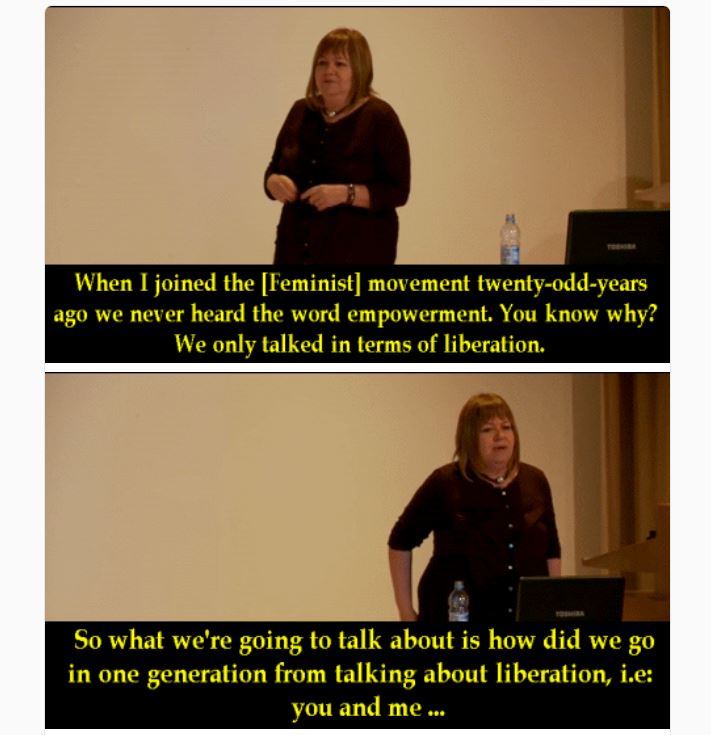
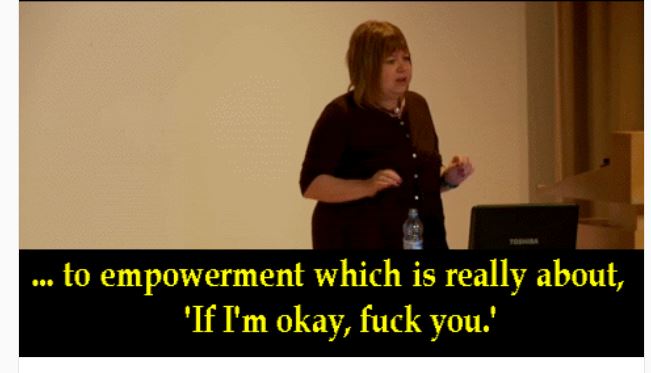
Let’s move away from the neo-liberal/libertarian ‘I’ve got mine, fuck you’ trend that has dominated much of recent popular feminist discourse.
One of the problems while debating misguided 3rd wavers, or gender/qu**r activists is that lack of definitional rigour when it comes to the terms ‘sex’ and ‘gender’. What is chilling is that these activists often refuse to define their terms, yet as demonstrated here in Canada want these same terms enshrined into Canadian law. Obviously, this should not happen if clear guidelines and expectations are supposed to be part of our legislative goals.
Canadian focus aside, lets look at Auntie Wanda and krismichelle429 tackle the situation of defining sex and gender in a more general sense.
“In my experience talking to gender/qu**r activists, when they say “sex,” they can mean either “the biological differences between men and women” or “the behaviors that society expects from each sex,” or both at the same time. When they say “gender,” they can mean either “personality” or “the behaviors that society expects from each sex” or “the biological differences between men and women,” or all three at the same time. Oftentimes they switch between definitions without telling you, and then expect you to read their mind and just know which meaning they’re using at that moment. And no matter how many times you explain your definitions to them, they never acknowledge it and choose instead to project their definitions onto your words (or to put it more simply: they hear what they want to hear instead of what you’re saying).
Like, we have explained our definitions of “sex” and “gender” thousands of times on this site. We have used them clearly and consistently. We don’t change them. When gender critical feminists use the word “sex,” it ALWAYS refers to the biological differences between sexes. When we say “gender,” it ALWAYS refers to the behaviors forced on men and women by a sexist society.
And yet, we constantly get into arguments with gender/qu**r activists who think we believe that sexist expectations for behavior are biological. We have to explain that we don’t over and over and over again, even though we’ve been very clear about our beliefs and definitions, even though those beliefs and definitions have not changed since we last explained them 5 minutes ago. And that’s because when we say “sex” and “gender,” gender/qu**r activists hear their own definitions instead of ours, and because the words “sex” and “gender” can mean absolutely anything to them, they can hear anything that they want to hear.
Oftentimes they switch between definitions without telling you, and then expect you to read their mind and just know which meaning they’re using at that moment. And no matter how many times you explain your definitions to them, they never acknowledge it and choose instead to project their definitions onto your words (or to put it more simply: they hear what they want to hear instead of what you’re saying).”
– See the whole post on [Blackswallowtailbutterfly].
http://tehbewilderness.tumblr.com/post/160068494084/literal-violence
Yeah. So trans community what is the plan to deal members who choose to behave like this? I’m curious because this particular sub-set seems to be defining what trans-activism is all about and illustrating quite succinctly the threat it poses to women.
Found on the Women’s Liberation Front Feed. :)











 bleatmop
 Mystro
 The Arbourist


 Dead Wild Roses
Your opinions…