
You are currently browsing the category archive for the ‘Science’ category.
I’m glad that our Universe is so large that we shouldn’t have to worry (much) about being erased as a species by a gamma ray burst. :)
Health fads come and go, some shouldn’t, but some should definitely make a quick exit. Here is a guide to the good and the bad.
**Update** – One of our merry band of contributors here at DWR, Bleatmop, astutely pointed out that the last graph that was posted here, has some glaring problems with accuracy of the claims being made. That infographic has been removed from DWR and replaced with another with links to where they got their data from. Consider visiting Information is beautiful.net to see the graph in its full size and interactive format.
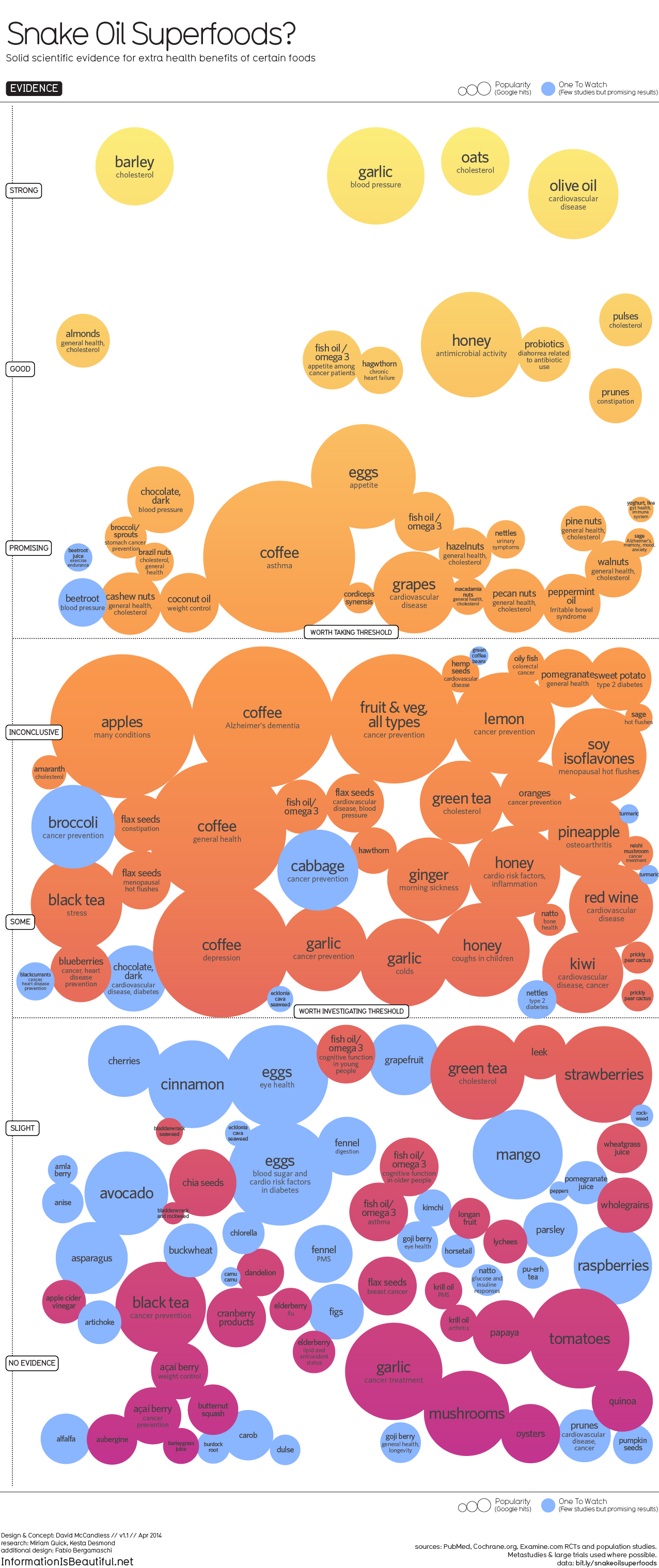
Link to studies cited in poster here.
Scientists are predicting the Perseid Meteor Shower will be extra-spectacular this year, with up to double the usual number of meteors – up to 200 per hour!
Arb and I are probably not going to get to see them: the forecast is for clouds and rain a good portion of the night. If any of our dear readers manage to take in the sight, I’d love to live vicariously through your reports!
Here is the new ‘joke’ –
What did Watson & Crick discover?
Rosalind Franklin’s notes.
Rosalind Franklin’s Legacy
When it comes to her place in the discovery of the double helix structure of DNA, Rosalind Franklin has not received fair treatment. Or so maintains Lynne Osman Elkin, a professor of biological sciences at California State University, Hayward, who spends much of her time these days trying to clarify Franklin’s significant role in one of the 20th century’s greatest scientific achievements. In March 2003, Elkin published a lengthy article on Franklin in Physics Today, and she’s hard at work on a biography. In this interview, hear what Elkin has to say about exactly where Franklin stands in her mind—and where Photo 51’s creator ought to stand in the history books. Click on highlighted words or phrases for a glossary.
With all she did to make Watson and Crick’s discovery possible, Rosalind Franklin was essentially “a de facto collaborator,” says Lynne Osman Elkin. EnlargePhoto credit: © Novartis Foundation
Within reach
NOVA: How close did Franklin actually come to deciphering the structure of DNA?
Elkin: She was very close. She had all the parameters of the helical backbone. She was the one who figured out that there were two forms of DNA, which made solving the whole structure possible. She had figured out that backbone of the A form is antiparallel. It wouldn’t have been very long before she figured out that the B form backbone was antiparallel as well.
The other thing was base-pairing, which was Watson‘s brilliant idea, made possible by chemical information supplied by Jerry Donohue. But if you look at her notebooks, she was very, very aware of hydrogen bonding. She was very, very aware of the difference between enol and keto forms, which were the key to base-pairing. She was aware of Chargaff’s ratios. She was aware of Donohue’s work. All the stuff that circled around base-pairing.
How soon might she have worked it out if Watson and Crick hadn’t gotten her data?
Well, at one time Crick estimated that it would have taken her three months. I don’t know how long it would have taken her, but I think the critical thing with the timing is that she was about to publish her paper on the B form. That’s the March 17th draft that Aaron Klug discovered. And that paper was written well before March 17th, and then after the Watson-Crick structure was figured out, she modified it very minimally, and it became the third Nature paper.
“After Watson saw Photo 51, he went out to dinner with Maurice Wilkins and pressed him for the interpretation of it.”There is no way without her data that Watson and Crick could have figured out the structure before [her March 17th draft] got published. Now, if that had gotten published first and then they figured it out—remember, she talked about the double helix in that paper—then even though they had figured out the actual structure, they would have had to incorporate her information and credit her properly, and she would not have been written out of history.
Franklin’s famous Photo 51, which led to Watson and Crick’s breakthrough insight into the double-helical structure of DNA Enlarge Photo credit: © Franklin, R. and Gosling, R.G./Nature
Picture perfect
What did Watson actually get out of Photo 51 beyond the idea that the “X” signified a helix?
After Watson saw Photo 51, he went out to dinner with Wilkins and pressed him for the interpretation of it—the 34-angstrom measurements and so on. At that early date Watson didn’t know how to interpret a diffraction photo, other than that an “X” meant helix. In terms of getting measurements out of it, he hadn’t the foggiest—at that point. It was Wilkins who told him how to interpret it. [For a closer look at the image, see Anatomy of Photo 51.]
What about the idea that the sugar-phosphate groups were on the outside? Did Watson get that from Photo 51?
No. That was from the MRC report. Watson and Crick got a tremendous amount of information from that MRC report. Now, they persisted in wanting to put the bases on the outside. And it’s absurd—you don’t put a hydrophobic thing on the outside of a structure in a cell. You put the hydrophobic stuff on the inside where it’s protected, and the hydrophilic phosphates and sugars on the outside.
As a chemist Franklin knew that automatically, and so did even a graduate student at King’s, Bruce Fraser, when he tried building a model. But Watson and Crick, being weak in their knowledge of chemistry, kept putting it on the outside. And Wilkins said, “You know, Rosalind said it should be on the inside.” So Wilkins once again was telling them information that he knew from Rosalind. They kept resisting, however, because to put it on the inside, it seemed very difficult to know how to pack things.
But when Crick saw the MRC report—in which Franklin had not only said that the phosphates are on the outside but had offered measurements of the interphosphate distances—even he couldn’t argue with that anymore. So when Watson once again was trying to build a model and it wasn’t working, Crick said, “Why don’t you put the phosphates on the outside, like Rosalind said?”
Of Franklin and the Nobel Prize she never won, Elkin points out that “even Watson begrudgingly says that she should have gotten it.” EnlargePhoto credit: © Corbis Images
Oh, it was that easy? :)
 Lateral awareness, or the ability to discriminate left from right is an acquired skill. Most people have it by age 10 and most people start to lose in after age 50 (good times). Lateral awareness, of course, falls on a spectrum and here are the results so far:
“A recent survey of 800 people found that 9 percent of men and 18 percent of women report a problem with left-right discrimination. And when 290 undergraduate medical students from Ireland were tested on laterality using a series of stick-figure images, more than half of them had trouble, scoring less than 77 percent (the test had 144 questions). Both of these studies found that women struggled more than men; one of the world’s leading researchers on this subject, Dr. Gerard Gormley of Queen’s University Belfast, became interested in the subject because his wife often mixed up her left and right. (She’s a righty who also mimes writing to set herself straight.) The studies also found that lateral awareness did not affect intellect—although in practice, spatial reasoning troubles can make you feel like a doofus, in fact they do not indicate inferior intellect. (Phew!)”
Truth time gentle readers! I’m pretty good with left and right, but the cardinal directions always send me for a loop – especially when travelling South. Everything just feels wrong as I’m navigating through the directions. I keep hoping that my sense of unease will diminish, but as of yet, no luck. Successfully navigating to a school across town is the first victory of the day, getting attendance is the second. Once those hurdles have been overcome, the easy part of the day, teaching ambivalent children can begin.
My google map experiences are one thing, but getting mixed up as health care professional can have obvious deleterious consequences.
“However, the field under the most pressure to avoid lateral confusion is medicine. In the dentist’s chair, there’s money wasted when hygienists x-ray the wrong tooth. It’s even worse when a left-right-disoriented dentist pulls one or more teeth from the incorrect side of the mouth. It’s even more serious in general surgery: A 2011 report estimates that there are 40 wrong-site surgeries done weekly in the U.S., and many of those involve mixing up a patient’s left and right. This is a devastating problem: If a doctor removes the healthy kidney and not the cancerous one, the results can be fatal. Wrong eye? Now we have a fully blind patient.
Healthcare professionals work in tricky circumstances that make laterality harder. For them, distinguishing left from right almost always requires rotation. During a consultation, a patient is often sitting up, but that same patient is likely lying down during the subsequent procedure. The doctor or nurse’s perspective in the operating room could then change if he or she moves around the room while the patient stays stationary.
In addition, in medical situations—and in the transportation and aviation industries—there’s often time pressure and a bustle of other things going on. A 2015 study of medical students found that distracting people with sounds impacted their ability to tell left from right, and interrupting them with cognitive tasks made matters even worse. This is why the second item on the WHO’s Surgical Safety Checklist asks if the surgical site is marked—ideally by someone not distracted, and well in advance of the pressures of the operating suite.”
So, when at a hospital and if conscious make sure you talk to your surgeon and have them mark the procedure beforehand. Just to be safe.
“That leaves us with our mnemonic devices. Some wear a wristwatch. Others make a capital “L” with their fingers. But it’s been shown that people who use mnemonic devices, particularly in a medical setting, are those the most likely to make mistakes. Our tricks fail, in other words, and practice doesn’t necessarily make perfect.”
Yeah, so mnemonic devices are out. Pretty bleak picture eh? :/ While I was reading this, I thought of the common practice of turning down the radio while looking for parking or following directions. We often see on the internet people making fun of the practice, but as this study indicates loud noises/distractions hinder our ability to make left/right distinctions. So perhaps the radio-muters might just be on to something. :)
The Fermi paradox or Fermi’s paradox, named after Enrico Fermi, is the apparent contradiction between the lack of evidence and high probability estimates, e.g. those given by the Drake equation, for the existence of extraterrestrial civilizations.[1] The basic points of the argument, made by physicists Enrico Fermi (1901–1954) and Michael H. Hart (born 1932), are:
- There are billions of stars in the galaxy that are similar to the Sun,[2][3] many of which are billions of years older than Earth.[4][5]
- With high probability, some of these stars will have Earth-like planets,[6][7] and if the Earth is typical, some might develop intelligent life.
- Some of these civilizations might develop interstellar travel, a step the Earth is investigating now.
- Even at the slow pace of currently envisioned interstellar travel, the Milky Way galaxy could be completely traversed in about a million years.[8]
According to this line of thinking, the Earth should have already been visited by extraterrestrial aliens. In an informal conversation, Fermi noted no convincing evidence of this, leading him to ask, “Where is everybody?”[9][10] There have been many attempts to explain the Fermi paradox,[11][12] primarily suggesting either that intelligent extraterrestrial life is extremely rare, or proposing reasons that such civilizations have not contacted or visited Earth.
My thoughts are quite simply this: What race would want to contact us? If they read the papers or browsed our interwebs, do you think they’d want any part of humanity? :/











 bleatmop
 Mystro


 Dead Wild Roses


Your opinions…