You are currently browsing the category archive for the ‘Social Science’ category.
Category Archive
Chris Hedges’ 2003 Rockford College Commencement Address – Speaking Truth to Power
August 12, 2013 in Education, International Affairs, Politics, Social Science | Tags: American Exceptionalism, Decline of the American Empire, Frightening Video, Speaking Truth to Power, The Power of Ignorance | by The Arbourist | 5 comments
Let us take a good look at how free speech and competing idea’s are treated at a American College. You wonder why so many people just roll their eyes when the words American and enlightened are mentioned in the same sentence.
What gets me is that these are the supposed emerging ‘educated class’… the new leaders of American society. Such inanity, such ignorance such dedication to american exceptionalism. This is really a chilling video.
Speaking the truth, as always, is never well received.
[Full Text of Speech]
I want to speak to you today about war and empire.
Killing, or at least the worst of it, is over in Iraq. Although blood will continue to spill — theirs and ours — be prepared for this. For we are embarking on an occupation that, if history is any guide, will be as damaging to our souls as it will be to our prestige, power, and security. But this will come later as our empire expands and in all this we become pariahs, tyrants to others weaker than ourselves. Isolation always impairs judgment and we are very isolated now.
We have forfeited the good will, the empathy the world felt for us after 9-11. We have folded in on ourselves, we have severely weakened the delicate international coalitions and alliances that are vital in maintaining and promoting peace and we are part now of a dubious troika in the war against terror with Vladimir Putin and Ariel Sharon, two leaders who do not shrink in Palestine or Chechnya from carrying out acts of gratuitous and senseless acts of violence. We have become the company we keep.
The censure and perhaps the rage of much of the world, certainly one-fifth of the world’s population which is Muslim, most of whom I’ll remind you are not Arab, is upon us. Look today at the 14 people killed last night in several explosions in Casablanca. And this rage in a world where almost 50 percent of the planet struggles on less than two dollars a day will see us targeted. Terrorism will become a way of life, and when we are attacked we will, like our allies Putin and Sharon, lash out with greater fury. The circle of violence is a death spiral; no one escapes. We are spinning at a speed that we may not be able to hold. As we revel in our military prowess — the sophistication of our military hardware and technology, for this is what most of the press coverage consisted of in Iraq — we lose sight of the fact that just because we have the capacity to wage war it does not give us the right to wage war. This capacity has doomed empires in the past.
“Modern western civilization may perish,” the theologian Reinhold Niebuhr warned, “because it falsely worshiped technology as a final good.”
The real injustices, the Israeli occupation of Palestinian land, the brutal and corrupt dictatorships we fund in the Middle East, will mean that we will not rid the extremists who hate us with bombs. Indeed we will swell their ranks. Once you master people by force you depend on force for control. In your isolation you begin to make mistakes.
Fear engenders cruelty; cruelty, fear, insanity, and then paralysis. In the center of Dante’s circle the damned remained motionless. We have blundered into a nation we know little about and are caught between bitter rivalries and competing ethnic groups and leaders we do not understand. We are trying to transplant a modern system of politics invented in Europe characterized, among other things, by the division of earth into independent secular states based on national citizenship in a land where the belief in a secular civil government is an alien creed. Iraq was a cesspool for the British when they occupied it in 1917; it will be a cesspool for us as well. The curfews, the armed clashes with angry crowds that leave scores of Iraqi dead, the military governor, the Christian Evangelical groups who are being allowed to follow on the heels of our occupying troops to try and teach Muslims about Jesus.
Hedges stops speaking because of a disturbance in the audience. Rockford College President Paul Pribbenow takes the microphone.
“My friends, one of the wonders of a liberal arts college is its ability and its deeply held commitment to academic freedom and the decision to listen to each other’s opinions. (Crowd Cheers) If you wish to protest the speaker’s remarks, I ask that you do it in silence, as some of you are doing in the back. That is perfectly appropriate but he has the right to offer his opinion here and we would like him to continue his remarks. (Fog Horn Blows, some cheer).
The occupation of the oil fields, the notion of the Kurds and the Shiites will listen to the demands of a centralized government in Baghdad, the same Kurds and Shiites who died by the tens of thousands in defiance of Sadaam Hussein, a man who happily butchered all of those who challenged him, and this ethnic rivalry has not gone away. The looting of Baghdad, or let me say the looting of Baghdad with the exception of the oil ministry and the interior ministry — the only two ministries we bothered protecting — is self immolation.
As someone who knows Iraq, speaks Arabic, and spent seven years in the Middle East, if the Iraqis believe rightly or wrongly that we come only for oil and occupation, that will begin a long bloody war of attrition; it is how they drove the British out and remember that, when the Israelis invaded southern Lebanon in 1982, they were greeted by the dispossessed Shiites as liberators. But within a few months, when the Shiites saw that the Israelis had come not as liberators but occupiers, they began to kill them. It was Israel who created Hezbollah and was Hezbollah that pushed Israel out of Southern Lebanon.
As William Butler Yeats wrote in “Meditations in Times Of Civil War,” “We had fed the heart on fantasies / the hearts grown brutal from the fair.”
This is a war of liberation in Iraq, but it is a war now of liberation by Iraqis from American occupation. And if you watch closely what is happening in Iraq, if you can see it through the abysmal coverage, you can see it in the lashing out of the terrorist death squads, the murder of Shiite leaders in mosques, and the assassination of our young soldiers in the streets. It is one that will soon be joined by Islamic radicals and we are far less secure today than we were before we bumbled into Iraq.
We will pay for this, but what saddens me most is that those who will by and large pay the highest price are poor kids from Mississippi or Alabama or Texas who could not get a decent job or health insurance and joined the army because it was all we offered them. For war in the end is always about betrayal, betrayal of the young by the old, of soldiers by politicians, and of idealists by cynics. Read Antigone, when the king imposes his will without listening to those he rules or Thucydides’ history. Read how Athens’ expanding empire saw it become a tyrant abroad and then a tyrant at home. How the tyranny the Athenian leadership imposed on others it finally imposed on itself.
This, Thucydides wrote, is what doomed Athenian democracy; Athens destroyed itself. For the instrument of empire is war and war is a poison, a poison which at times we must ingest just as a cancer patient must ingest a poison to survive. But if we do not understand the poison of war — if we do not understand how deadly that poison is — it can kill us just as surely as the disease.
We have lost touch with the essence of war. Following our defeat in Vietnam we became a better nation. We were humbled, even humiliated. We asked questions about ourselves we had not asked before.
We were forced to see ourselves as others saw us and the sight was not always a pretty one. We were forced to confront our own capacity for a atrocity — for evil — and in this we understood not only war but more about ourselves. But that humility is gone.
War, we have come to believe, is a spectator sport. The military and the press — remember in wartime the press is always part of the problem — have turned war into a vast video arcade came. Its very essence — death — is hidden from public view.
There was no more candor in the Persian Gulf War or the War in Afghanistan or the War in Iraq than there was in Vietnam. But in the age of live feeds and satellite television, the state and the military have perfected the appearance of candor.
Because we no longer understand war, we no longer understand that it can all go horribly wrong. We no longer understand that war begins by calling for the annihilation of others but ends if we do not know when to make or maintain peace with self-annihilation. We flirt, given the potency of modern weapons, with our own destruction.
The seduction of war is insidious because so much of what we are told about it is true — it does create a feeling of comradeship which obliterates our alienation and makes us, for perhaps the only time of our life, feel we belong.
War allows us to rise above our small stations in life; we find nobility in a cause and feelings of selflessness and even bliss. And at a time of soaring deficits and financial scandals and the very deterioration of our domestic fabric, war is a fine diversion. War for those who enter into combat has a dark beauty, filled with the monstrous and the grotesque. The Bible calls it the lust of the eye and warns believers against it. War gives us a distorted sense of self; it gives us meaning.
(A man in the audience says: “Can I say a few words here?” Hedges: Yeah, when I finish.)
Once in war, the conflict obliterates the past and the future all is one heady intoxicating present. You feel every heartbeat in war, colors are brighter, your mind races ahead of itself. (Confusion, microphone problems, etc.) We feel in wartime comradeship. (Boos) We confuse this with friendship, with love. There are those who will insist that the comradeship of war is love — the exotic glow that makes us in war feel as one people, one entity, is real, but this is part of war’s intoxication.
Think back on the days after the attacks on 9-11. Suddenly we no longer felt alone; we connected with strangers, even with people we did not like. We felt we belonged, that we were somehow wrapped in the embrace of the nation, the community; in short, we no longer felt alienated.
As this feeling dissipated in the weeks after the attack, there was a kind of nostalgia for its warm glow and wartime always brings with it this comradeship, which is the opposite of friendship. Friends are predetermined; friendship takes place between men and women who possess an intellectual and emotional affinity for each other. But comradeship — that ecstatic bliss that comes with belonging to the crowd in wartime — is within our reach. We can all have comrades.
The danger of the external threat that comes when we have an enemy does not create friendship; it creates comradeship. And those in wartime are deceived about what they are undergoing. And this is why once the threat is over, once war ends, comrades again become strangers to us. This is why after war we fall into despair.
In friendship there is a deepening of our sense of self. We become, through the friend, more aware of who we are and what we are about; we find ourselves in the eyes of the friend. Friends probe and question and challenge each other to make each of us more complete; with comradeship, the kind that comes to us in patriotic fervor, there is a suppression of self-awareness, self-knowledge, and self-possession. Comrades lose their identities in wartime for the collective rush of a common cause — a common purpose. In comradeship there are no demands on the self. This is part of its appeal and one of the reasons we miss it and seek to recreate it. Comradeship allows us to escape the demands on the self that is part of friendship.
In wartime when we feel threatened, we no longer face death alone but as a group, and this makes death easier to bear. We ennoble self-sacrifice for the other, for the comrade; in short we begin to worship death. And this is what the god of war demands of us.
Think finally of what it means to die for a friend. It is deliberate and painful; there is no ecstasy. For friends, dying is hard and bitter. The dialogue they have and cherish will perhaps never be recreated. Friends do not, the way comrades do, love death and sacrifice. To friends, the prospect of death is frightening. And this is why friendship or, let me say love, is the most potent enemy of war. Thank you.
Share this:
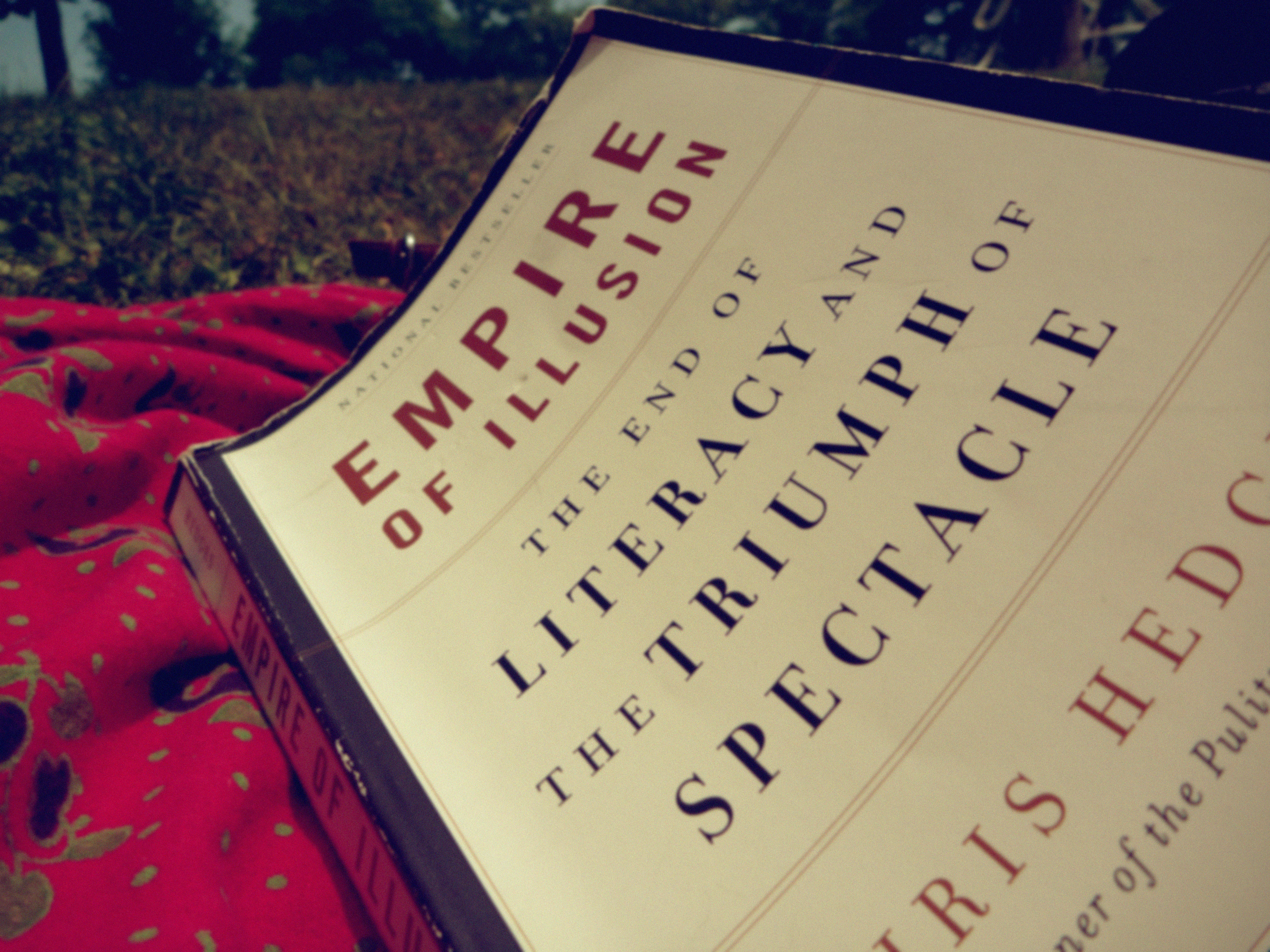
Chris Hedges on The Empire of Illusion
August 7, 2013 in Education, Politics, Social Science | Tags: Chris Hedges, Culture, Media, Summer Reading, The Empire of Illusion | by The Arbourist | 3 comments
My summer vacation reading was a sunny little book by Nick Turse called Kill Anything That Moves. I finished the other book I was noshing on, the Age of American Unreason, just after returning from Kaslo and now I’ve started Chris Hedges book, the Empire of Illusion. Turse’s book is a necessary read for anyone who wants to understand what war is all about; I’ll be posting quotes from it here soon, but a work of that calibre needs time to digest, to make sense of the crushing sorrow it brings about.
Hedges book is similar to Jacoby’s Age of Unreason, but takes a different tack focusing almost immediately on the present. Hedges begins with a pro-wrestling story and broadens it to convey the idea that we are replacing substance and reality with flash and dramatic narrative (Check out the CBC Podcast on the Empire of Illusion):
[Plato’s Cave just before this…]
“We are chained to the flickering shadows of celebrity culture, the spectacle of the arena and the airwaves, the lies of advertising, the endless personal dramas, many of them completely fictional, that have become the staple of news, celebrity gossip, New Age mysticism, and pop psychology. In the Image: A Guide to Pseudo-Events in America, Daniel Boorstin writes that in contemporary culture the fabricated, the inauthentic, and the theatrical have displaced the natural, the genuine, and the spontaneous, until reality itself has been converted into stagecraft. Americans, he writes, increasingly live in a “world where fantasy is more real than reality,” He warns:
We risk being the first people in history to have been able to make their illusions so vivid, so persuasive, so “realistic” that they can live in them. We are the most illusioned people on earth. Yet we dare not become disillusioned, because your illusions are the very house in which we live; they are our news, our heroes, our adventure, our forms of art, our very experience.
Boorstin goes on to caution that
an image is something we have claim on. It must serve our purposes. Images are means. If a corporation’s image of itself or a man’s image of himself is not useful, it is discarded. Another may fit better. The image is made to order, tailored to us. An ideal, on the other hand, has a claim on us. It does not serve us; we serve it. If we have trouble striving towards [sic] it , we assume the matter is with us, and not with the ideal.
Those who manipulate the shadows that dominate our lives are the agents, publicists, marketing departments, promoters, script writers, television and movie producers, advertisers, video technicians, photographers, bodyguards, wardrobe consultants, fitness trainers, pollsters, public announcers, and television news personalities that create the vast stage for illusion. They are the puppet masters. No one achieves celebrity status, no cultural illusion is swallowed as reality, without these armies of cultural enablers and intermediaries. The sole object is to hold attention and satisfy an audience. These techniques of theatre, as Boorstin notes, have leached into politics, religion, education, literature, news, commerce, warfare and crime. The squalid dramas played out for fans in the wrestling ring mesh with the ongoing dramas on television, in movies, and in the news, where “real-life” stories, especially those involving celebrities, allow news reports to become mini-drams complete with a star, a villian, a supporting cast, a good-looking host, and a neat, if often unexpected, conclusion”.
*boom* The beginnings of understanding our manufactured culture in less than 600 words. Enjoy.
Share this:
Quote of the Day – Chris Hedges and the Empire of Illusion
August 5, 2013 in Social Science | Tags: Chris Hedges, Empire of Illusion, Quote of the Day | by The Arbourist | 12 comments
“We now live in two Americas. One—now the minority—functions in a print-based, literate world that can cope with complexity and can separate illusion from truth. The other—the majority—is retreating from a reality-based world into one of false certainty and magic. To this majority—which crosses social class lines, though the poor are overwhelmingly affected—presidential debate and political rhetoric is pitched at a sixth-grade reading level. In this “other America,” serious film and theatre, as well as newspapers and books, are being pushed to the margins of society.”
-Overview from the Empire of Illusion, by Chris Hedges
I’m currently reading this book and gosh oh boy, am I ever glad that we don’t have a connected TV anymore.
Share this:
Gendered Cheese!
May 25, 2013 in Feminism, Social Science | Tags: Cheese, Gender binary, Gender Cheese!, Sociological Images | by The Arbourist | 19 comments
*sigh* Like the gender binary needs more reinforcement…

Thanks to Dr. Lisa Wade over at Sociological Images for the pic and commentary.
“Dieting is for women.
I mean we all know that dieting and women go together like peas and carrots. We know this — collectively and together, even if we don’t agree that it should be this way – not because it’s inevitable or natural, but because we constantly get reminded that women should be on diets and dieting is a feminine activity.”
Share this:
Spot the Problem?
May 21, 2013 in International Affairs, Social Science | Tags: Helpful Infographics, Public Sector, USA | by The Arbourist | 9 comments
Of course, it could just be me…
Share this:
Inequality Begins at Home
March 5, 2013 in Social Science | Tags: Familiy, Inequality, Sociology | by The Arbourist | Comments closed
For your quick hit of sociological fact, look no further. Inequality is bad for societies and also bad for families. In other breaking news global warming is a “go”, religious is still deceiving people and women are still being systematically discriminated against.
Enjoy the video. :)
Share this:
Project Unbreakable – Pictures that say too much.
November 10, 2012 in Education, Feminism, Social Science | Tags: Feminism, Healing, Project Unbreakable, Rape Culture, Sexual Assualt | by The Arbourist | 2 comments
*TW for sexual violence.
Project Unbreakable is about the survivors of sexual assault. It is a photoblog of survivors holding up signs with messages about their experiences and feelings. Powerful stuff.
Abuse is epidemic in our societies, not thinking about it does not make it go away. Please link to and propagate Project Unbreakable’s message.


Your opinions…