The “oof” will be big when it lands.


Canadian cogitations about politics, social issues, and science. Vituperation optional.
The “oof” will be big when it lands.
The Liberal Party of Canada’s decision to remove Chandra Arya from the leadership race is a concerning display of undemocratic behavior.
Arya, having met the necessary criteria and raised the required funds, should have been allowed to compete on an equal footing with other candidates. This exclusion smacks of internal manipulation, suggesting that the party leadership might be more interested in controlling the outcome than in fostering a fair and open contest.
Such actions raise serious questions about the integrity of the leadership selection process and whether it truly reflects the will of party members or is instead orchestrated by a select few. This move not only disenfranchises Arya’s supporters but also undermines the democratic ethos that the Liberal Party should champion.
It’s a clear indication that the party might prioritize maintaining a particular narrative or candidate over the democratic ideals it claims to uphold, thereby casting a shadow over the legitimacy of the entire leadership race and, by extension, the future governance of the country.
The decision by the current Liberal Government in Canada to prorogue Parliament is a stark demonstration of political opportunism trumping democratic principles.
By shutting down Parliament, they’ve effectively silenced the legislative body’s ability to hold the government accountable at a crucial juncture, especially with the looming leadership change. This move appears less about a necessary “reset” for government action and more about buying time to manage internal party politics ahead of a potential vote of non-confidence.
It’s particularly egregious given the backdrop of significant national and international issues that demand parliamentary attention, including economic recovery and international relations.
The prorogation not only delays important legislative work but also undermines the democratic process by preventing timely scrutiny of government actions, further eroding public trust in a government that seems more focused on self-preservation than public service. This is not governance; it’s a blatant manipulation of parliamentary procedure for partisan gain.
This is like when you really *really* wanted Santa Claus to be real. You look for information to confirm your beliefs (the exact opposite of you like doing the corresponding to reality thing).

Of course, the non EKOS polls show a rather different story.
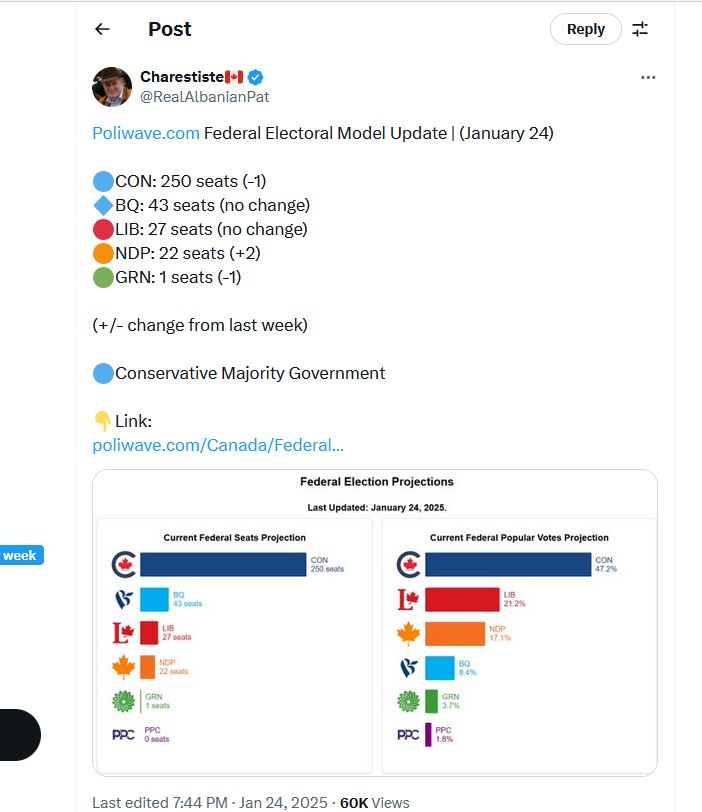
The take away for today: The easiest person to fool is yourself.
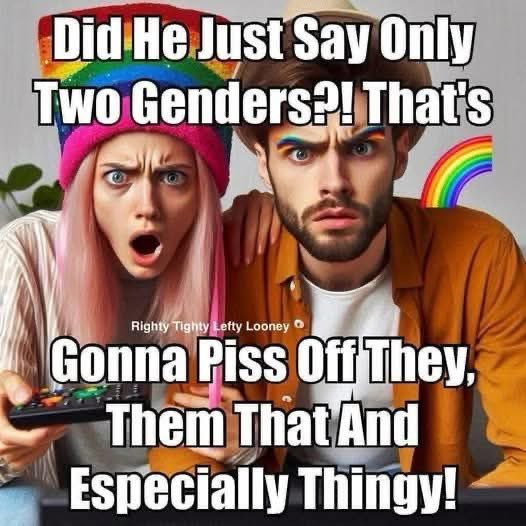
We really need to get away from using the term “gender” when we mean “sex”. Word confusion is part of the reason why we are in this sad state.
Let’s take a look at the three arguments and counter-arguments commonly used to when discussing Diversity policies within the framework of Diversity, Equity, and Inclusion (DEI):
Undermining Merit-Based Systems:
Explanation: Critics argue that diversity policies can lead to a focus on demographic representation over merit, potentially resulting in less qualified individuals being selected for positions. This perspective suggests that prioritizing diversity might mean overlooking the most competent candidates, thereby undermining the meritocratic principles that are supposed to drive organizational success and fairness.
Counterpoint: Proponents of DEI might argue that what’s often labeled as “merit” can be influenced by biases, where traditional metrics of merit do not account for systemic disadvantages some groups face. They propose that diversity initiatives aim to expand the pool of candidates, ensuring that merit is assessed within a broader, more equitable context.
Promoting Division and Resentment:
Explanation: There’s an argument that DEI policies can foster division by emphasizing differences rather than commonalities, leading to resentment among those who feel they are discriminated against or unfairly overlooked due to their demographic characteristics. This can create an “us vs. them” mentality, potentially fracturing team cohesion and morale.
Counterpoint: Supporters might counter that acknowledging and addressing differences is essential for true inclusion, promoting understanding rather than division. They argue that well-implemented DEI strategies educate, unite, and enrich workplace culture by celebrating diversity as a strength rather than a source of division.
Inefficiency and Reduced Performance:
Explanation: Some critics claim that diversity for its own sake can introduce inefficiencies. They suggest that integrating diverse perspectives might initially slow down decision-making processes due to the need for more discussion to reconcile differing viewpoints or cultural misunderstandings. This could be seen as a hindrance in fast-paced environments where quick, decisive action is valued.
Counterpoint: Advocates for diversity would argue that while there might be an initial adjustment period, the long-term benefits include more innovative solutions, better problem-solving, and resilience against groupthink. They cite studies showing that diverse teams can outperform homogeneous ones over time by leveraging a wider range of experiences and ideas.
These arguments are part of a broader, ongoing debate about the implementation and impact of DEI policies. Each point of view has its merits and criticisms, and the effectiveness of diversity policies can depend significantly on how they are executed within specific organizational contexts. The goal should be to critically assess both the challenges and benefits in pursuit of a balanced approach that truly enhances equity and inclusion.
 The Canadian Broadcasting Corporation











Ben Eastaugh and Chris Sternal-Johnson.
Religion. Politics. Life.
Solve ALL the Problems
Art, health, civilizations, photography, nature, books, recipes, etc.
Independent source for the top stories in worldwide gender identity news
LESBIAN SF & FANTASY WRITER, & ADVENTURER
herstory. poetry. recipes. rants.
Communications, politics, peace and justice
Transgender Teacher and Journalist
Conceptual spaces: politics, philosophy, art, literature, religion, cultural history
Loving, Growing, Being
A topnotch WordPress.com site
Life After an Emotionally Abusive Relationship
No product, no face paint. I am enough.
UNDER CONSTRUCTION
Observations and analysis on survival, love and struggle
the feminist exhibition space at the university of alberta
About gender, identity, parenting and containing multitudes
Spreading the dangerous disease of radical feminism
Not Afraid Of Virginia Woolf
The Evolution Will Not BeTelevised
writer, doctor, wearer of many hats
Teaching Artist/ Progressive Educator
Identifying as female since the dawn of time.
A blog by Helen Saxby
A blog in support of Helen Steel
Where media credibility has been reborn.
Memoirs of a Butch Lesbian
Radical Feminism Discourse
deconstructing identity and culture
Fighting For Female Liberation from Patriarchy
Politics, things that make you think, and recreational breaks
cranky. joyful. radical. funny. feminist.
Movement for the Abolition of Prostitution
These are the best links shared by people working with WordPress
Gender is the Problem, Not the Solution
Peak Trans and other feminist topics
if you don't like the news, make some of your own
Musing over important things. More questions than answers.
short commentaries, pretty pictures and strong opinions
gender-critical sex-negative intersectional radical feminism
 bleatmop
 Mystro
 The Arbourist


 Dead Wild Roses
Your opinions…