
You are currently browsing the tag archive for the ‘Activist Tactics’ tag.
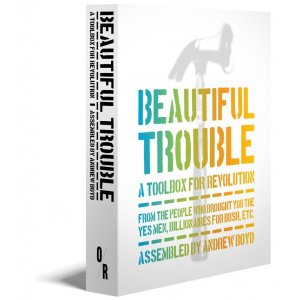
Beautiful Trouble is a public toolbox for creative activism: first a collaboratively assembled book, later an online repository, and now also a training ecosystem. Its pitch is not subtle. Movements don’t only need convictions; they need methods.
The core value of Beautiful Trouble is not that it “proves” anything about the morality of activism. The value is that it exposes a modern fact of politics: attention is terrain. If you want to understand contemporary protest, you have to understand how actions are designed to travel, how institutions are pushed into visible choices, and how audiences form conclusions with partial information.
The project’s structure supports that aim. It’s modular: tactics, principles, theories, and short case stories that can be mixed and reused. It describes itself as a kind of “pattern language,” and its licensing encourages adaptation. That makes it unusually legible as an object of civic study: it doesn’t hide the playbook.
What it optimizes for
Most people still think politics is mainly argument. It isn’t. Not anymore. It’s increasingly interpretation under time pressure.
A large share of the public will never read the policy memo, the injunction, or the investigative timeline. They will see a clip. They will inherit a caption. They will absorb a moral frame already installed. Beautiful Trouble is built for that environment. It treats activism as attention design: actions shaped to be seen, remembered, and shared.
One of its principles says the quiet part out loud: the decisive moment is often the target’s response. That is not inherently nefarious. It is a standard logic in asymmetric conflict. When you can’t move power directly, you provoke power into showing itself.
For media literacy, this yields a simple rule: some public actions are designed less to “state a grievance” than to produce a reaction that will be more persuasive than the grievance.
Three clusters worth understanding
The toolbox contains many tools, but three clusters matter for public comprehension because they recur across movements and because they interact strongly with journalism and social media.
1) Impersonation formats and “identity correction”
The toolbox includes tactics associated with hoaxes, spoof announcements, and “identity correction.” These actions usually aim to create a dilemma: if the target rejects the message, the target may look callous; if it accepts any part of it, the target concedes ground. Their success depends on speed. A claim that travels faster than verification can leave residue even after correction.
The neutral point is not “this is always unethical” or “this is always justified.” The point is functional: these tactics exploit a predictable weakness in information flow. Novelty beats confirmation. Moral satisfaction beats caution.
The reader’s defense is boring and effective: treat “too perfect” claims and “official-sounding” announcements as unverified until corroborated.
2) Media-jacking and reaction capture
Another cluster focuses on borrowing attention: hijacking an event, inserting into an opponent’s stage, or redirecting a news cycle. The target is forced into a choice: ignore the action and risk looking weak or indifferent; respond forcefully and risk producing the exact optics the activists want.
This is why the response becomes the payload. The goal is often to make the institution appear brittle, panicked, or oppressive, whether through its own errors or through selective presentation.
The media-literacy question here is straightforward: is the target reacting to a genuine threat, or to an engineered dilemma designed to force a visible response? Sometimes it’s both. Don’t let a viral clip collapse the distinction.
3) Framing and reframing as the main contest
The most consequential “tactic” is not a stunt. It is framing: assigning roles, values, and categories before evidence arrives. What counts as “violence”? What counts as “self-defense”? What counts as “harm”? What is “legitimate”?
Framing is unavoidable. Humans need categories. But because it is unavoidable, it can be weaponized. When framing succeeds, neutral description becomes socially costly. Even vocabulary starts to signal affiliation.
The most reliable defense is category discipline. Separate:
-
what happened (event),
-
what the rule was (policy),
-
what the law allows (legal),
-
what you think is right (moral),
-
what will work (strategic).
Framing tries to weld those together into one reflex. Citizens stay free by refusing that weld.
What this means for civic competence
Beautiful Trouble is a public, teachable catalog of activist methods. That is precisely why it matters. It’s a window into how modern movements think about leverage in an attention economy.
The neutral takeaway is not “activism is manipulation.” It is that contemporary politics runs on reaction, narrative compression, and low-context consumption. A public that wants to be hard to steer needs one habit: slow the tape when an event arrives already framed as a moral emergency.
That is media literacy now. Not cynicism. Pattern recognition. 🧠
References
-
Beautiful Trouble homepage / toolbox landing pages.
Beautiful Trouble principle page (“the real action is your target’s reaction”).
Beautiful Trouble tactic pages: Identity correction; Media-jacking.
-
OR Books listing for Beautiful Trouble: Pocket Edition.
-
ICNC resource entry describing Beautiful Trouble as book/toolbox/training resource.
-
Google Books bibliographic page for Beautiful Trouble: A Toolbox for Revolution.
Reading long threads on X sucks, so I asked Grok to combine a great threat into an “essential read” essay on what is happening in California.

The recent riots in Los Angeles, as depicted in a post by Wokal Distance on X (dated June 9, 2025), reveal a level of organization that challenges the notion of spontaneous public unrest. The accompanying images show protesters strategically using barricades made from traffic cones and benches, suggesting premeditated planning rather than an impromptu reaction to the Immigration and Customs Enforcement (ICE) raids. Wokal Distance argues that these riots are “designed to look chaotic to cover up the fact that they’re well funded, exceptionally organized, and carried out by well-trained activists using intelligent, highly developed tactics.” This perspective is supported by the visible preparation, including the distribution of shields and the use of coordinated tactics, which indicate a structured effort rather than a random outburst of anger.
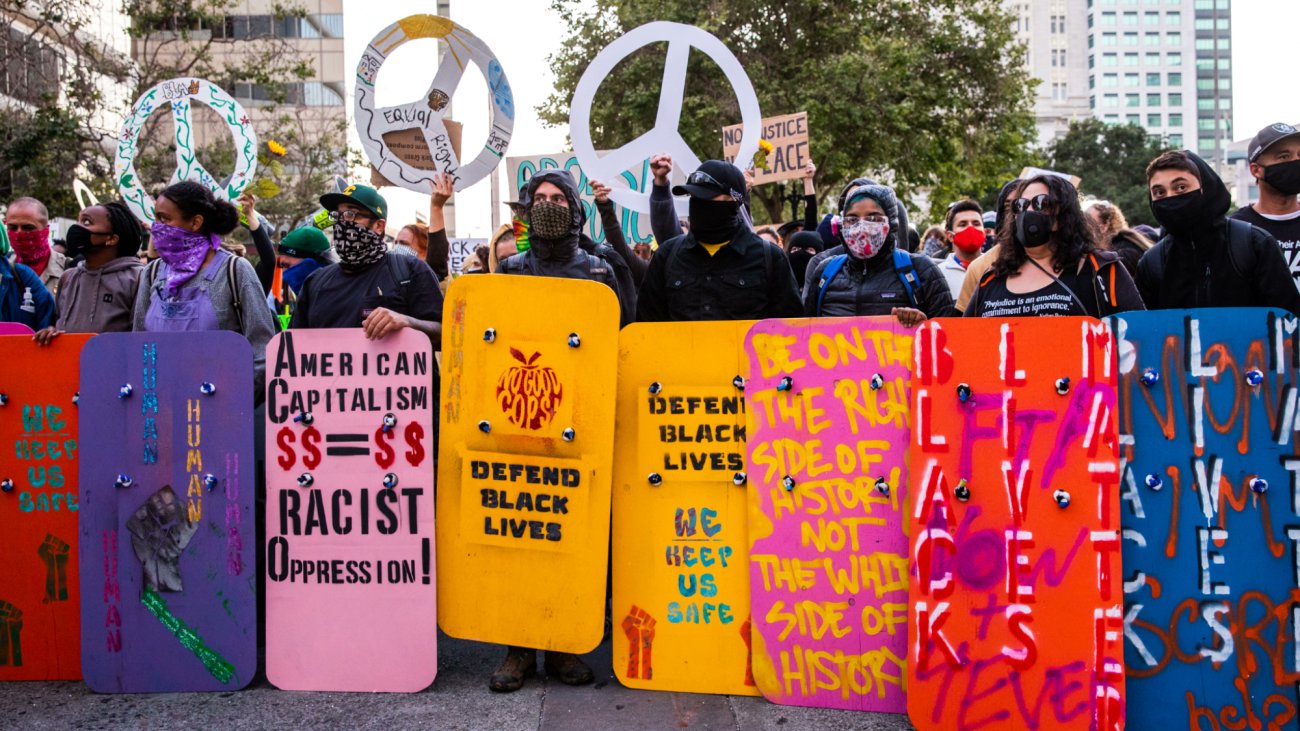
The tactical use of shields, as highlighted in the post, further underscores the organized nature of these protests. The images reveal protesters equipped with plywood shields disguised as cardboard signs, a method previously employed during the 2020 Black Lives Matter protests and the 2024 pro-Hamas riots. Wokal Distance notes that crafting each shield requires approximately three hours, a process that involves activists dedicating entire days to preparation. This level of commitment and resource allocation points to a well-funded operation, possibly linked to broader activist networks. The presence of a Home Depot bucket in the imagery suggests a centralized supply chain, reinforcing the idea that these materials are systematically distributed to participants, a tactic also observed in past organized protests.
Beyond physical preparation, the riots employ sophisticated strategies aimed at manipulating public perception and pressuring authorities. Wokal Distance outlines a “decision dilemma” tactic, where protesters create situations—such as blocking roads with barricades—that force authorities into no-win scenarios, regardless of their response. This is complemented by the “real action is your target’s reaction” approach, where any overreaction by police is leveraged to portray protesters as sympathetic underdogs. The inclusion of a baby in the protest, as mentioned, serves as a calculated move to heighten this sympathy, placing law enforcement in an impossible position where any use of force could be spun as an attack on the vulnerable. These tactics are designed to play to an external audience, shaping the narrative through media coverage and social platforms.
The theoretical foundation for these strategies, as explained by Wokal Distance, draws from radical academic works and activist training manuals, such as “Beautiful Trouble.” This book, co-authored by individuals with whom Wokal Distance has personal experience, provides a blueprint for using violence and disruption to gain political leverage. The post references historical examples, like the 2000 Summit of the Americas protests with their color-coded zones (Green, Yellow, Red) for varying levels of action, illustrating a long-standing tradition of planned escalation. This intellectual backing, combined with the practical execution seen in Los Angeles, suggests a movement informed by decades of activist theory and real-world application.
In conclusion, the Los Angeles riots, as analyzed by Wokal Distance, are far from spontaneous; they are a meticulously orchestrated campaign with roots in both funding and ideology. The involvement of well-trained activists, the use of pre-fabricated tools, and the application of strategic theories highlight a concerted effort to influence political outcomes. While the immediate trigger may be the ICE raids, the deeper structure points to broader networks, potentially involving figures like Neville Singham, as suggested in related threads by @DataRepublican. As the situation unfolds, understanding these dynamics is crucial for crafting an effective response that avoids the traps set by these calculated tactics.
**Reference:** Wokal Distance. (2025, June 9). [Post on X]. https://x.com/wokal_distance/status/1931953269775188449
 il
il











 bleatmop
 Mystro


 Dead Wild Roses
Your opinions…