
You are currently browsing the tag archive for the ‘Africa’ tag.
This is a lens shattering essay by Olúfẹ́mi Táíwò who asks us to put aside our current demarcations of African history – Precolonial, Colonial, and Post-Colonial because they obfuscate the rich tapestry that is the history of Africa.
“When ‘precolonial’ is used for describing African ideas, processes, institutions and practices, through time, it misrepresents them. When deployed to explain African experience and institutions, and characterise the logic of their evolution through history, it is worthless and theoretically vacuous. The concept of ‘precolonial’ anything hides, it never discloses; it obscures, it never illuminates; it does not aid understanding in any manner, shape or form.”
[…]
“Perhaps the most pernicious effect of deploying the various iterations of ‘precolonial’ is the way it marginalises ideas, especially philosophy, in Africa. Because ‘precolonial’ takes colonialism as the dividing line for organising ideas within its temporality and forces us to conceive of spaces relative to how they stand in the arrival and dispersal of colonialism in the continent, we, unwittingly for the most part, end up talking as if ideas, practices, processes and institutions can be understood within frameworks delineated by the precolonial, colonial and postcolonial schema. So, when we are looking at philosophy or modes of governance – to take two arbitrary examples – given our justifiable hostility to things colonial, we construe ‘precolonial’ as necessarily having nothing to do with the colonial, the latter understood as having ‘European’, ‘Western’ or ‘modern’ provenance while, simultaneously, interpreting it as ‘traditional’, ‘indigenous’ and the like.
The misdescription we identified above induces misinterpretation as well as a misrecognition of the genealogy and exchange of ideas, the evolution of institutions, and the identity of thinkers in the area. The problem is profound. Because of the primacy accorded to identity in the business of finding ideas and institutions that could be separated from anything European, Western or modern, African scholars for a long time contorted themselves into finding ‘African philosophy’ that was authentically ‘African’, were even willing to give up on the very term ‘philosophy’ and called their ideational production ‘African Traditional Thought’. The driving question was a matter of whether or not such ideas had been ‘contaminated’ by colonialism and its appurtenant practices, ideas, processes and institutions. When a scholar announces an interest in studying ‘Traditional African Political Thought’, in light of our analysis so far, the first question to ask is whether ‘traditional’ in this formulation has any room for evolution such that we can periodise ‘traditional thought’. Of course, I am assuming what should be obvious: is the thought involved the same throughout history, or were there changes induced by both exogenous and endogenous causes to it, and how are those changes to be understood? The other problem takes us to the next section of this discussion: the problem of facilely deploying an entire continent as a unit of analysis.
Let us recall the temporal framework adopted by Solanke above. Anyone reading his account is immediately enabled to situate his ideas about what transpired in medieval West Africa in relation to what was happening at other places in Africa, nay, the world, within the same temporal boundaries. This enables us to see how similar ideas found in different parts of our world do not have to be explained in terms of influences or common origins. That way, we would have no difficulty identifying African contributions to the global circuit of ideas in ancient times, in medieval times and right to the present. And such contributions would not be limited to so-called ‘authentic’, ‘indigenous’ or ‘traditional’ African fare. The tendency to treat Africa as a unit of analysis motivated by a wrong-headed approach, which took challenging Europe’s ignorant elucidations of African phenomena as the primary object, has issued in genealogies and narratives of intellectual history that bear no resemblance to how things really happened in history, or how African thinkers actually conducted themselves in the global circuit of ideas. This is why Africa hardly ever features in the annals of philosophy, and chronologies in philosophy anthologies do not carry African entries in frameworks demarcated by the Gregorian calendar.”
[…]
“All this would be invisible to the trinity of precolonial, colonial and postcolonial division of African history for organising states and ideas, practices and institutions, processes and thinkers and intellectual movements through time. Tossing the retrograde ‘precolonial’ epithet in the dustbin can bring only gains in expanding our knowledge, enriching our conceptual repertoires, and telling stories that are closer to the truth than the alternative.
It is time to say bye-bye to the idea of a ‘precolonial’ anything in our intellectual discourses respecting Africa.”
I recommend following the link and reading the entire essay, it’s a great read.
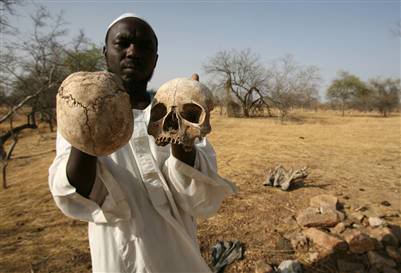
Not quite the World Cup Trophy.
I bet the last thing you heard from Africa was who won the World Cup. Al-Jazeera reports on the violence that has been ramping up in Sudan after peace talks were suspended.
“Nearly 400 people have been killed in recent clashes between the Sudanese army and Darfur’s main rebel group, according to Sudanese state media.
Most of the people killed – more than 300 – were members of the Justice and Equality Movement (Jem).”
The UN is on the scene but is sounds like they are fighting a 5 alarm fire with a squirt gun.
“United Nations peacekeepers in Darfur confirmed that there were at least two major clashes between the two sides.The under-equipped peacekeepers, with a mandate to cover an area the size of Spain, said they were also investigating reports of a third clash in Daba Tago, near the north Darfur settlement of Mellit.”
Yep, we can continue to ruin Afghanistan and Iraq to the tune of billions of dollars per day, and yet we cannot even keep more than a laughable presence in the Sudan. I am actually quite surprised as Sudan has OIL which makes it much more likely be on Western foreign policy radars.
“Darfur, which is about the same size as France, has been gripped by civil war since ethnic minority rebels rose up against the Arab-dominated government and their supporters in 2003.”
I guess we need to call Bono back into the fray, because it seems unless altruism and empathy are fronted by a rock band, things just do not get done.











 bleatmop
 Mystro


 Dead Wild Roses
Your opinions…