
You are currently browsing the tag archive for the ‘Analysis: The “51st State” Rhetoric and Canada’s 2025 Election’ tag.
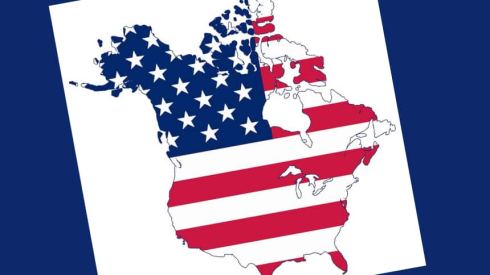
In late 2024 and early 2025, U.S. President Donald Trump repeatedly referred—sometimes jokingly, sometimes provocatively—to the idea of Canada becoming the “51st state.” These remarks reportedly began during conversations with then–Prime Minister Justin Trudeau and later appeared in public comments tied to trade disputes, tariffs, and economic leverage. Early reporting in both U.S. and Canadian outlets frequently described the remarks as characteristic of Trump’s hyperbolic negotiation style rather than as indicators of formal U.S. policy.
Canadian media coverage, however, quickly amplified the comments. Headlines and commentary increasingly framed the remarks as symbolic of American overreach or a potential threat to Canadian sovereignty. This framing coincided with heightened public attention to U.S.–Canada trade tensions and broader anxieties about economic dependence.
Following Trudeau’s resignation and Mark Carney’s rise to Liberal leadership, a snap federal election was called for April 28, 2025. At the outset of the campaign, the Liberals were trailing significantly in public polling. During the campaign, Liberal messaging increasingly emphasized the need to “stand up” to Trump-era pressure, warning that a Conservative government led by Pierre Poilievre could leave Canada exposed to U.S. demands or coercion. References to Trump’s “51st state” comments featured prominently in this broader narrative.
The election concluded with an unexpected Liberal minority victory, widely interpreted by commentators as influenced by a surge in nationalist sentiment and voter backlash against perceived American bullying. After the election, no U.S. policy moves or official statements suggested any genuine intent to pursue annexation, and Trump’s remarks continued to be linked primarily to trade pressure rather than territorial ambition.
Analytical Interpretation.
From an analytical standpoint, this sequence of events raises questions about how ambiguous external rhetoric can be transformed into domestic political leverage. Trump’s comments were provocative but informal; their political impact in Canada appears to have depended less on their substance than on how they were framed, repeated, and contextualized within a domestic campaign.
One interpretation is that Canadian media dynamics and electoral incentives interacted to elevate a symbolic remark into a perceived existential issue. In this reading, uncertainty itself became politically useful: the lack of a clear U.S. position allowed competing narratives to flourish, some of which emphasized worst-case scenarios rather than probable outcomes.
Another, more charitable interpretation is that heightened sensitivity to sovereignty concerns was a rational response to Trump’s unpredictability. Even without formal policy intent, critics argue, repeated rhetorical pressure from a powerful neighbor can legitimately influence voter behavior and campaign strategy.
A third interpretation lies between these poles: that while no annexation threat existed, the rhetoric nonetheless provided a mobilizing frame that shifted attention away from domestic issues such as housing affordability, inflation, and economic stagnation. Whether this constituted deliberate fear-manufacturing or opportunistic narrative adaptation is ultimately a matter of judgment rather than documentation.
Inviting the Reader’s Conclusion
What is clear is that the “51st state” rhetoric had political consequences in Canada despite the absence of any corresponding policy action. Whether those consequences reflect justified caution, media amplification, strategic political framing, or some combination of all three remains open to interpretation.
Readers may reasonably conclude that the episode demonstrates how modern democratic politics often operate less on concrete policy threats than on perceived risk shaped by narrative repetition. Others may see it as a case study in responsible vigilance toward an erratic ally. The available evidence supports multiple readings—and the distinction between them depends less on disputed facts than on how one interprets political incentives and media behavior in high-stakes elections.
Selected Sources
BBC News – Canadian PM reveals Trump brought up ‘51st state’ on March call (April 2025)
The Guardian – Trump’s chaotic threats won Mark Carney the Canadian election (April 2025)
The New York Times – On Canada’s Election Day, Trump Repeats ‘51st State’ Threat (April 2025)
CBC News – Carney says Trump raised ‘51st state’ during their call (April 2025)
CBS News – Canada’s Liberal Party wins election in turnaround seen as reaction to Trump threats (April 2025)
Wikipedia – 2025 Canadian federal election (accessed January 2026)











 bleatmop
 Mystro
 The Arbourist


 Dead Wild Roses
Your opinions…