
You are currently browsing the tag archive for the ‘Atheism’ tag.
 Responding to criticism and arguing coherently are the hallmarks of reasonable, mature debate. Browsing the articles on Alternet my attention was drawn to the article that shares the same moniker as this post, minus the question mark. I was hoping for some meaty, thought-provoking arguments by Scofield. I was disappointed. The 5 points seem to be weak caricatures of common atheist arguments, and if they can rebutted by the relative small fry of the atheist community like me, they most certainly do not hold much weight.
5. Liberal and Moderate Religion Justifies Religious Extremism
“Sam Harris states that moderates are “in large part responsible for the religious conflict in our world” and “religious tolerance–born of the notion that every human being should be free to believe whatever he wants about God–is one of the principal forces driving us toward the abyss.” And Richard Dawkins states, “The teachings of ‘moderate’ religion, though not extremist in themselves, are an open invitation to extremism.” Christopher Hitchens has called liberation theology “sinister nonsense” and compared the liberal Unitarian tradition to rats and vermin.
The problem with this line of thinking is that it leads to some unwanted logical conclusions when applied equally to other ideas. It is hypocritical to selectively apply the principle where it suits one’s needs but not elsewhere.”
“We can ask whether or not all liberal and moderate expressions of something are responsible for their most extreme forms. Are the people who casually smoke marijuana in any way responsible for the death of someone involved in a violent heroin drug trade? Is a social drinker of alcohol creating the environment that leads to alcoholism?” Is a pediatrician responsible for Nazi medical experiments simply because he or she participates in the field of medicine? How about politics? Is a liberal democracy responsible for forms of government such as totalitarianism or fascism? […]
“[…] the more rational and tolerant uses of science, religion, medicine or government cannot be blamed for the destructive and harmful uses of them.”
Sam Harris speaks about this idea of the moderately religious supporting the radical religious in a very case. It is not a generalization that makes sense to apply to other situations. The idea that religious moderates facilitate the radical wings of their religion is different than the examples Scofield uses. The difference begins with the idea that there is an equivalency based in religion that does not exist in the other examples listed. The equivalency is this: Religious moderates and radicals use the same play-book to express their beliefs.
This leads to Islam claiming to be the religion of “peace” while claiming to do God’s work in suicide bombings, or the christian faith in both justifying and arguing against slavery using passages from the bible. It is this salient point that makes Harris’s argument work while exposing the false equivalence of what Scofield is attempting to do.
Does social drinking set the environment for the abuse of alcohol, it certainly can, but it does not claim to justify destructive actions caused by people who take drinking to the extreme. Social drinkers do not tacitly condone the irresponsible actions of others; it is rather the opposite, if responsible people are around, overindulgence is generally frowned upon. I have never once seen a “please consume responsibly” warning on a religious text or commercial.
I’d go further with examples, but there really is no point because the analogies Scofield draws are incongruous with reality. Science, when still performed as science adheres closely with rationality whether you are a moderate believer in science or a radical one, that aim remains the same, the search for testable, falsifiable, truths about the physical universe we inhabit.
4. Religion Requires a Belief in a Supernatural God
“I understand why anti-religious atheists are so reluctant to accept the fact that being religious doesn’t mean belief in the supernatural. The simplistic and convenient myth they’ve constructed would be shattered.”
Well, there are exceptions to the rule. That is unsurprising. The problem is that the religious that are currently infecting North American currently *do* require a belief in the supernatural, or at the very least magic. Scofield’s fourth point is a a red herring of sorts.
3. Religion Causes Bad Behavior
 It is nice when you can find some who speaks so clearly on a topic. I recommend you read the entire article by Greta Christina, but these are her concluding words. Her post is a response to William Lane Craig an educated religious apologist who in his writing and debates defends the christian religion against rationality and reality.
“It’s funny. One of the most common pieces of bigotry aimed at atheism is that it doesn’t provide any basis for morality. It’s widely assumed that without religion — without moral teachings from religious traditions, and without fear of eternal punishment and desire for eternal reward — people would behave entirely selfishly, with no concern for others. And atheists are commonly accused of moral relativism: of thinking that there are no fundamental moral principles, and that all morality can be adapted to suit the needs of the moment.
But it isn’t atheists who are saying, “Well, sure, genocide seems wrong… but under some circumstances, it actually makes a certain amount of sense.” It isn’t atheists who are saying, “Well, sure, infanticide seems wrong… but looked at in a certain light, it really isn’t all that bad.” It isn’t atheists who are prioritizing an attachment to an ancient ideology over the clearest moral principles one can imagine: the principle that entire races ought not to be systematically exterminated, and the principle that children ought not to be slaughtered.
Human beings have intrinsic compassion. We have a sense of justice. We have feelings of revulsion and rage when we see others harmed. We have a desire to help create a livable world. We have a willingness to make personal sacrifices — sometimes great sacrifices — to help others in need. And contrary to what Craig and many other Christians think, these moral emotions don’t derive from the Bible, and don’t require belief in God. They’re taught by virtually every religion and every society, and atheists feel them every bit as much as believers. Humans are a social species, and these emotions and principles evolved because they help members of a social species survive and reproduce. (Other social species seem to have some or all of these moral emotions as well.)
But our compassion and justice, our altruism and moral revulsion, can be twisted. They can be stunted. They can be denied, ignored, shoved to the back burner, rationalized away. They can be contorted to the point where we’re saying that black is white, war is peace, and the most blatant evil is actually goodness if you squint your eyes just right. They can be contorted to the point where we’re saying that genocide is okay because everyone gets what they deserve in the afterlife, and that infanticide is morally necessary to teach a lesson about the evils of murdering children.
And religion is Exhibit A in how this can happen.”
Some of the barriers to reasonable debate and argument are showcased in this darkmatter 2525 video. It is a touch on the long side, but necessarily so because the double standards are so darn numerous.
At least we can be happy, the Evil Atheists usually have better hair.
One of the more brilliant minds of youtube, Thunderfoot dispels the notion that Atheism and Atheists are a depressed, hopeless cause. I share many of his insights about living without a sky-daddy and thought it would be nice to share his thoughts with you.
I’m glad the Globe and Mail fired Rick Salutin because we certainly need more of the risible god-bagging apologetics and whinging over the evils of ‘strident Atheists’. Irshad Manji grapples with these great problems(?) with considerable aplomb as she is a card carrying member of the religiously addled, reality challenged sect. Her first paragraph does incite some hope, maybe this piece will not be a festival of banal accommodationalist drivel.
“In this, the season of giving, I propose we give novelty a chance – novelty, that is, in the debate between atheists and people of faith.”
Ooh… so far so good…
“Let’s move beyond the stale polemics that insult everybody’s intelligence.”
*sigh* It is those humourless irascible Atheists and their tone! Let us just be clear here about who has the problem and who does not.
 Rational people inform their decisions based on evidence that is available to them. Informing your decision making process on mythology and declared ‘truth’ is the path that wends distinctly away from any sort of rationally coherent underpinning. Having a distinct preference for reality based decision making, as opposed to “my sky daddy says so”, is not a particularly strident position, but rather an overreaction on the part of the deluded when you point to their pet mythology and magic men and call ‘bullshit’. Sorry believers, but without evidence it sounds like you are arguing for the existence Unicorns and Santa Claus. Rational people find it hard to take mystical arguments like this very seriously.
We must soldier on though, and hit the low-points of this particular bit of whinging about the evils of atheism.
“I’m riveted by a new biography of Dietrich Bonhoeffer, the German Lutheran pastor who famously opposed the Nazi regime – and was hanged for his role in a plot to assassinate Adolf Hitler. Bonhoeffer grew up in a household that valued science, logic and independent thinking. A habit of asking questions helped him pierce Nazi orthodoxy early on, and his vascular faith motivated him to do something about it. Bottom line: His moral courage came from a combination of reason and religion.”
Citation needed. Did his moral thinking explicitly come from a combination of reason and religion? The qualities mentioned, valuing science, logic and independent thinking are atypical of those encouraged by religious institutions. Of course, he could be the insider and saw religion for the hokey sham that it is and decided to rely on reason instead of magic to inform his decision making processes.
“So it’s shallow to suggest we must choose between God and progress.”
The world is 14 Billion(ish) years old. The world is 6,000 years old. One statement is based of fact, the other… well, not so much. Is it important to note that even a little magic in one’s thought processes can have deleterious effects. Ask those who lecture on the evils of ‘refined sugar‘ or those who believe you can make happy water; see what a little magic in your thinking can do for you? So, the divide between rational and religious influenced thought is a little deeper than the “shallow” pond Manji suggests.
“But if it’s entertainment value we’re after, we should know that the “new” atheists are only rehashing what’s already been said umpteen times. In the late 1700s […]”
Unfortunately the delusion known as religion has formidable staying power, praying to the sky-daddy makes people feel good. Furthermore, repeating a fact when faced with irrational nonsense is not necessarily a bad thing. The religious bullshit has not changed over the centuries (more handwaving granted, but still no proof), so why should the rational response change? Ahh, but instead of talking about how transparently false religion is, lets project the evil that religion is known for onto Atheism:
“[…] historian Edward Gibbons – a luminary of the British Enlightenment and a consummate skeptic – observed that the “bigotry” of the anti-God squad mimics the fanaticism of churchmen.”
Oh ho! Checkmate Atheists! Your religion dedication to rationality is just as bad as our belief in Jeebus (allah,etc, insert your fairytale here, not to mention our fallacious friend the Tu Quoque argument)! I wonder when apologists will stop comparing non believers to the deluded when the real issue is the inherent irrationality of religious belief.
But apparently, I am being to harsh on Ms.Manji as she advocates a “different” debate. It must be my stridency, inherent in Atheism, showing through.
“Today’s conversation can be different. In January of 2009, novelist Salman Rushdie and I had a public discussion in New York to mark the 20th anniversary of Ayatollah Ruhollah Khomaini’s death warrant against him. Mr. Rushdie and I thoroughly agreed on the need to defend freedom of thought, conscience and expression.
Toward the end of our exchange, he took a jab at my belief in God. I chuckled and retorted that the existence of successful atheists like him is proof positive that a merciful God exists. Mr. Rushdie laughed affectionately. Clearly, this debate can be had with deep appreciation of the other.”
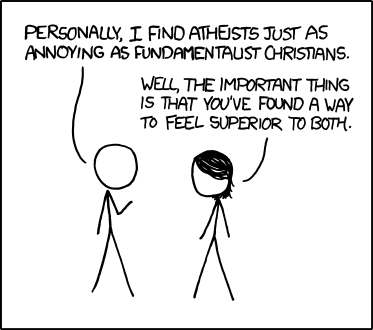
From xkcd
Wow. Proof positive a merciful god exists. Oh wait, no proof here, just anecdotal evidence that a noted Atheist when confronted with a dyed in the wool believer, just does not want to go there, again, because the bullshit is the same, just coming from a different mouth. Dragging people up Mount Rationality is a difficult, often frustrating process and frankly, until people see the delusion for themselves it is often not worth a rational persons time and effort explaining that god, like unicorns and santa (most likely) do not exist.
“Here’s my humble contribution: It may be that atheists themselves are inadvertently affirming the existence of a loving God. Lao Tzu, the ancient Chinese sage, noted that a great leader makes his followers believe they’ve led themselves. In that sense, a scientist, humanist or atheist who chalks up all progress to the human mind could be showing what an empowering and effective leader God actually is.”
I just vomited up my corpus callosum and it is yelling at me for feeding it such inane batshittery.
It could be, also Ms.Manji, that these people inspired by Reason and the quest for knowledge did some remarkable things. No god or magic required. Of course you could defend your position on how awesome a leader god is by explaining how righteous and purposeful smallpox, AIDS, hell even malaria, are without resorting mysticism. We’ll just leave the floor open for your response on that one Ms.Manji, but please watch your tone for stridency.
“No doubt, this idea will come off as insane to some. But if so, why is it crazy? As a person of faith, I’m used to being challenged by atheists – among them, Richard Dawkins, who heckled me from the audience when I spoke at Oxford University. “
Good on Dawkins for speaking up when you bring your edifice of irrationality to the table and attempt to pass it off as a notion that deserves credibility. Magic and myth need to be called out each time they attempt to stick their head into goings on in the real word. Hopefully Ms.Manji, you learned something from Dawkins’ line of questioning, although your Op-Ed suggests quite another conclusion.
What Atheism can be – a Lack of Belief in gods.
It is troublesome to have the faith compare your views to theirs, when clearly they are not in the same category. Sam Harris addresses this and the often quoted “evil three” of Atheism Hitler, Stalin and Pol Pot. He does a fine job in dismantling these clunky canards.
Enjoy!











 bleatmop
 Mystro


 Dead Wild Roses
Your opinions…