
You are currently browsing the tag archive for the ‘Capitalism’ tag.
“95 percent of economics is common sense deliberately made complicated.” – Ha-Joon Chang
Thing One. There is really no such thing as a free market.
Thing Two. Companies should not be run in the interest of their owners.
Thing Three. Most people in rich countries get paid more than they should.
Thing Four. The washing machine has changed the world more than the internet.
Thing Five. Assume the worst about people, and you get the worst.
Thing Six. Greater macroeconomic stability has not made the world economy more stable.
Thing Seven. Free-market policies rarely make poor countries richer.
Thing Eight. Capital has a nationality.
Thing Nine. We do not live in a post-industrial age.
Thing Ten. The US does not have the highest living standard in the world.
Thing Eleven. Africa is not destined for under-development.
Thing Twelve. Government can pick winners.
Thing Thirteen. Making rich people richer doesn’t make the rest of us richer.
Thing Fourteen. US managers are over-priced.
Thing Fifteen. People in poor countries are more entrepreneurial than people in rich countries.
Thing Sixteen. We are not smart enough to leave things to the market.
Thing Seventeen. More education in itself is not going to make a country richer.
Thing Eighteen. What is good for the General Motors is not necessarily good for the US.
Thing Nineteen. Despite the fall of Communism, we are still living in planned economies.
Thing Twenty. Equality of opportunities is unequal.
Thing Twenty-one. Big government makes people more, not less, open to changes.
Thing Twenty-two. Financial markets need to become less, not more, efficient.
Thing Twenty-three. Good economic policy does not require good economists.
The capitalist system is not working, despite what elite opinion says. Starting with these points is a great place to look into our perceptions of what Capitalism is.
Is this a Craps game we should play?
“The consequences of the Japanese earthquake – especially the ongoing crisis at the Fukushima nuclear power plant – resonate grimly for observers of the American financial crash that precipitated the Great Recession. Both events provide stark lessons about risks, and about how badly markets and societies can manage them.
 Of course, in one sense, there is no comparison between the tragedy of the earthquake – which has left more than 25,000 people dead or missing – and the financial crisis, to which no such acute physical suffering can be attributed. But when it comes to the nuclear meltdown at Fukushima, there is a common theme in the two events.
Experts in both the nuclear and finance industries assured us that new technology had all but eliminated the risk of catastrophe. Events proved them wrong: not only did the risks exist, but their consequences were so enormous that they easily erased all the supposed benefits of the systems that industry leaders promoted.”
The elites who are insulated from many of the problems they cause, continue to promote ideas and systems that are destructive to the people and very societies that allow them to become wealthy.
“Before the Great Recession, America’s economic gurus – from the head of the Federal Reserve to the titans of finance – boasted that we had learned to master risk. “Innovative” financial instruments such as derivatives and credit-default swaps enabled the distribution of risk throughout the economy. We now know that they deluded not only the rest of society, but even themselves.”
Not a bad description of the state of the financial sector in North America these days. Deluded, self-absorbed and self interested individuals dedicated to getting their profits at any cost.
“These wizards of finance, it turned out, didn’t understand the intricacies of risk, let alone the dangers posed by “fat-tail distributions”- a statistical term for rare events with huge consequences, sometimes called “black swans”. Events that were supposed to happen once in a century – or even once in the lifetime of the universe – seemed to happen every ten years. Worse, not only was the frequency of these events vastly underestimated; so was the astronomical damage they would cause – something like the meltdowns that keep dogging the nuclear industry.”
Yep, with less regulation and less government interventions the cycles become even more unstable and prone to catastrophic failure.
“Research in economics and psychology helps us understand why we do such a bad job in managing these risks. We have little empirical basis for judging rare events, so it is difficult to arrive at good estimates. In such circumstances, more than wishful thinking can come into play: we might have few incentives to think hard at all. On the contrary, when others bear the costs of mistakes, the incentives favour self-delusion. A system that socialises losses and privatises gains is doomed to mismanage risk.”
Ah, but socialism for the rich is GOOD. It is what the keeps the country running, it is the heroic investment/business class that is building society… except, while on its never-ending quest for profit, it is actively destroying the fundamental supports and institutions required to keep society running.
“Indeed, the entire financial sector was rife with agency problems and externalities. Ratings agencies had incentives to give good ratings to the high-risk securities produced by the investment banks that were paying them. Mortgage originators bore no consequences for their irresponsibility, and even those who engaged in predatory lending or created and marketed securities that were designed to lose did so in ways that insulated them from civil and criminal prosecution.”
For politicians who preach responsibility, it would seem that the message is only for the poor who have to continually tighten their belts, while the message of irresponsibility aka the status quo, is maintained for the financial sector.
“This brings us to the next question: are there other “black swan” events waiting to happen? Unfortunately, some of the really big risks that we face today are most likely not even rare events. The good news is that such risks can be controlled at little or no cost. The bad news is that doing so faces strong political opposition – for there are people who profit from the status quo.
We have seen two of the big risks in recent years, but have done little to bring them under control. By some accounts, how the last crisis was managed may have increased the risk of a future financial meltdown.”
Oh hey you really screwed up, just keep doing what you’re doing we’ll let the public take care of the herculean pile of debt you amassed while shuffling your paper around. And yet at the same time conservative politicians preach austerity for poor people and deride people on welfare for ‘abusing the system’. The irony is galling.
“Too-big-to fail banks, and the markets in which they participate, now know that they can expect to be bailed out if they get into trouble. As a result of this “moral hazard”, these banks can borrow on favourable terms, giving them a competitive advantage based not on superior performance but on political strength. While some of the excesses in risk-taking have been curbed, predatory lending and unregulated trading in obscure over-the-counter derivatives continue. Incentive structures that encourage excess risk-taking remain virtually unchanged.
So, too, while Germany has shut down its older nuclear reactors, in the US and elsewhere, even plants that have the same flawed design as Fukushima continue to operate. The nuclear industry’s very existence is dependent on hidden public subsidies – costs borne by society in the event of nuclear disaster, as well as the costs of the still-unmanaged disposal of nuclear waste. So much for unfettered capitalism!”
Ah yes, externalities, the Capitalists best friend. See the concept of private profits and public risk…gambling with other peoples money is always so much easier. Given the course of our society, I think a serious reevaluation of the concept of limited liability is in order.
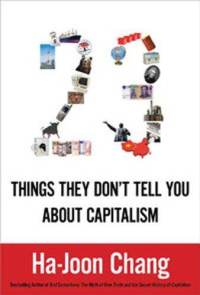 As I am often told by my free market indoctrinated friends the market will solve societies problems, if….(insert the big whingy diatribe about government interfering here) it was just left to its own devices.
A sample of the pap I usually hear, coherently summarized by Mr.Chang and his book I happen to be reading right now.
“We should leave markets alone, because, essentially, market participants know what they are doing – that is, they are rational. Since individuals (and firms as collections of individuals who share the same interests) have their own best interests in mind and since they know their circumstances best, attempts by outsiders, especially the governement, to restrict freedom of their actions can only produce inferior results. It is presumptuous of any government to prevent market agents from doing things they find profitable or force them to to do things they do not want to do, when it possesses inferior information.
What they don’t tell you…
People do not necessarily know what they are doing, because our ability to comprehend even matters that concern us directly is limited – or, in the jargon, we have “bounded rationality”. The world is very complex and our ability to deal with it is severely limited. Therefore, we need to, and usually do, deliberately restrict our freedom of choice in order to reduce the complexity of the problems we face. Often, government regulation works, especially in complex areas like the modern financial market, not becaues the government has superior knowledge but because it restricts choices and thus the complexity of the problems at hand, thereby reducing the possibility that things may go wrong.”
-Excerpt from 23 Things they don’t tell you about Capitalism – Ha – Joon Chang. pp. 168-169
People always seem to forget that the rational self maximizing actors they talk about in economics text books are merely theoretical constructions and do not figure prominently in the real world. We are neither rational nor do we have complete information when it comes to making economic decisions. Therefore, as Mr. Chang implies government regulation can be a good, even helpful thing, when it comes to market conditions.

Wonder why things are generally going as they are? Start here.
This short video is entitled the Crisis of Capitalism, and depicts the recent history of what has happened over here in the Western world. I think it speaks correctly on several of the shortcomings of the capitalist system and is well worth your 10 minuets your time.
 Media Lens offers a valuable service of presenting the news that does not make the front page of the newspapers (or even the back page) and providing analysis and edification that does not come with the mandatory business class prism. This excerpt can be found on their web page.
Beyond Corporate Propaganda
In his latest excellent book, ‘Beyond the Profits System’, the British economist Harry Shutt observes that one of the most striking features of the financial crisis has been:
“… the uniformly superficial nature of the analysis of its causes presented by mainstream observers, whether government officials, academics or business representatives. Thus it is commonly stated that the crisis was caused by a combination of imprudent investment by bankers and others […] and unduly lax official regulation and supervision of markets. Yet the obvious question begged by such explanations – of how or why such a dysfunctional climate came to be created – is never addressed in any serious fashion.”
Shutt continues:
“The inescapable conclusion […] is that the crisis was the product of a conscious process of facilitating ever greater risk of massive systemic failure.” (Harry Shutt, ‘Beyond the Profits System: Possibilities for a Post-Capitalist Era’, Zed Books, London, 2010, p.6)
In several books and articles, David Harvey, a social theorist at the City University of New York, has cogently written of how capitalism has shaped western society, risking and even destroying nations, populations and ecosystems. Not only are periodic episodes of “meltdown” inevitable, but they are crucial to capitalism’s very survival. The essence of capitalism is self-interest; and any talk of reforming it through regulation or by imposing morality – a kinder, gentler capitalism – is both irrational and deceitful.
The bankruptcy of investment bank Lehman Brothers in September 2008 triggered the latest crisis of capitalism. Drastic action was required to save the system. And so, observes Harvey, a few US Treasury officials and bankers including the Treasury Secretary himself, a past president of Goldman Sachs and the present Chief Executive of Goldman, “emerged from a conference room with a three-page document demanding a $700 billion bail-out of the banking system while threatening Armageddon in the markets.”
Harvey continues:
“It seemed like Wall Street had launched a financial coup against the government and the people of the
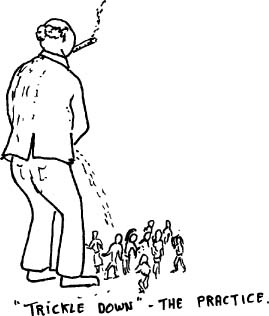
Things they do not teach you in Economics 101.
United States. A few weeks later, with caveats here and there and a lot of rhetoric, Congress and then President George Bush caved in and the money was sent flooding off, without any controls whatsoever, to all those financial institutions deemed ‘too big to fail’.” (David Harvey, ‘The Enigma of Capital: And the Crises of Capitalism’, Profile Books, London, 2010, p. 5)
Shutt translates “too big to fail”, that over-used defence employed by capitalists and their cheerleaders, as meaning that a tiny super-wealthy clique recognised that they risked losing vast fortunes if the markets were allowed to take their course free of intervention from the state. Wholesale nationalisation of insolvent banks would have posed an existential threat to elite power; or even led to the collapse of the capitalist profits system in its entirety. Rather than accept such a fate, rich investors tried to ensure that their toxic assets be “largely transferred to the state, thereby adding unimaginable sums – officially estimated at $18 trillion world-wide – to already excessive public debt.” (Shutt, op. cit., p. 36)
As ever, the public were made to pay the price for private greed. In simple terms: it’s socialism for the rich, and capitalism for the rest of us.”
Make no mistake, capitalism for the rest of us, is no happy place.











 bleatmop
 Mystro
 The Arbourist


 Dead Wild Roses
Your opinions…