
You are currently browsing the tag archive for the ‘Chris Hedges’ tag.
The points of view put forward here represent the thinking of an individual that does not believe in the political process, and one that believes that change can come from inside the process. Fascinating stuff.
CHRIS HEDGES: Well, that’s precisely what we’re trying to do. There is a point where you have to—do I want to keep quoting Ralph?—but where you have to draw a line in the sand. And that’s part of the problem with the left, is we haven’t.
I covered the war in Yugoslavia, and I find many parallels between what’s happening in the United States and what happened with the breakdown of Yugoslavia. What is it that caused this country to disintegrate? It wasn’t ancient ethnic hatreds. It was the economic meltdown of Yugoslavia and a bankrupt liberal establishment that, after the death of Tito, until 1989 or 1990, spoke in the language of democracy, but proved ineffectual in terms of dealing with the plight of working men and women who were cast out of state factories, huge unemployment and, finally, hyperinflation.
And the fact is that these neoliberal policies, which the Democratic Party is one of the engines for, have created this right-wing fascialism. You can go back—this proto-fascism. You can go back and look at the Weimar, and it—Republic—was very much the same. So it’s completely counterintuitive. Of course I find Trump a vile and disturbing and disgusting figure, but I don’t believe that voting for the Democratic establishment—and remember that this—the two insurgencies, both within the Republican Party and the—were against figures like Hillary Clinton, who spoke in that traditional feel-your-pain language of liberalism, while assiduously serving corporate power and selling out working men and women. And they see through the con, they see through the game.
I don’t actually think Bernie Sanders educated the public. In fact, Bernie Sanders spoke for the first time as a political candidate about the reality the public was experiencing, because even Barack Obama, in his State of the Union address, was talking about economic recovery, and everything was wonderful, and people know that it’s not. And when you dispossess—
ROBERT REICH: Well, let me—let me—
CHRIS HEDGES: Let me just finish. Let me finish. When you dispossess that segment, as large as we have—half the country now lives in virtual poverty—and you continue to essentially run a government that’s been seized by a cabal, in this case, corporate, which uses all of the machinery of government for their own enrichment and their own further empowerment at the expense of the rest of the citizenry, people finally react. And that is how you get fascism. That is what history has told us. And to sit by—every time, Robert, you speak, you do exactly what Trump does, which is fear, fear, fear, fear, fear. And the fact that we are going to build some kind of—
ROBERT REICH: Well, let me—let me try to—
CHRIS HEDGES: —amorphous movement after Hillary Clinton—it’s just not they way it works.
ROBERT REICH: Let me try to inject—let me—let me try to inject—
AMY GOODMAN: Former Clinton Labor Secretary Robert Reich?
ROBERT REICH: Let me try to inject some hope in here, in this discussion, rather than fear. I’ve been traveling around the country for the last two years, trying to talk to tea partiers and conservatives and many people who are probably going to vote for Donald Trump, to try to understand what it is that they are doing and how they view America and why they’re acting in ways that are so obviously against their self-interest, both economic self-interest and other self-interest. And here’s the interesting thing I found.
This great antiestablishment wave that is occurring both on the left and the right has a great overlap, if you will, and that overlap is a deep contempt for what many people on the right are calling crony capitalism—in fact, many people on the left have called crony capitalism. And those people on the right, many, many working people, they’re not all white. Many of them are. Many of them are working-class. Many of them have suffered from trade and technological displacement and a government that is really turning its back on them, they feel—and to some extent, they’re right. Many of them feel as angry about the current system and about corporate welfare and about big money in politics as many of us on the progressive side do.
Now, if it is possible to have a multiracial, multiethnic coalition of the bottom 90 percent that is ready to fight to get big money out of politics, for more equality, for a system that is not rigged against average working people, where there are not going to be all of these redistributions upward from those of us who have paychecks—and we don’t even realize that larger and larger portions of those paychecks are going to big industries, conglomerates, concentrated industries that have great market power, because it’s all hidden from view—well, the more coalition building we can do, from right to left, multiethnic, multiracial, left and right, to build a movement to take back our economy and to take back our democracy, that is—
[…]
CHRIS HEDGES: I don’t think it makes any difference. The TPP is going to go through, whether it’s Donald Trump or Hillary Clinton. Endless war is going to be continued, whether it’s Trump or Clinton. We’re not going to get our privacy back, whether it’s under Clinton or Trump. The idea that, at this point, the figure in the executive branch exercises that much power, given the power of the war industry and Wall Street, is a myth. The fact is—
Can a compromised system produce results that benefit the non-elite portions of society. I’m thinking no.
Chris Hedges occasionally has some good ideas when it comes to the American body politic. Consider what we are seeing on the news, and is it really that far off from what is being stated here?
“As Arendt noted, the fascist and communist movements in Europe in the 1930s “… recruited their members from this mass of apparently indifferent people whom all other parties had given up as too apathetic or too stupid for their attention. The result was that the majority of their membership consisted of people who had never before appeared on the political scene. This permitted the introduction of entirely new methods into political propaganda, and indifference to the arguments of political opponents; these movements not only placed themselves outside and against the party system as a whole, they found a membership that had never been reached, never been ‘spoiled’ by the party system. Therefore they did not need to refute opposing arguments and consistently preferred methods which ended in death rather than persuasion, which spelled terror rather than conviction. They presented disagreements as invariably originating in deep natural, social, or psychological sources beyond the control of the individual and therefore beyond the control of reason. This would have been a shortcoming only if they had sincerely entered into competition with either parties; it was not if they were sure of dealing with people who had reason to be equally hostile to all parties.”
Fascism is aided and advanced by the apathy of those who are tired of being conned and lied to by a bankrupt liberal establishment, whose only reason to vote for a politician or support a political party is to elect the least worst. This, for many voters, is the best Clinton can offer.
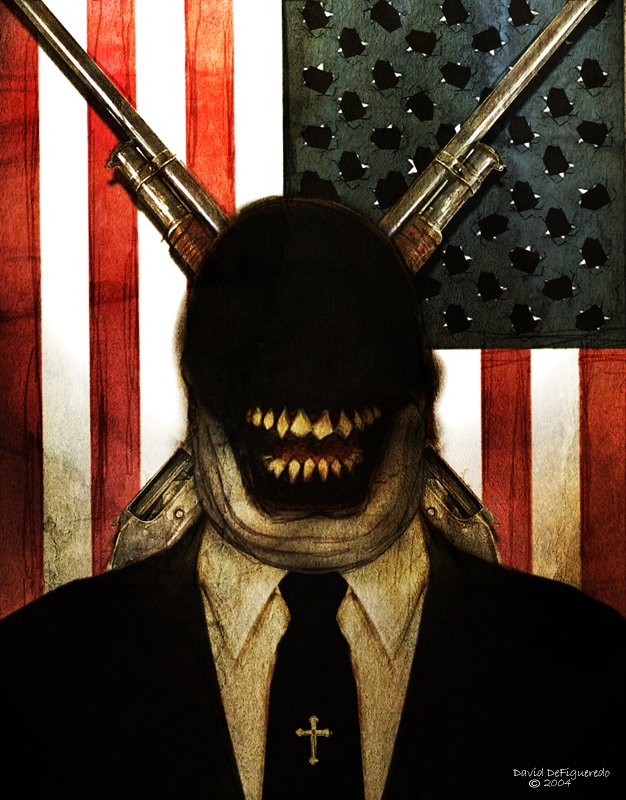
Fascism expresses itself in familiar and comforting national and religious symbols, which is why it comes in various varieties and forms. Italian fascism, which looked back to the glory of the Roman Empire, for example, never shared the Nazis’ love of Teutonic and Nordic myths. American fascism too will reach back to traditional patriotic symbols, narratives and beliefs.”
[…]
“There is only one way left to blunt the yearning for fascism coalescing around Trump. It is to build, as fast as possible, movements or parties that declare war on corporate power, engage in sustained acts of civil disobedience and seek to reintegrate the disenfranchised—the “losers”—back into the economy and political life of the country. This movement will never come out of the Democratic Party. If Clinton prevails in the general election Trump may disappear, but the fascist sentiments will expand. Another Trump, perhaps more vile, will be vomited up from the bowels of the decayed political system. We are fighting for our political life. Tremendous damage has been done by corporate power and the college-educated elites to our capitalist democracy. The longer the elites, who oversaw this disemboweling of the country on behalf of corporations—who believe, as does CBS Chief Executive Officer Leslie Moonves, that however bad Trump would be for America he would at least be good for corporate profit—remain in charge, the worse it is going to get.”
It would seem that the revival of class consciousness is going to play a large role in saving democracy in the United States. Remembering class interests and organizing to protect them may be a way to bring people back into the political fold.
One hour of your time, one hour to appreciate an alternate point of view of how the world works.
 Chris Hedges went to ground zero during the attacks on the World Trade Centre. This is part of the article that he wrote in 2011 –
I returned that night to the newsroom hacking from the fumes released by the burning asbestos, jet fuel, lead, mercury, cellulose and construction debris. I sat at my computer, my thin paper mask still hanging from my neck, trying to write and catch my breath. All who had been at the site that day were noticeable in the newsroom because they were struggling for air. Most of us were convulsed by shock and grief.
There would soon, however, be another reaction. Those of us who were close to the epicenters of the 9/11 attacks would primarily grieve and mourn. Those who had some distance would indulge in the growing nationalist cant and calls for blood that would soon triumph over reason and sanity. Nationalism was a disease I knew intimately as a war correspondent. It is anti-thought. It is primarily about self-exaltation. The flip side of nationalism is always racism, the dehumanization of the enemy and all who appear to question the cause. The plague of nationalism began almost immediately. My son, who was 11, asked me what the difference was between cars flying small American flags and cars flying large American flags.
“The people with the really big flags are the really big assholes,” I told him.
The dead in the World Trade Center, the Pentagon and a field in Pennsylvania were used to sanctify the state’s lust for war. To question the rush to war became to dishonor our martyrs. Those of us who knew that the attacks were rooted in the long night of humiliation and suffering inflicted by Israel on the Palestinians, the imposition of our military bases in the Middle East and in the brutal Arab dictatorships that we funded and supported became apostates. We became defenders of the indefensible. We were apologists, as Christopher Hitchens shouted at me on a stage in Berkeley, “for suicide bombers.”
Because few cared to examine our activities in the Muslim world, the attacks became certified as incomprehensible by the state and its lap dogs, the press. Those who carried out the attacks were branded as rising out of a culture and religion that was at best primitive and probably evil. The Quran—although it forbids suicide as well as the murder of women and children—was painted as a manual for fanaticism and terror. The attackers embodied the titanic clash of civilizations, the cosmic battle under way between good and evil, the forces of light and darkness. Images of the planes crashing into the towers and heroic rescuers emerging from the rubble were played and replayed. We were deluged with painful stories of the survivors and victims. The deaths and falling towers became iconographic. The ceremonies of remembrance were skillfully hijacked by the purveyors of war and hatred. They became vehicles to justify doing to others what had been done to us. And as innocents died here, soon other innocents began to die in the Muslim world. A life for a life. Murder for murder. Death for death. Terror for terror.
What was played out in the weeks after the attacks was the old, familiar battle between force and human imagination, between the crude instruments of violence and the capacity for empathy and understanding. Human imagination lost. Coldblooded reason, which does not speak the language of the imagination, won. We began to speak and think in the empty, mindless nationalist clichés about terror that the state handed to us. We became what we abhorred. The deaths were used to justify pre-emptive war, invasion, Shock and Awe, prolonged occupation, targeted assassinations, torture, offshore penal colonies, gunning down families at checkpoints, massive aerial bombardments, drone attacks, missile strikes and the killing of dozens and soon hundreds and then thousands and later tens of thousands and finally hundreds of thousands of innocent people. We produced piles of corpses in Afghanistan, Iraq and Pakistan, and extended the reach of our killing machine to Yemen and Somalia. And by beatifying our dead, by cementing into the national psyche fear and the imperative of permanent war, and by stoking our collective humiliation, the state carried out crimes, atrocities and killings that dwarfed anything carried out against us on 9/11. The best that force can do is impose order. It can never elicit harmony. And force was justified, and is still justified, by the first dead. Ten years later these dead haunt us like Banquo’s ghost.
[…]
We could have gone another route.
We could have built on the profound sympathy and empathy that swept through the world following the attacks. The revulsion over the crimes that took place 10 years ago, including in the Muslim world, where I was working in the weeks and months after 9/11, was nearly universal. The attacks, if we had turned them over to intelligence agencies and diplomats, might have opened possibilities not of war and death but ultimately reconciliation and communication, of redressing the wrongs that we commit in the Middle East and that are committed by Israel with our blessing. It was a moment we squandered. Our brutality and triumphalism, the byproducts of nationalism and our infantile pride, revived the jihadist movement. We became the radical Islamist movement’s most effective recruiting tool. We descended to its barbarity. We became terrorists too. The sad legacy of 9/11 is that the assholes, on each side, won.
Dealing with positive psychology and its converts can be most irksome at times because, like religion, they don’t smell the bullshit they are peddling. Let’s look at the concise way Chris Hedges sums up this toxic phenomena in his book Empire of Illusion.
“There is a dark, insidious quality to the ideology promoted by the positive psychologists. They condemn all social critics and iconoclasts, the dissidents and the individualists, for failing to surrender and seek fulfillment in the collective lowing of the corporate herd. They strangle creativity an moral autonomy. They seek to mold and shape individual human beings into a compliant collective. The primary teaching of this movement, which reflects the ideology of the corporate state, is that fulfillment is to be found in complete and total social conformity, a conformity that all totalitarian and authoritarian structures seek to impose on those they dominate. Its false promise of harmony and happiness only increases internal anxiety and feelings of inadequacy. The nagging undercurrents of alienation and the constant pressure to exhibit a false enthusiasm and buoyancy destroy real relationships. The loneliness of a work life where self-preservation is valued over authenticity and one must always be upbeat and positive, no matter what one’s actual mood or situation, is disorienting and stressful. The awful feeling that being positive may not, in fact, work if one is laid off or becomes sick must be buried and suppressed. Here, in the land of happy thoughts, there are no gross injustices, no abuses of authority, no economic and political systems to challenge, and no reason to complain.
Here, we are all happy. “
– Chris Hedges, The Empire of Illusion, p. 138 -139.

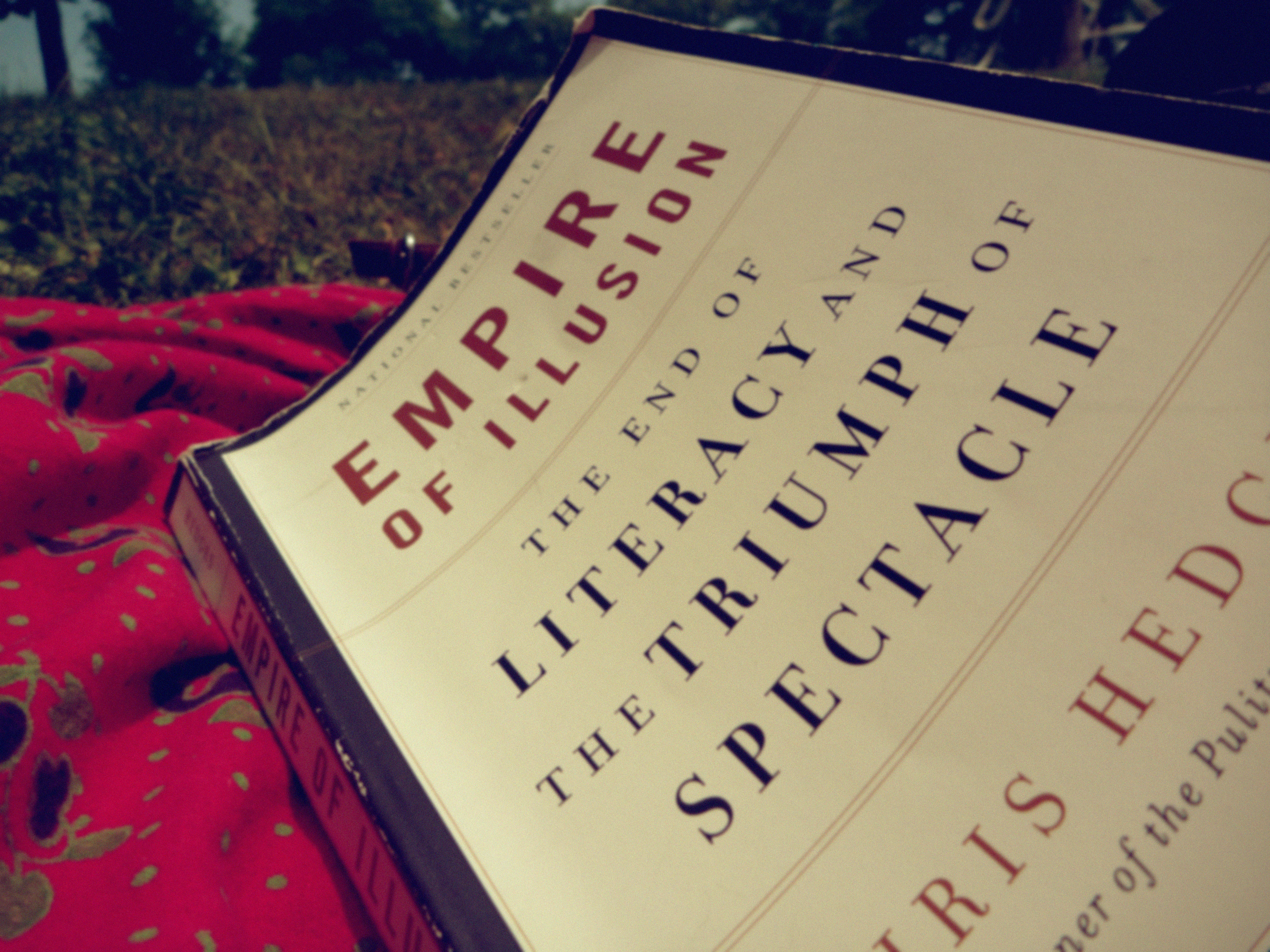 My summer vacation reading was a sunny little book by Nick Turse called Kill Anything That Moves. I finished the other book I was noshing on, the Age of American Unreason, just after returning from Kaslo and now I’ve started Chris Hedges book, the Empire of Illusion. Turse’s book is a necessary read for anyone who wants to understand what war is all about; I’ll be posting quotes from it here soon, but a work of that calibre needs time to digest, to make sense of the crushing sorrow it brings about.
Hedges book is similar to Jacoby’s Age of Unreason, but takes a different tack focusing almost immediately on the present. Hedges begins with a pro-wrestling story and broadens it to convey the idea that we are replacing substance and reality with flash and dramatic narrative (Check out the CBC Podcast on the Empire of Illusion):
[Plato’s Cave just before this…]
“We are chained to the flickering shadows of celebrity culture, the spectacle of the arena and the airwaves, the lies of advertising, the endless personal dramas, many of them completely fictional, that have become the staple of news, celebrity gossip, New Age mysticism, and pop psychology. In the Image: A Guide to Pseudo-Events in America, Daniel Boorstin writes that in contemporary culture the fabricated, the inauthentic, and the theatrical have displaced the natural, the genuine, and the spontaneous, until reality itself has been converted into stagecraft. Americans, he writes, increasingly live in a “world where fantasy is more real than reality,” He warns:
We risk being the first people in history to have been able to make their illusions so vivid, so persuasive, so “realistic” that they can live in them. We are the most illusioned people on earth. Yet we dare not become disillusioned, because your illusions are the very house in which we live; they are our news, our heroes, our adventure, our forms of art, our very experience.
Boorstin goes on to caution that
an image is something we have claim on. It must serve our purposes. Images are means. If a corporation’s image of itself or a man’s image of himself is not useful, it is discarded. Another may fit better. The image is made to order, tailored to us. An ideal, on the other hand, has a claim on us. It does not serve us; we serve it. If we have trouble striving towards [sic] it , we assume the matter is with us, and not with the ideal.
Those who manipulate the shadows that dominate our lives are the agents, publicists, marketing departments, promoters, script writers, television and movie producers, advertisers, video technicians, photographers, bodyguards, wardrobe consultants, fitness trainers, pollsters, public announcers, and television news personalities that create the vast stage for illusion. They are the puppet masters. No one achieves celebrity status, no cultural illusion is swallowed as reality, without these armies of cultural enablers and intermediaries. The sole object is to hold attention and satisfy an audience. These techniques of theatre, as Boorstin notes, have leached into politics, religion, education, literature, news, commerce, warfare and crime. The squalid dramas played out for fans in the wrestling ring mesh with the ongoing dramas on television, in movies, and in the news, where “real-life” stories, especially those involving celebrities, allow news reports to become mini-drams complete with a star, a villian, a supporting cast, a good-looking host, and a neat, if often unexpected, conclusion”.
*boom* The beginnings of understanding our manufactured culture in less than 600 words. Enjoy.
“We now live in two Americas. One—now the minority—functions in a print-based, literate world that can cope with complexity and can separate illusion from truth. The other—the majority—is retreating from a reality-based world into one of false certainty and magic. To this majority—which crosses social class lines, though the poor are overwhelmingly affected—presidential debate and political rhetoric is pitched at a sixth-grade reading level. In this “other America,” serious film and theatre, as well as newspapers and books, are being pushed to the margins of society.”
-Overview from the Empire of Illusion, by Chris Hedges
I’m currently reading this book and gosh oh boy, am I ever glad that we don’t have a connected TV anymore.











 bleatmop
 Mystro
 The Arbourist


 Dead Wild Roses
Your opinions…