
You are currently browsing the tag archive for the ‘Class Struggle’ tag.
 The excerpt is from a great piece by Christopher Lasch writing in the short lived journal “Democracy”. Written in the 80’s, details the systemic problems facing US democracy. The situation described shows the roots of where we are now, and how (unfortunately) we have arrived here.
“The centralization of power in the United States and the decline of popular participation in community life have become dramatically visible only in the
period since World War II. The roots of these conditions, however, go back to the formative period around the turn of the century. We have been living ever since then with the long-term consequences of the momentous changes inaugurated at that time.The most important of these changes, of course, was the emergence of the corporation and the spread of the corporate form throughout
American industry. Often misunderstood as a shift from entrepreneurial to managerial control, the corporation emerged out of conflicts between capital
and labor for control of production. It institutionalized the basic division of labor that runs all through modern industrial society, the division between brainwork and handwork-between the design and the execution of production.
Under the banner of scientific management, capitalists expropriated the technical knowledge formerly exercised by workers and vested it in a new
managerial elite. The managers extended their power not at the expense of the owners of industry, who retained much of their influence and in any case tended to merge with the managerial group, but at the expense of the workers.Nor did the eventual triumph of industrial unionism break this pattern of managerial control. By the 1930s, even the most militant unions had acquiesced in the division of labor between the planning and execution of work. Indeed the very success of the union movement was predicated on a strategic retreat from issues of worker control. Unionization, moreover, helped to stabilize and rationalize the labor market and to discipline the work force. It did not alter the arrangement whereby management controls the technology of production, the rhythm of work, and the location of plants (even when these decisions affect entire communities), leaving the worker with the task merely of carrying out orders.
Having ·organized mass production on the basis of the new division of labor-most fully realized in the assembly line-the leaders of American industry
next turned to the organization of a mass market. The mobilization of consumer demand, together with the recruitment of a labor force, required a far-reaching series of changes that amounted to a cultural revolution; The virtues of thrift, avoidance of debt, and postponement of gratification had to give way to new habits of installment buying and immediate gratification, new standards of comfort, a new sensitivity to changes in fashion. People had to be discouraged from providing for their own wants and resocialized as consumers. Industrialism by its very nature tends to discourage home production and to make people dependent on the market, but a vast effort of reeducation, starting in the 1920s, had to be undertaken before Americans accepted consumption as a way of life.
As Emma Rothschild has shown in her study of the automobile industry, Alfred Sloan’s innovations in marketing-the annual model change, constant upgrading of the product, efforts to associate it with social status, the deliberate inculcation of an insatiable appetite for change-constituted the necessary counterpart of Henry Ford’s innovations in production. Modern industry came to rest on the twin pillars of Fordism and Sloanism. Both tended to discourage initiative and self-reliance and to reduce work and consumption alike to an essentially passive activity. […]
When I read this section I was immediately drawn to the sections highlighted in purple. What I hear from conservative commentators and business commentators is that what it takes to succeed in society is to get out there and play the market, or innovate, or work hard and save money and improve yourself et cetera. Usually, along with their sprightly commentary on how bootstrapping oneself to greatness, is another piece on the evils of the nanny state and how those damn social programs (WELFARE *clutches chest* *dies*) are making people into lazy dependent sloths who do nothing but keep the productive people down.
Of course, like most capitalistic propaganda, it is utter shite. The message retains its ubiquity and longevity in our society only because of its constant repetition in the business press and media.
“The virtues of thrift, avoidance of debt, and postponement of gratification had to give way to new habits of installment buying and immediate gratification, new standards of comfort, a new sensitivity to changes in fashion.“
I quote this again because damn, if this isn’t an indictment of how capitalism has malformed our society, I’m not sure what is. This way of life we now live was a choice made by the elite classes, as to how society was to be run. Clearly, attributes like avoiding debt and postponement of gratification have no place in a modern civilized society (!).
Racking up debt, conspicuous consumption, becoming dependent on the market – didn’t just *happen* – they were orchestrated to feed the industrial elite’s needs and as always, at the expense of the working class.
So, the business class essentially builds/nurtures a culture of dependency – that is, actively discourages self production and self-reliance – and then has the temerity to bluster about Big Government creating a welfare state chock full of slothful, gormless, dependent people.
Create a society where dependency is rewarded, and then proceed to blame the people for becoming dependent. Fascinating stuff this capitalism is.
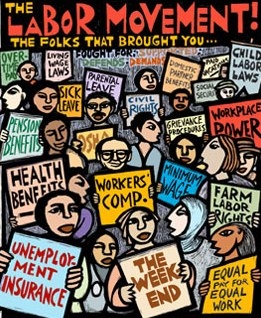 The rights we enjoy today in Canada as workers and professionals were not given to us. It was through determined, bloody at times, never-say-die, collective struggle that our rights as workers were imposed on the capitalist class. Power never makes concessions – struggles for basic working benefits must be fought for and taken. The price for humane working conditions can be as high as death or as in the case of Cleaning Workers Union in Greece, permanent disfigurement.
“Vassilis Kikilias, didn’t lose time. Less than an hour after he took office, riot police cracked down on a protest of the cleaning staff of the ministry of finance.
The protesters are more than 500 women of all ages and national backgrounds who were cleaning tax offices, the ministry of finance and customs services until a ministerial decree, fired them all indiscriminately and permanently.
The austerity rationale behind the decision was spurious because these women were not a fiscal burden – quite the contrary. The privatisation of cleaning services has increased the amount spent in order to keep public working spaces decently clean.”
Ah, there we go, the popular myth that privatization is solution to all problems in the public sector. It usually isn’t when it comes to saving money as privatized services cost more and treat their employees badly; less pay, less benefits, less job security. Embrace job insecurity! It is but one of the lovely intrinsic features of privatization of society and a necessary feature of the capitalist paradigm.
“The fate of these 500 women is nothing new in Greece; for years now, and especially since the financial crisis, workers have had to take to the streets to reclaim their rights.”
“Overall, privatising services and reverting to temporary contracts for workers has been associated with slavery-like conditions of labour exploitation.”
We must never forget the blood price paid by earlier generations to erect the bulwarks of labour protections against the capitalist tide. People fought and died for what we consider “normal” working conditions.
“Kouneva, a trained historian, emigrated to Greece from Bulgaria in 2001, because of the financial troubles many countries in Eastern Europe were going through at the time.
In 2003 she was hired as a janitor by private company OIKOMET, which had a contract with the Athenian railway service. Seeing the conditions in which her colleagues were working (low and infrequent pay, lack of insurance, mistreatment), Kouneva entered the janitors union of Athens and soon became one of its leading figures.
From that moment on, she didn’t stop protesting working conditions, struggling for the rights of cleaning staff, who were often ignored by the main trade unions.
She ignored threats against her life and never regretted her decision to continue the fight for labour rights.
One night in December 2008, Konstantina Kouneva was attacked by two men while walking back home in downtown Athens. They threw sulfuric acid on her face and forced her to drink the rest in what could have been a fatal attack.”
What was her crime? Protesting for decent working conditions. People need to realize the coercive power capital holds and guard against it regaining the sort of destructive influence observed in Greece.
“This doesn’t change the significance of the cleaners’ story: Fired from governmental institutions some of these women will be hired back at half of their original salaries, no insurance in some cases, and incapable to fight employer blackmail as employees.
This is what the austerity programme is all about.
A lot has been written about the high unemployment figures in Greece due to the crisis but there’s another aspect that affects the working population. Salaries drop, conditions worsen and the negotiating power of workers is annihilated.
500 women are continuing the struggle Konstantina Kouneva paid for with her health, fighting hard to keep the gates that lead to the precarious underclass, closed .
Despite the fact that they have already won their litigation against the Greek state, they are being constantly attacked by conservative politicians, the mainstream media, and riot police. Just recently they were brutally beaten again while trying to reach the finance ministry and demonstrate for, yet another day.”
People fighting for their lives while conservatives, the media and of course the police try to crush them. This was commonplace here in North America not long ago and the conservative capitalist forces of today are doing their very best to erase the memory of workers popular struggle so they can continue to chip away at the hard fought rights and benefits we enjoy today.
[Source]











 bleatmop
 Mystro
 The Arbourist


 Dead Wild Roses
Your opinions…