
You are currently browsing the tag archive for the ‘Deregulation’ tag.
A regulated economy may not perform at peak performance, but rather to its credit has built in stability and resilience in order to mute and calm the wider variances of the business cycle. The rules and regulations that govern Banking and Finance are there for a reason – to protect American citizens from the predatory nature of untrammelled capitalism. It comes as no surprise that the current Republican Administration is doing its best to eliminate the checks and balances currently in place and promote winner take all (at the cost of society) capitalism. Nomi Prins describes the regulation situation in the US:
“The Emperor Has No Rules
Nearly every regulatory institution in Trumpville tasked with monitoring the financial system is now run by someone who once profited from bending or breaking its rules. Historically, severe financial crises tend to erupt after periods of lax oversight and loose banking regulations. By filling America’s key institutions with representatives of just such negligence, Trump has effectively hired a team of financial arsonists.
Naturally, Wall Street views Trump’s chosen ones with glee. Amid the present financial euphoria of the stock market, big bank stock prices have soared. But one thing is certain: when the next crisis comes, it will leave the last meltdown in the shade because our financial system is, at its core, unreformed and without adult supervision. Banks not only remain too big to fail but are still growing, while this government pushes policies guaranteed to put us all at risk again.
There’s a pattern to this: first, there’s a crash; then comes a period of remorse and talk of reform; and eventually comes the great forgetting. As time passes, markets rise, greed becomes good, and Wall Street begins to champion more deregulation. The government attracts deregulatory enthusiasts and then, of course, there’s another crash, millions suffer, and remorse returns.
Ominously, we’re now in the deregulation stage following the bull run. We know what comes next, just not when. Count on one thing: it won’t be pretty.”
One video, sixteen minutes equals deep insight into how American society runs. (Hint: Most likely not for your benefit.)
I grow tired of hearing arch-conservatives rail on about the evils of regulation and how it stifles industry. People die because of deregulation and lax standards – but somehow the profit motive trumps all that human welfare shit, almost every time.
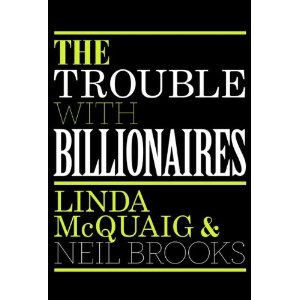 I wish I had gotten around to reading this book sooner. It is a great read and takes a great deal of piss out of the arguments (made by our beloved conservative/libertarian friends) for lower taxes and more love for the wealthy. I highly recommend reading it. Check out other reviews here and here. I found a brief summary of what McQuaig talks about in the book:
“In the last few decades, the concentration of income in the United States, Britain and Canada has reached levels not seen since the late 1920s. Such extreme income concentration created a dynamic that led to the disastrous Wall Street crash in 2008 – just as it did in 1929. The financial collapse is simply the most striking example of the problems caused by the rise of a new class of billionaires. Their massive fortunes – widely considered benign or even beneficial to society — are actually detrimental to everyone else. The glittering lives of the new super-rich may seem like harmless sources of entertainment. But such concentrated economic power reverberates throughout society, threatening the quality of life and the very functioning of democracy. It’s no accident that the United States claims the most billionaires—but suffers from among the highest rates of infant mortality and crime, the shortest life expectancy, as well as the lowest rates of social mobility and electoral political participation in the developed world. Our society sees itself as a meritocracy. So we tend to regard large fortunes as evidence of great talent or accomplishment. Yet the vast new wealth isn’t due to an increase in talent or effort at the top, but rather to changing social attitudes legitimizing greed and to policy changes made by governments under pressure from the new elite.”
Oh and a quick excerpt from the book taking down the notion of the “self-made” billionaire (p.25 – 28).
“The notion that it should be possible to become a billionaire is rooted in the idea that there are some uniquely talented individuals whose contribution is so great that they deserve to be hugely, fabulously rewarded.
Some billionaires, such as Leo J. Hindery Jr., have made this point themselves. Hindery, whose contribution was to found a cable television sports network, put it this way: “I think there are people, including myself at certain times in my career, who because of their uniqueness warrant whatever the market will bear.” Similarly, Sanford Weill, long a towering figure on Wall Street, is impressed with the contributions of billionaires like himself: “People can look at the last 25 years and say that this is an incredibly unique period of time. We didn’t rely on somebody else to build what we built…”
What is striking in such statements, in addition to the absence of modesty, is the lack of any acknowledgement of the role of society in their good fortune. These men seem unaware of the pervasive role played by society in general (as well as by specific other people) in every aspect of their lives — in nurturing them, shaping them, teaching them what they know, performing innumerable functions that contribute to the running of their businesses and indeed every aspect of constructing and operating the market that has enabled them to get rich. Weill’s statement that “We didn’t rely on somebody else to build what we built” can be quickly tested. Would Weill, having built everything from scratch, be able to reproduce his fortune if stranded on a desert island?
If so, then he should be able to keep every bit of it for himself, having been solely responsible for its creation. If not, then it is reasonable to ask what portion of it was created by him, and what by others?
The Desert Island Test is a useful one to keep in mind. The primacy and ubiquity of society — so casually erased by billionaires and others justifying their fortunes — must be restored if we are to have any meaningful discussion of income and wealth, and where an individual’s claim ends and society’s begins.
One of the crucial ways that society assists individuals in generating wealth lies in the inheritance from previous generations.
This inheritance from the past is so vast it is almost beyond calculation. It encompasses every aspect of what we know as a civilization and every bit of scientific and technological advance we make use of today, going all the way back to the beginning of human language and the invention of the wheel. Measured against this vast human cultural and technological inheritance, any additional marginal advance in today’s world — even the creation of a cable television sports network — pales in significance.
The question then becomes: who is the proper beneficiary of the wealth generated by innovations based on the massive inheritance from the past — the individual innovator who adapts some tiny aspect of this past inheritance to create a slightly new product, or society as a whole (that is, all of us)?
Under our current system, the innovator captures an enormously large share of the benefits. Clearly, the innovator should be compensated for his contribution. But should he or she also be compensated for the contributions made by all the other innovators who, over the centuries, have built up a body of knowledge that made his marginal advance possible today? What share of the newly-generated wealth correctly belongs to the society that has not only nurtured him but also provided him with this rich past inheritance — without which, stranded on a desert island, he wouldn’t have the means to even keep himself warm.”
The youtube summary as well.
The CBC article sounds innocuous enough; full marks for making the pillaging of public good sound palatable.
|

 Privatization, as always, is still on the move in Alberta. As usual, it will be a wild success, for the private investors at the cost of the public good.
This is being marketed as a way to increase capital so Epcor can continue to expand its operations across North America. In reality though this is just another move toward privatizing a public good for the benefit of the business class.











 bleatmop
 Mystro
 The Arbourist


 Dead Wild Roses
Your opinions…