
You are currently browsing the tag archive for the ‘Feminism’ tag.
Wow. What brilliant article by Ms.Fowles recently published by the Walrus. I’m gonna put the whole thing up here because it sheds light on so many of the issues that face women today in the online world. Consider this example #2348239487 of how woman’s experiences in society are dramatically different than those of men.
“Every so often, someone (always a man) sends me a casual tweet asking why he can’t retweet me. Of course, the obvious answer is that my account is locked—a tiny optional blessing of Twitter’s functionality that means I’m not searchable to the world outside. The more complex answer relates to why my account is locked in the first place, why I would choose to keep people from reading my brilliant musings on ’90s’ teen movies, Rihanna’s latest video, or the myriad virtues of Magic Mike XXL. There are easy, palatable answers I have given to those that ask; I value my privacy, or I like to keep my circle small and manageable, or I prefer to keep the personal aspects of my life away from my employers and ex-boyfriends.
But the most important (and truest) answer is this: I am afraid of men on the Internet.
There’s good reason for this fear, and it’s likely one you’ll empathize with if you’re a woman who has ever dared to have an opinion in the techno-public realm. In fact, women have never once asked me why my account is locked—and unlike some of my male editors, they’ve never recommended opening it up. They understand that the online world has become a horror show, and that men largely drive that horror. Men are usually the ones who post nude pictures of their exes, release the home addresses of the women they dislike, and run the vileness that is Gamergate. (I’m even reluctant to type the word Gamergate, as if doing so conjures the hoards like some kind of Internet Candyman.) Of course, Not All Men, but unless a new Twitter follower has “I hate women” or some variation thereof in his bio, there’s no good way to predict which one will decide to take offence at you merely existing. And there’s no way to know whether that person who is offended will be the one to threaten to end your life.
Online technology has allowed a stranger to tell me he’d like to penetrate me with a broken light bulb because I’d “probably like it.” It has let a commenter inform me that women shouldn’t act the “way they do” if they don’t want men to commit crimes against them. I’ve been the subject of mockery and derision on men’s-rights-activist websites and right-wing blogs. On a good day, the Internet helps people let me know I’m stupid, and on a bad one it helps them threaten me with bodily harm. It’s facilitated me being called a man hater, a feminazi, a libtard, a hack, an attention whore, or just a plain old whore. It’s brought me patronizing questions, profanity-laden emails, and abuse masquerading as “criticism.”
It has also been a great way for people to tell me that I should ignore all this, that I should get a thicker skin, and if I don’t like it maybe I should get offline altogether.”

Catch the rest at the Walrus, as apparently they need their ad revenue – tracking down hole in the wall blogs for copyright violations is an expensive business.
I have no interest in playing the new Mad Max game, Jim Sterling summarizes the hollow shell that is this game:
“Mad Max feels like the embodiment of everything Ubisoft has been building with its own dire stable of open world games – a pure saturation of nebulous “content” that offers nothing of substance but simply litters a massive map with repetitive busywork so it may display a facsimile of “value” to its audience.
It’s just stuff. Exhausting, tiring stuff. The very opposite of a game like Wander or Submerged. While those games present a massive vacuum of things to do, Mad Max drowns its player in endless scarecrows to tear down, snipers to kill, encampments to dismantle, and scavenging posts to loot. None of it compelling in the least.”

Yeah… So… Why write about a shitty game Arbourist?
Glad you asked faithful reader because I think that Mad Max the video game shows exactly how ubiquitous the deference to the status-quo is in the triple A gaming market.
The makers of this video game overlooked one unique aspect of the movie that made the movie so awesome.

Oh you mean the protagonist in Fury Road that got shit done? What was her name again… Imperator Furiosa?
The game is centered around Max – the boring protagonist of the movie, while Furiosa the character with motivations, emotions, and speaking lines is relegated to the background in the game.
This would seem to be a bad decision at the very root of this particular game. The choice to go with Blandy McBlanderson in an attempt to court the supposed appropriate demographic (youngish white dudes) resulted in a lack lustre, been there done that game, whose mechanics have been done with more polish and better execution in a game released last year – Shadow of Mordor (even in SoM you have the option to play as a female character).
What would have garnered my attention rather than another sandbox fetch quest grind, featuring Blandy? Maybe a story where you get to play as the female bad-ass of the movie, where we could learn more about her and her backstory. A game that featured Furiosa would almost write itself as you might get to see her move up in the ranks, how she lost her arm, why she makes the choices that she does. All interesting shit.
But nope. Let’s go with ‘safe’ and staid Blandy and let the chips fall where they may.
The chips have fallen, and yet another cookie-cutter grindfest is the result. Way to go Triple A publishers. :/

An interesting lesson in patriarchy.
Men can be gay and want to get married.
Men can’t get pregnant.
[Source:Radicalfeministuprising]

Autumn approaches; the obnoxious university ‘Week of Welcome’ orientation drones are yelling insipid, yet inclusive, chants at each other; and of course, more stupid post mostly made of straw languidly emerge from the turbid depths of the wordpress “patriarchy” tag. Like appreciating the subtle fireworks of the turning of the leaves, one can appreciate the flawed assumptions and ignorance on display over at A Reasonable Faith. But Lo! The coming of Fall and the exudation of a steaming pile of Herp-Derp always leaves one gasping for breath at the enchanting majesty of nature in all her glory in the first case, and in wonderment at the raw-stupid on display in the other. (hurrah for awkward parallel sentence construction!)
Two concepts that will help us in our merry cavalcade of fail will be that of the (1.)Naturalistic Fallacy(with due consideration to Hume) and the concept of a (2.)Social Construct lets define them:
- The Naturalistic Fallacy – […] the term is sometimes used loosely to describe arguments which claim to draw ethical conclusions from natural facts. Even more distantly, the term is used to describe arguments which claim to draw ethical conclusions from the fact that something is “natural” or “unnatural.”
- Social Construct – A social construction, or social construct or a social concept is an invention or artifact of a particular culture or society which exists solely because people agree to behave as if it exists, or agree to follow certain conventional rules.
Most of the problems with the post I’m about to critique will default to a lack of understanding of these concepts and how they work in our society. I would be remiss to also point out that there is, of course, a generous helping of strawwoman arguments that serve to undermine the authors arguments and credibility.
So let loose the doges of war, and we shall have at it:
“If there’s one truth that would impact culture for good more than just about any other if it were more male-female-brainwidely believed, accepted, and embraced, it’s this: males and females are quite different from each other. We are. And not just anatomically but physiologically and emotionally”
Sounds good right? Too bad its almost entirely bullocks. Let’s take a peek at what people who study sex and gender differences have to say:
“A 2005 analysis of 46 meta-analyses that were conducted during the last two decades of the 20th century underscores that men and women are basically alike in terms of personality, cognitive ability and leadership.”
Hmm…it would seem that the some of the research directly contradicts your claim..but wait!!! There might be hope, there are differences!!!!
“Only a few main differences appeared: Compared with women, men could throw farther, were more physically aggressive, masturbated more, and held more positive attitudes about sex in uncommitted relationships.”
Whooops… you’re still wrong.
“Hyde found that gender differences seem to depend on the context in which they were measured. In studies designed to eliminate gender norms, researchers demonstrated that gender roles and social context strongly determined a person’s actions. For example, after participants in one experiment were told that they would not be identified as male or female, nor did they wear any identification, none conformed to stereotypes about their sex when given the chance to be aggressive. In fact, they did the opposite of what would be expected – women were more aggressive and men were more passive.”
We could simply drop the mic here and be done with this piffle (flawed assumptions leading to flawed conclusions and all that), but where is the fun in that?
Let us soldier on brave readers! Bewarned and wary, forward we must go fellow travellers(of the loquaciously impenitent persuasion), to further reconnoitre this curiously(willfully?) ignorant realm.
Every once and awhile something good bubbles up from the seething mass known as tumblr. This is a good summary of what sex and gender are and how they interact in our society.
“It seems like on here at tumblr there’s a lot of misinformation going around. people are using sex and gender interchangeably as if they mean the same thing. There’s a lot of unclear information and everything seems rally vague and distorted so the goal of this post is to help clear some of this up.
What are the differences between sex and gender?
The main difference is that sex describes your body’s biological reproductive role. Humans as a species reproduce sexually, as opposed to species which reproduce asexually, such as by budding. In human reproduction, a sperm cell will fertilize an egg cell and cause a pregnancy.
We call people whose biology designated them to be sperm depositors “male” and we call people who are designed by biology to be pregnancy carriers “female”. That is all these terms mean, they reference what role we would play in reproduction if we decided to produce offspring.
Gender on the other hand, is a big mass of controversy. See, unlike biological sex, gender is not innate. We are not born with a gender. Gender is a social construct–that means it only exists as long as society propagates it.
What is gender?
Gender is an oppressive force that dictates to people how they should behave, dress, act, what their role in life is, how to interact with other people, etc.. While specific gender roles and norms vary from culture to culture, in every culture, gender exists to tell people how to live, and it is always oppressive.
Gender is a hierarchy which places males above females. Gendered interaction dictates that women defer to men, that men are taken more seriously, that men are more credible, that men are treated as superior.
In our society, femininity is the gender role forced on to women, and masculinity is the gender role forced on to men. We also label objects and clothes and behaviors as “feminine” or “masculine” based on how these objects are linked to oppressive gender roles.
Why is femininity oppressive?
From the day we are born, female people are forced against our will in to the gender role of femininity. People will immediately begin to judge this tiny human, telling her she is “cute” and “pretty”. Even as she is first learning language and what words mean, she is also learning that it is rewarding to be “pretty” and that she receives praise for it. She will learn this way, since her birth, that her value as a person is determined by her visual appeal to others.
There is much literature written on the oppressive nature of femininity. In short, femininity is how society tells women to behave. Femininity is policing one’s appearance as if we are a visual object, paying rent in beauty just to exist in the world. Femininity is in our meekness, our smallness, how we are trained to put ourselves second and put men especially first, to be accommodating, to accept disrespect from men, to not have boundaries lest we insult men, to put male feelings above our own safety and bodily autonomy.
Femininity is not innate to women. It is something we are taught, something we are forced in to. Women do not naturally behave meekly, we are not born wanting to put make up on our faces.
The idea that gender is innate oppresses women.
Historically, women have been told that femininity, this forced gender role of being innate and subservient and meek and stupid and focused on vanity/appearance, is actually a biological innate part of who we are and is exactly what makes us women.
This idea, that femininity is natural to women, has been used to keep us out of science, to keep us oppressed housewives, because that is all that gender dictates we are good for (remember, gender is a hierarchy which tells you how to live).
Gender is obviously not innate–the existence of feral children, generally cases of extreme negligence, illustrates to us just how gender is something we are taught and not something we are born with. Women are not born with the idea that they must shave their legs and be meek and accommodating to men. This is not natural to us. Gender oppresses us.
Gender is an oppressive belief system and buying in to it continues the oppression of women.
The solution is gender abolition. If we abolish gender, nobody would be told how to live, what to wear, or how to behave. There would be no hierarchy placing males above females. Biological sex would continue to exist, because it is something made by evolution and required for reproduction of our species. But gender, the idea that your biological sex says anything about your personality, would not exist.
Males and females would each be permitted to have any kind of personality.
We would not needlessly assign femininity or masculinity to hobbies or toys or any other objects in order to limit peoples’ interests. Everyone could be free to be who they truly are, without oppressive gender labels telling people how to live.
Abolishing gender is best for everyone involved, and also liberates women from the oppressive system of gender.”
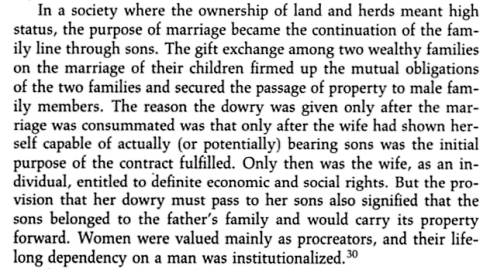
This quote is from the Harper’s Magazine archive. We Do Abortions Here: A Nurse’s Story, is a powerful piece that goes  beyond the well worn positions that are still being dragged about today. I recommend a full reading, go to Harper’s Archive to read it.
“Women have abortions because they are too old, and too young, too poor, and too rich, too stupid and too smart. I see women who berate themselves with violent emotions for their first and only abortion, and others who return three times, five times, hauling two or three children, who cannot remember to take a pill or where they put the diaphragm. We talk glibly about choice. But the choice for what? I see all the broken promises in lives lived like a series of impromptu obstacles. There are the sweet, light promises of live and intimacy, the glittering promise of education and progress, the warm promise of safe families, long years of innocence and community. And there is the promise of freedom: freedom from failure, from faithlessness. Freedom from biology. The early feminist defense of abortion asked many questions, but the one I remember is this: Is biology destiny? And the answer is yes, sometimes it is. Women who have the fewest choices of all exercise their right to abortion the most.”
A small slice of what the emancipation of women looks like can be found here. There is a distinct lack of ’empowerment’ and empty consumerist gestures in the second wave – just women liberating the space for women to make the tough calls in their lives as they see fit. It is not happy-fun-times, not empowerful, but rather it is the cold embrace of the bitter-sweet choices in life that, till recently, only half of the population was deemed worthy enough to experience.











 bleatmop
 Mystro


 Dead Wild Roses
Your opinions…