
You are currently browsing the tag archive for the ‘GDP’ tag.
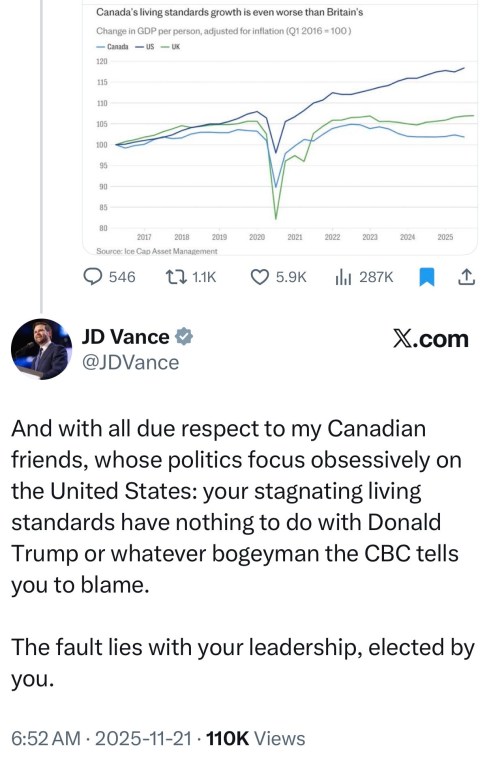
Canada finds itself at a crossroads. In recent years, per capita GDP growth has stalled, productivity remains sluggish, and housing, healthcare, and infrastructure face mounting pressure. These trends have prompted urgent debate about the causes of stagnation, ranging from global economic shifts and demographic aging to domestic policy decisions. Among commentators, JD Vance recently sparked attention with pointed critiques of Canada’s immigration policies and multicultural model, framing them as principal contributors to declining living standards. Beyond the immediate provocation, his intervention highlights a deeper question: how should Canadians assess responsibility for the state of their economy?
Immigration, Policy Choices, and Economic Outcomes
Canada’s foreign-born population now stands at approximately 23 percent, the highest in the G7, reflecting a sharp rise over the past decade. This increase was accelerated by post-pandemic labor shortages and policy decisions prioritizing high-volume admissions. While immigration is a crucial driver of population growth and labor supply, recent evidence indicates that integration has lagged, particularly for newcomers with credentials or skills mismatched to domestic demand. Unemployment rates among recent immigrants are approximately twice those of Canadian-born workers, and overall productivity growth has remained below historical trends.
These outcomes underscore a key point: while external factors including global commodity cycles, trade dynamics, and U.S. policy affect Canada’s economy, domestic decisions regarding immigration volume, infrastructure investment, and skills integration exert primary influence over living standards. The choice to expand immigration without simultaneously scaling capacity for integration, housing, and healthcare has consequences that voters ultimately authorize at the ballot box.
Stoic Lessons for Civic Responsibility
Confronted with these structural and policy realities, Canadians might feel tempted to externalize blame to markets, foreign governments, or pundits. Here, the Stoic philosophers offer timeless guidance. Marcus Aurelius wrote in his Meditations: “You have power over your mind—not outside events. Realize this, and you will find strength.” Epictetus similarly asserted: “It’s not what happens to you, but how you react to it that matters.” These principles demand that citizens distinguish between factors within their control and those beyond it, focusing energy on the former.
Stoicism is not a creed of passivity. It insists on rigorous self-examination and deliberate action. In Canada’s context, this means acknowledging the consequences of policy choices and recognizing that solutions—whether adjusting immigration strategy, improving integration programs, or investing in productivity-enhancing infrastructure—lie within domestic capacity.
Pathways to Renewal
Practical measures aligned with these principles include:
- Aligning immigration targets with absorptive capacity: Recent adjustments to temporary resident admissions, reducing projected numbers by approximately 43 percent, illustrate the potential for recalibration.
- Prioritizing skill-aligned integration: Investing in credential recognition, language training, and targeted labor placement can ensure that new arrivals contribute effectively to productivity.
- Strengthening domestic infrastructure and services: Housing, healthcare, and transportation require proportional investment to match demographic growth.
- Informed civic engagement: Voting with awareness of policy consequences is fundamental to maintaining democratic accountability and ensuring long-term economic stability.
By taking responsibility, Canadians act in accordance with Stoic precepts: focusing on what they can control rather than scapegoating external forces. The challenge is not merely economic—it is moral and civic. Prosperity depends as much on deliberate collective action as on external circumstance.
Conclusion
Canada’s stagnating living standards are the product of complex factors, yet domestic choices remain decisive. While commentary from external observers like JD Vance may provoke discomfort, the underlying lesson is clear: sovereignty entails responsibility, and agency begins at home. To confront stagnation, Canadians must embrace candid assessment of policy outcomes, deliberate reform, and disciplined civic engagement. In the words of Seneca: “We suffer more often in imagination than in reality.” Facing the realities we have constructed—and acting to improve them—is the first step toward renewal.
References
- Statistics Canada. Labour Force Survey, 2025. https://www150.statcan.gc.ca/n1/en/type/data
- Government of Canada. Immigration, Refugees and Citizenship Canada: Annual Report to Parliament on Immigration, 2024. https://www.canada.ca/en/immigration-refugees-citizenship/corporate/publications-manuals/annual-report-parliament-immigration.html
- Marcus Aurelius. Meditations. Trans. Gregory Hays, 2002.
- Epictetus. Enchiridion. Trans. Elizabeth Carter, 1758.
- Seneca. Letters from a Stoic. Trans. Robin Campbell, 2004.
Glossary
- Per Capita GDP: The average economic output per person, often used as a measure of living standards.
- Productivity: Output per unit of input; a key driver of sustainable economic growth.
- Integration Programs: Policies and services designed to help immigrants participate effectively in the labor market and society.
- Absorptive Capacity: The ability of a system (economy, infrastructure, institutions) to accommodate growth without adverse effects.
- Stoicism: Philosophical framework emphasizing rational control over one’s mind and actions rather than external circumstances.
 The ongoing media campaign to make the economy the monofocus of our societies continues on unabated. Do almost any news search and you will see economic principles overlaid and tied to the idea that somehow they are related to how healthy and how “good” a society actually is. Economic health is but one part of a successful society as a strength of a society not only lies in its economy but in its culture and even more importantly, its people. Jeffry Sachs opines on a better way of analyzing and structuring a society:
“We live in a time of high anxiety. Despite the world’s unprecedented total wealth, there is vast insecurity, unrest, and dissatisfaction. In the United States, a large majority of Americans believe that the country is “on the wrong track”. Pessimism has soared. The same is true in many other places.
Against this backdrop, the time has come to reconsider the basic sources of happiness in our economic life. The relentless pursuit of higher income is leading to unprecedented inequality and anxiety, rather than to greater happiness and life satisfaction. Economic progress is important and can greatly improve the quality of life, but only if it is pursued in line with other goals.”
Let me reassure you skeptical reader, a more egalitarian society is not only better for its people, it is better for productivity as well. What its bad for, capital accumulation and socialism for the rich.
“First, we should not denigrate the value of economic progress. When people are hungry, deprived of basic needs such as clean water, health care, and education, and without meaningful employment, they suffer. Economic development that alleviates poverty is a vital step in boosting happiness.
Second, relentless pursuit of GNP to the exclusion of other goals is also no path to happiness. In the US, GNP has risen sharply in the past 40 years, but happiness has not. Instead, single-minded pursuit of GNP has led to great inequalities of wealth and power, fueled the growth of a vast underclass, trapped millions of children in poverty, and caused serious environmental degradation.”
I would add here, the growth of the courtier corporate media whose job it is to reframe the massive inequality and unjust conditions prevalent in the US as “normal” and manage to get the poor people to actually fight against reforms that would benefit them (see the dismal failure instituting universal healthcare in the US).
“Third, happiness is achieved through a balanced approach to life by both individuals and societies. As individuals, we are unhappy if we are denied our basic material needs, but we are also unhappy if the pursuit of higher incomes replaces our focus on family, friends, community, compassion, and maintaining internal balance. As a society, it is one thing to organise economic policies to keep living standards on the rise, but quite another to subordinate all of society’s values to the pursuit of profit.
Yet politics in the US has increasingly allowed corporate profits to dominate all other aspirations: fairness, justice, trust, physical and mental health, and environmental sustainability. Corporate campaign contributions increasingly undermine the democratic process, with the blessing of the US Supreme Court”
Profits before people, who rather than rightly blame the corporate oligarchy for their misery funnel their discontent toward their government. Of course, the government corrupted by corporate interests, should be a focus of scrutiny but at the moment, the focus of the rage and anger of the American people is mostly displaced.
“Fourth, global capitalism presents many direct threats to happiness. It is destroying the natural environment through climate change and other kinds of pollution, while a relentless stream of oil-industry propaganda keeps many people ignorant of this. It is weakening social trust and mental stability, with the prevalence of clinical depression apparently on the rise. The mass media have become outlets for corporate “messaging”, much of it overtly anti-scientific, and Americans suffer from an increasing range of consumer addictions.”
Consumption is not a way to happiness, it is but a mere false paradise of shallow contrivances, moral turpitude and ethical decay.
“Fifth, to promote happiness, we must identify the many factors other than GNP that can raise or lower society’s well-being. Most countries invest to measure GNP, but spend little to identify the sources of poor health (like fast foods and excessive TV watching), declining social trust, and environmental degradation. Once we understand these factors, we can act.
The mad pursuit of corporate profits is threatening us all. To be sure, we should support economic growth and development, but only in a broader context: one that promotes environmental sustainability and the values of compassion and honesty that are required for social trust.”
What? A balance between rapacious capitalism and social, ethical and environmental concerns? Is it possible? Of course it is possible, but needs to come from outside the current political superstructure of Canada and the United States. The people of the Western countries need to organize (labour unions are a great place to start, as the represent people as opposed to business interests) and campaign for a balanced society, as opposed to the GNP fixated, world destroying paradigm we currently inhabit.

Easy values to follow for a better society.











 bleatmop
 Mystro
 The Arbourist


 Dead Wild Roses
Your opinions…