
You are currently browsing the tag archive for the ‘History’ tag.

Divide and conquer has always been an effective strategy. Applied against women, it has blossomed into one of tap roots of Foppression.
“The feminist historian, Gerda Lerner, showed that prostitution has not always existed. It first arose at the beginning of patriarchy, which was relatively recently in the long history of the human race. Prostitution began when men systematically seized control over women. One of the key ways they controlled women was to divide them into two groups: respectable women and prostitutes. Respectable women had to cover their heads and the prostitutes were not allowed to cover their heads – so all could see which group each woman belonged to. The respectable women were dependent on the patronage of a named man – her husband or father. The prostitutes were fair game for all men, any man, to rape. So women accepted “respectability” to avoid being fair game. And then she had to make sure that she was always taken as a respectable wife so she wouldn’t be mistaken for a prostitute who was fair game. She had to distance herself from the prostitutes. And so women were divided, one from another. In order that they could be more easily fucked.”
[Source]
There has always been a struggle by the people against the gratuitous accumulation of wealth and power. So the inequality we live with today is a problem that humanity has been grappling with since is inception. Tariq Ali explains how in this passage:
[…]
In Sparta in the third century BCE, a fissure developed between the ruling elite and ordinary people following the Peloponnesian Wars, and those who were ruled demanded change because the gap between rich and poor had become so huge it couldn’t be tolerated. A succession of radical monarchs, Agis IV, Cleomenes III and Nabis, created a structure to help revive the state. Nobles were sent into exile; the magistrates’ dictatorship was abolished; slaves were given their freedom; all citizens were allowed to vote; and land confiscated from the rich was distributed to the poor (something the ECB wouldn’t tolerate today). The early Roman Republic, threatened by this example, sent its legions under Titus Quinctius Flamininus to crush Sparta. According to Livy, this was the response from Nabis, the king of Sparta, and when you read these words you feel the cold anger and the dignity:
“Do not demand that Sparta conform to your own laws and institutions … You select your cavalry and infantry by their property qualifications and desire that a few should excel in wealth and the common people be subject to them. Our law-giver did not want the state to be in the hands of a few, whom you call the Senate, nor that any one class should have supremacy in the state. He believed that by equality of fortune and dignity there would be many to bear arms for their country.”
Now if I can just find the the right people to negotiate with in front of mysteriously bottomless pits, with a THIS…IS…CANADA snarly overture primed, I too believe we can punt our way to a better country. :)
I can see it now, a special guest Gerard Butler meets Steven Harper…
[Source: Counterpunch]
We tell ourselves the stories we need to hear. This is excerpt details American involvement in Afghanistan, but from a non-embedded reporters point of view and analysis.
“The central thesis of the American failure in Afghanistan — the one you’ll hear from politicians and pundits and even scholars — was succinctly propounded by Deputy Secretary of State Richard Armitage: “The war in Iraq drained resources from Afghanistan before things were under control.” In this view, the American invasion of Iraq became a crucial distraction from stabilization efforts in Afghanistan, and in the resulting security vacuum the Taliban reasserted themselves.
At its core, the argument rests upon a key premise: that jihadi terrorism could be defeated through the military occupation of a country. That formulation seemed natural enough to many of us in the wake of 9/11. But travel through the southern Afghan countryside, and you will hear quite a different interpretation of what happened. It comes in snippets and flashes, in the stories people tell and their memories of the time, and it points to a contradiction buried deep in the war’s basic premise.
You can find this contradiction embodied in a sprawling jumble of dust-blown hangars, barracks, and Burger Kings, a facility of barbed wire, gunmen, and internment cages: Kandahar Airfield, or KAF, as it came to be called, the nerve center for American operations in southern Afghanistan, home to elite units like the Navy SEALs and the Green Berets. A military base in a country like Afghanistan is also a web of relationships, a hub for the local economy, and a key player in the political ecosystem. Unravel how this base came to be, and you’ll begin to understand how war returned to the fields of Maiwand.
In December 2001, an American Special Operations Forces unit pulled into an old Soviet airbase on the outskirts of Kandahar city. They were accompanied by a team of Afghan militiamen and their commander, a gregarious, grizzly bear of a man named Gul Agha Sherzai. An anti-Taliban warlord, Sherzai had shot to notoriety in the 1990s following the death of his illustrious father, Hajji Latif, a onetime bandit turned mujahed known as “the Lion of Kandahar.” (Upon assuming his father’s mantle, Gul Agha had rechristened himself Sherzai, Son of the Lion. His first name, incidentally, roughly translates as “Respected Mr. Flower.”) With American backing, Sherzai seized the airfield, then in ruins, and subsequently installed himself in the local governor’s mansion — a move that incensed many, Hamid Karzai among them. Nonetheless, Sherzai brought a certain flair to the office, quickly catching notice for his fist-pounding speeches, tearful soliloquies, and outbursts of uncontrollable laughter, sometimes all in a single conversation.
Sherzai may not have had much experience in government, except a brief tenure as Kandahar’s “governor” during the anarchic mid-1990s, but he knew a good business opportunity when he saw one. The airbase where the Americans were encamped was derelict and weedy, strewn with smashed furniture and seeded with land mines from the Soviet era. Early on, one of Sherzai’s lieutenants met Master Sergeant Perry Toomer, a U.S. officer in charge of logistics and contracting. “I started talking to him,” Toomer said, “and found out that they had a knowledge of how to get this place started.” After touring the facilities, the Americans placed their first order: $325 in cash for a pair of Honda water pumps.
It would mark the beginning of a long and fruitful partnership. With Sherzai’s services, the cracked and cratered airstrip blossomed into a massive, sprawling military base, home to one of the world’s busiest airports. Kandahar Airfield would grow into a key hub in Washington’s global war on terror, housing top-secret black-ops command rooms and large wire-mesh cages for terror suspects en route to the American prison in Guantanamo Bay, Cuba.
For Sherzai, KAF would be only the beginning. In a few swift strokes, he made the desert bloom with American installations — and turned an extravagant profit in the process. He swiped land and rented it to U.S. forces to the tune of millions of dollars. Amid the ensuing construction boom, he seized gravel quarries, charging as much as $100 a load for what would normally have been an $8-a-load job. He furnished American troops with fuel for their trucks and workers for their projects, raking in commissions while functioning as an informal temp agency for his tribesmen.
With this windfall, he diversified into gasoline and water distribution, real estate, taxi services, mining, and, most lucrative of all, opium. No longer a mere governor, he was now one of the most powerful men in Afghanistan. Every morning, lines of supplicants would curl out of the governor’s mansion.
As his web of patronage grew, he began providing the Americans with hired guns, usually from his own Barakzai tribe — making him, in essence, a private security contractor, an Afghan Blackwater. And like the employees of that notorious American firm, Sherzai’s gunmen lived largely outside the jurisdiction of any government. Even as Washington pumped in funds to create a national Afghan army and police, the U.S. military subsidized Sherzai’s mercenaries, who owed their loyalty to the governor and the special forces alone. Some of his units could even be seen garbed in U.S. uniforms, driving heavily armed flatbed trucks through the streets of Kandahar.
How to Fight the War on Terror Without an Adversary
Of course, even in the new Afghanistan there was no such thing as a free lunch. In return for privileged access to American dollars, Sherzai delivered the one thing U.S. forces felt they needed most: intelligence. His men became the Americans’ eyes and ears in their drive to eradicate the Taliban and al-Qaeda from Kandahar.
Yet here lay the contradiction. Following the Taliban’s collapse, al-Qaeda had fled the country, resettling in the tribal regions of Pakistan and in Iran. By April 2002, the group could no longer be found in Kandahar — or anywhere else in Afghanistan. The Taliban, meanwhile, had ceased to exist, its members having retired to their homes and surrendered their weapons. Save for a few lone wolf attacks, U.S. forces in Kandahar in 2002 faced no resistance at all. The terrorists had all decamped or abandoned the cause, yet U.S. special forces were on Afghan soil with a clear political mandate: defeat terrorism.
How do you fight a war without an adversary? Enter Gul Agha Sherzai — and men like him around the country. Eager to survive and prosper, he and his commanders followed the logic of the American presence to its obvious conclusion. They would create enemies where there were none, exploiting the perverse incentive mechanism that the Americans — without even realizing it — had put in place.
Sherzai’s enemies became America’s enemies, his battles its battles. His personal feuds and jealousies were repackaged as “counterterrorism,” his business interests as Washington’s. And where rivalries did not do the trick, the prospect of further profits did. (One American leaflet dropped by plane in the area read: “Get Wealth and Power Beyond Your Dreams. Help Anti-Taliban Forces Rid Afghanistan of Murderers and Terrorists.”)
-Excerpted from No Good Men Among the Living: America, the Taliban, and the War Through Afghan Eyes by Anand Gopal, published by Metropolitan Books, an imprint of Henry Holt and Company, LLC.Copyright 2015 Anand Gopal
 We here in Canada often like to think of ourselves as the ‘good guys’. Our history somehow a few degrees shinier, more pristine than the the bloodstained record our American neighbours seem to bandy about with pride.
Like any colonial narrative though certain distortions are present and sometimes the distortions are encouraged. Let’s take a look at one incident in our history through the lens of Thomas King in his work The Inconvenient Indian – specifically about a land grant in 1717 by the French Crown of a parcel of land by the Ottawa River to the Sulpician Missionary Society:
“The gift did not sit well with the Mohawk, since the land in the French Grant was their land, and for the next 151 years, this piece of real estate wold be a thorn in the side of Mohawk and Sulpician relations.
In 1868, a year after Confederation had overtaken Canada, Joseph Onasakenrat, a chief of the Mohawk, wrote a letter to the Sulpicians demanding the return of the land within eight days. The Sulpicians ignored the warning, and Onasakenrat led a march on the Sulpician seminary, weapons in hand. After a short and rather unpleasant confrontation, local authorities arrived and forced the Mohawks to retreat. Then, in 1936, the Sulpicians sold the property and left the area. The Mohawk protested the sale, and again, the protest fell on deaf ears.
Twenty three years later, in 1959, a nine-hole golf course, Club de Golf d’Oka, was built on the land, right next to the band’s cemetery. This time the Mohawk launched a legal protest, hoping that the courts would provide them with some relief from White encroachment. The authorities and the courts dillied back and dallied forth, and in the meantime, the developers went ahead with the construction of the course, and happy golfers began roaming up and down the fairways in their little carts.
Finally in 1977, the Mohawk filed an official land claim with the federal Office of Native Claims in an attempt to recapture the land. Nine yearts later, the claim was rejected because it failed to meet certain legal criteria. Which was a fancy way of saying that the Mohawk couldn’t prove that they owned the land, at least not in the way that Whites recognized ownership.
For the next eleven years, relations between the town of Oka and the Mohawk were spotty. Then, in 1989, the mayor of Oka Jean Ouellette, announced exciting news that the old golf course was going to be expanded into an eighteen-hole course, and that sixty luxury condominiums would also be built. In order to manage this expansion, the town prepared to move on the Mohawk, taking more of their land, levelling a forest known among the Mohawk as “the Pines”, and building new fairways and condominiums on top of the band cemetery.
That did it. After 270 – odd years of dealing with European arrogance and indifference, after trying every legal avenue available, the Mohawk had had enough. On March 10, 1990, Natives began occupying the Pines, protecting their trees and their graveyard. Their land.
Five months later, in the heat of July, the confrontation became a shooting war. Neither the provincial government not the federal government wanted to deal with the situation. Jean Ouellette had no intention of talking with the Mohawk and said so on television. Instead, he insisted that the province send in the Sûreté du Québec, and in they came, storming the barricades that the Mohawk had erected with tear gas and flash-bang grenades. Shots were fired. No one knows who fired first. Not that it would have made much difference. And when the smoke cleared, Corporal Marcel Lemay had been mortally wounded and a Mohawk elder, Joe Armstrong, had suffered what would be a fatal heart attack trying to escape an angry mob.
So began the Oka Crisis.”
-Thomas King. The Inconvenient Indian. p. 233 – 234
A mere 270 years-ish of lag time to get a land claim resloved, of course with loss of life and bloodshed. And Canada still claims to be one of the “good” colonial powers…
Fascinating article by Thomas Barker- here is the conclusion. Find the rest on Counterpunch.
[…]
Conclusions
As with so much of the racial tension in the United States, the origins of the present situation can be traced back to slavery. In his ground-breaking work on the American slave system, the historian John Blassingame has suggested that black passivity in the antebellum South existed primarily in the minds of whites—on the one hand, to justify white paternalism, and, on the other, to dispel the fear that they felt toward slaves: ‘Like a man whistling in the dark to bolster his courage, the white man had to portray the slave as [passive].’ Although, of course, much has changed since the transatlantic slave trade, there is no reason to suspect this ideology has been altogether vanquished. The underlying cause, it seems, is still fear – a fear which drives liberals to identify black victimhood only with the passive. However, fear does not only manifest itself as whistling in the dark, or in the lies told to maintain high spirits, but also in the clenched fist – poised, ready to defend. The liberal media’s bitter condemnation of black radicals as mindless killers is the expressive form of this anger, of this perceived insurgent threat. And so they should feel threatened – they have no stake in eliminating racial oppression. It is, simply put, not in their class-interest.
Though, of course, the Eric Garners and the Trayvon Martins of history are deserving of immense respect, and their murderers bitter condemnation, we must not be fooled into canonizing only those who the liberal media consider to be true victims. In the fight against racism in the US, it is frequently those who fight the hardest, who in every respect give their lives to the struggle, that are excluded from the liturgy of black victims. Indeed, such individuals are frequently portrayed as the opposite, as perpetrators of unjust violence. The ideology of black victimhood which predominates in the liberal media would have us believe that only the helpless can be victims – on the contrary, I argue that those who use violent methods in the struggle against racist oppression are victims nevertheless, and worthy of remembrance. To be sure, it is only through an appreciation of such individuals that a legitimate strategy for racial equality will emerge.
Remember Garner, yes. But also remember Little Bobby Hutton, Fred Hampton, and Malcolm X.
Oh, those wacky religious Muslim terrorists are at it again going all murder happy on people who dare to make fun of their religion.
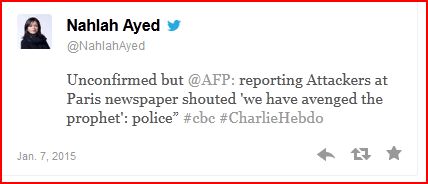
This event is completely ludicrous and, in 2015, should not be happening, some reasons off the top of my head:
1. Mohammad, Jebus, Krishna, Sif – pick your imaginary friend – they all don’t fucking exist.
2. If they did exist wouldn’t there be some godly smiting going on, like all the time? Being immortal and all powerful and all that shite, you would think that they could take care of business without the help of mere mortals.
3. How can you, a mere mortal, even think that you can contemplate what your Godhead wants, never mind what she’s offended by?
4. How does killing Western journalists advance your cause by even one micrometer? Not all journalists are card carrying lackeys of empire yet, but with doing shit-for-brains (shit for brains is my new term for “stupid” because I’ve been informed by certain elements that “stupid” is ablest slur) wankery like mass murder how is the non-wanking western media supposed to put forward the case for Islam not being full of yahoos ready to kill people for shit-for-brains reasons?
If you think this is going to be all about bashing the religious and the Muslims, you’d be wrong. Let’s get a little context on the situation from Ziauddin Sardar:
“I would argue that western imperialism has not so much forged an alliance with radical factions, as created them”, I was told, in London, by my friend, and leading progressive Muslim intellectual, Ziauddin Sardar.
And Mr. Sardar continued:
“We need to realize that colonialism did much more than simply damage Muslim nations and cultures. It played a major part in the suppression and eventual disappearance of knowledge and learning, thought and creativity, from Muslim cultures. Colonial encounter began by appropriating the knowledge and learning of Islam, which became the basis of the ‘European Renaissance’ and ‘the Enlightenment’ and ended by eradicating this knowledge and learning from both Muslim societies and from history itself. It did that both by physical elimination – destroying and closing down institutions of learning, banning certain types of indigenous knowledge, killing off local thinkers and scholars – and by rewriting History as the history of western civilization into which all minor histories of other civilization are subsumed.”
Of course our hands are dirty on this one most of the terrible shit going on in the world can be directly or indirectly attributed to putting our state interests (see colonialism, empire, and name your flavour of exceptionalism et al.) ahead of the needs of other people who happen to be living in their own countries.
Andre Vltchek continues:
“From the hopes of those post-WWII years, to the total gloom of the present days – what a long and terrible journey is has been!
The Muslim world is now injured, humiliated and confused, almost always on the defensive.
It is misunderstood by the outsiders, and often even by its own people who are frequently forced to rely on Western and Christian views of the world.
What used to make the culture of Islam so attractive – tolerance, learning, concern for the wellbeing of the people – has been amputated from the Muslim realm, destroyed from abroad. What was left was only religion.
Now most of the Muslim countries are ruled by despots, by the military or corrupt cliques. All of them closely linked with the West and its global regime and interests.
As they did in several great nations and Empires of South and Central America, as well as Africa, Western invaders and colonizers managed to totally annihilate great Muslim cultures.
What forcefully replaced them were greed, corruption and brutality.
It appears that everything that is based on different, non-Christian foundations is being reduced to dust by the Empire. Only the biggest and toughest cultures are still surviving.
Anytime a Muslim country tries to go back to its essence, to march its own, socialist or socially-oriented way – be it Iran, Egypt, Indonesia, or much more recently Iraq, Libya or Syria – it gets savagely tortured and destroyed.
The will of its people is unceremoniously broken, and democratically expressed choices overthrown.”
[Source]

Picture is unrelated. I need some awesome in this post, because otherwise it is too damn depressing.
You’ll see the word “stability” crop up when you begin to examine the officially accepted version of history we all know and love. Stability used in the geopolitical exceptional context is anti-democratic and anti-nationalist – pretty much the exact opposite of the flowery boilerplate about human rights and democracy promotion that is exuded from ‘top government’ officials.
It is usually about here I get painted as a part of the I hate america/canada crowd – but that shit can frack-off before it starts. I am not about hating my country, I’m about this country looking at our history without the friendly blinders on and owning up and taking responsibility for the horrible shit we have done/continue to do in the name of the ‘national interest’.
So ya, wanna fix the terrorism problem? Lets start at home ,with us, like this:
“If we seriously want to end the plague of terrorism, we know how to do it. First, end our own role as perpetrators. That alone will have a substantial effect. Second, attend to the grievances that are typically in the background, and if they are legitimate, do something about them. Third, if an act of terror occurs, deal with it as a criminal act: identify and apprehend the suspects and carry out an honest judicial process. That actually works. In contrast, the techniques that are employed enhance the threat of terror. The evidence is fairly strong, and falls together which much else. ”
Thank you Mr.Chomsky for that gem of a quote. Thank you dear readers for taking the time to listen to me rant.
Arbourist out.











 bleatmop
 Mystro


 Dead Wild Roses
Your opinions…