
You are currently browsing the tag archive for the ‘Identity Politics’ tag.
A conversation gleaned from Stardate Whenever –
“I was chatting with one of my managers and he told me he does drag performance and identifies as genderqueer. Which, you know, obviously I disagree with that terminology.
He had just been reprimanded at work for wearing makeup. In the same day that I was reprimanded for not wearing makeup.
And I just kept thinking about how while we framed it differently politically, we both were pissed that we were not allowed to do something because of our sex.
What was interesting is that he framed it as an invalidation of his identity whereas I framed it as an enforcement of my oppression. In my opinion, that is the big difference–I framed it as an oppressive system which people of my sex face, he framed is as a system he had not been allowed to opt out of. So it was the difference between an individual mindset and one of collective action.
Which of course became even more obvious when he explained to me the reasons why I *should* wear makeup to work.”
See the problem? The idea that your ‘identity’ is infringed upon and therefore the battle must be to change the rules within the system so you can validate your choices. The individual battle serves only the individual and as a by-product of the individual struggle the overall system is reinforced.
Is the quality of the choice ever examined? Is the nature of the system ever examined? Nope Nope Nope. The battle for individual identity choice is necessarily framed as making advancement within the oppressive framework of the gender hierarchy, thus to be affirmed in your choice, is simultaneously affirming the validity of the system. The status-quo is not threatened.
 In this case the role of gender in society is the overarching problem for both people. Gender is an hierarchy, constructed and designed for use in society to keep one class of people favoured and the other class oppressed.
The battle that should be fought, and is being fought by radical feminists, is not for getting a better a ‘choice’ within a shitty system, but for the destruction/rollback/replacement of the toxic system itself.
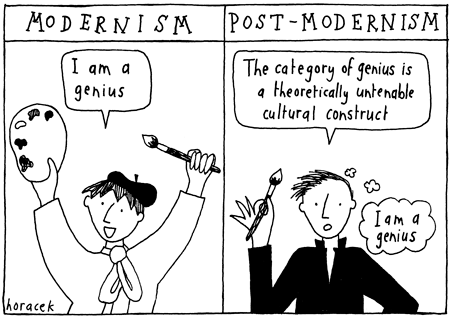 “How We Reached the Point Where We Can’t Hear Each Other” is a article on Counterpunch by Joseph Natoli. I’ve excerpted some of the beginning bits for context, but the best is when he focuses on what is happening in Education and how people are taught to think these days. I’m also a fan of his borrowing of radical feminist methodology that focuses on the the material reality of the situation and the naming of the problem. I heartily recommend you read the full article, as it suggests reasons why we are becoming less social despite ‘social’ media and the corrosive effect that identity politics, one of the crown jewels of post-modern theory, is having on our society.
[…]
“The intent of a past analog world to put us all on the same page so we could all direct ourselves in common to our common, societal problems is something now disseminated into an infinitude of self-designed enclaves. We have connectivity between the like-minded, or opinionated, but not conjunction which Bifo Berardi defines “as a way of becoming other.” (And: Phenomenology of the End, 2015)
If you want to reflect beyond the entrapment of your own personal experiences and the personal opinions derived from such, you are desiring something that has been superseded.
If you want not to be the blind man who feels the tail of an elephant and pronounces the elephant to be shaped like a snake, you are hoping for a door that leads out of the room of your own limited experience.
Unfortunately, there is no longer any need to leave that room because cyberspace has designed the whole world to be your room. You can blog, tweet, text. Video, emoji your reflections online without any intent to augment social knowledge or understanding or to encounter a counter-punch that will cause you to adjust your views.”
[…]
“We exist now within narratives, not impeccable logics and sound proofs, air-tight arguments or binding adjudications. For reasons too elaborate to condense, we have accepted Nietzsche’s view of reason as a pawn of power and have retreated to our own personal reasoning.
This retreat to personal arbitration of all matters is expressed in the politics of identity, a politics concerned with the full emancipation of the individual not as defined within any cultural, religious, historical, or anthropological notion of the individual, but defined by each and every variety of individual. It is as if the individual is a knowledge within itself.”
[…]
Education is also in a special dilemma considering the mission here is get a student to put his or her personal opinions and preferences and different experiences out of sight and attend to a rationally validated collective representation of a subject.
Nathan Heller points out that elite colleges find that the cultivation of the individual is not an easy matter when students will not leave their personal “experiential authority” at the door. (“The Big Easy,” The New Yorker May 30, 2016) One is not reading to extract eternal verities, the Enlightenment dream, or to deconstruct the pretenses of those same verities. In the climate that Heller describes, no content can be permitted to transgress the personally defined identity of the reader or listener.
An Oberlin student who Heller describes as “a trans man …educated in Mexico, walks with crutches, and suffers from A.D.H.D. and bipolar disorder …lately on suicide watch” objected to a discussion of Antigone without a trigger warning, i.e., characters in the play committed suicide. Identity-based oppression is responded to with a theory of intersectionality, which contends, “who knows what it means to live at an intersection better than the person there?” Thus, personal experiential authority now contends with a pedagogic tradition of minimizing the effects of personal experiential authority on objective, rational reflection.
Education attempts to respect individual arrangements of the results of critical thinking but not allow those arrangements to taint the process of critical thinking. This long standing agreement is no longer in effect. We have reached the point where we cannot engage in any way what may “trigger” our personal dislike or what may upset a private space we have self-designed. Long standing notions of both education and society are dissolving.
We now listen to our own voices and our clones in “social” media, a pathological condition that undermines much needed social and political communication and interrelationships. The way out, as with all pathologies, is to first recognize the condition, observe the point we have reached and reorient our compass.”
Teaching critical thinking in public education has always been a revolutionary activity, as this article confirms, it looks like it shall continue to be in the revolutionary category for quite some time.
“A generation ago, a post-modern cult now known as “identity politics” stopped many intelligent, liberal-minded people examining the causes and individuals they supported — such as the fakery of Obama and Clinton; such as bogus progressive movements like Syriza in Greece, which betrayed the people of that country and allied with their enemies.
Self absorption, a kind of “me-ism”, became the new zeitgeist in privileged western societies and signaled the demise of great collective movements against war, social injustice, inequality, racism and sexism.”
-John Pilger. A World War has Begun:Break the Silence
 I would suggest that you go read the full article by Rebecca Reilly-Cooper on politics.co.uk right now, as it describes the situation facing many feminists today. Increasingly there is no debate, there is only complete acceptance of a set of views or you’re marginalized. This is not a rational give or take situation, but rather an inquisitional drive for purity.
But I skip ahead – The article is about Germaine Greer deciding not to speak at Cardiff University because of concerns over her personal safety and the resulting fallout surrounding the event.
“In a Newsnight interview with Kirsty Wark, Greer remained characteristically uncompromising. Among the many things she said during that interview, the focus has been on two statements which directly echo Melhuish’s complaints: “I don’t think that post-operative transgender men, ie MtoF transgender people, are women” and “it is simply not true that intersexual people suffer in a way that other people don’t suffer” (given the context, it’s reasonable to assume she was referring to transgender as opposed to intersex people here).
You might not like these opinions very much. You might find them rude, obnoxious, blunt and hurtful. You might think it is disrespectful and unkind for Greer to openly proclaim that she does not share trans people’s perceptions of themselves and their identity. You might think she is mistaken, that trans women are in fact women, and do experience forms of discrimination and marginalisation that other groups do not share. But whatever your view about the truth of these opinions, it requires quite an argumentative leap to define them as hate speech, or to claim convincingly that merely holding and expressing such views is equivalent to inciting violence, hatred and discrimination against trans people. Crucially, Greer was explicit that she was making no statement at all on what treatment trans people ought to have. “I’m not saying that people should not be allowed to go through that procedure. What I’m saying is that it doesn’t make them a woman. It happens to be an opinion. It’s not a prohibition.” She also said that when speaking to trans women, she would “use female speech forms, as a courtesy”.
So Greer said nothing about what rights trans people ought to have or how they ought to be treated, and certainly nothing that could plausibly be interpreted as an incitement to violence. Believing that trans women are men is neither an incitement to violence, nor is it dehumanising, unless you also happen to think that men deserve violence and are not human. So the two main offences she is accused of are ones she openly admits to: not believing that transgender women are women, and not believing that transphobia – prejudice and bigotry towards transgender people – exists.
Both of these offences are solely concerned with the propositional content of Greer’s beliefs. That is, the objection is that she believes things that her opponents believe to be false, and that these beliefs are, for reasons that are never properly articulated, “dangerous”. So what Greer stands accused of is, essentially, thoughtcrime. She is guilty of holding the wrong thoughts, of believing the wrong things, of entertaining ideas and defining concepts in ways that diverge from some doctrine to which all decent people are supposed to subscribe. One must believe that trans women are women, and one must believe that trans people are subject to forms of prejudice and discrimination that others are not, and if you do not hold those beliefs, then you are by definition dangerous, a potential threat to others, and must be silenced. The possibility of reasonable disagreement on these issues is ruled out, ex hypothesi.
The response to Greer and her alleged transphobia is just one example of a creeping trend among social justice activists of an identitarian persuasion: a tendency towards ideological totalism, the attempt to determine not only what policies and actions are acceptable, but what thoughts and beliefs are, too. Contemporary identity-based social justice activism is increasingly displaying the kinds of totalising and authoritarian tactics that we usually associate with cults or quasi-religious movements which aim to control the thoughts and inner lives of their members. The doctrine of “gender identity” – the idea that people possess an essential inner gender that is independent both of their sexed body and of the social reality of being treated as a person with such a body – has rapidly been elevated to the status of quasi-religious belief, such that those who do not subscribe to it are seen as not only mistaken and misguided, but dangerous and threatening, and must therefore be silenced.”
Gender identity is all about the feels, however… strong personal feelings do not trump reality or the facts of the matter. Women, the feminist movement, and society in general will be in a great deal of trouble if they ever do.
“Queer theory and politics became involved in a gender rescue mission against the radical feminist campaign to abolish it. This may be because, for most women and men under male dominance, sexual desire is constructed precisely from eroticising the power difference between the sexes that is embodied in gender. Equality is unsexy and the very idea of dismantling gender is, therefore, as Catharine MacKinnon explains, ‘detumescent’ (Jeffreys, 1990; MacKinnon, 1989).”











 bleatmop
 Mystro


 Dead Wild Roses
Your opinions…