
You are currently browsing the tag archive for the ‘LHC’ tag.
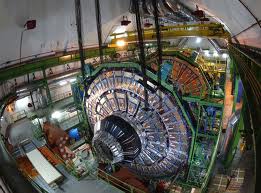 The LHC is beginning to collect evidence for the elusive Higgs Boson.
“Scientists are hoping that the Large Hadron Collider (LHC) will finally nail Higgs boson — the “God particle” which theoretically endowed every other particle with mass, but has proved elusive to date. The discovery of Higgs boson is one of the chief goals of the LHC, the most powerful particle accelerator on Earth and perhaps the most complex scientific endeavour ever attempted.
At a meeting of the European Physical Society in Grenoble, France, physicists – including some from Caltech – announced that the latest data from the LHC might hint at the existence of the elusive particle.
But the data are not yet statistically significant enough to be called a definite signal, let alone a discovery of the Higgs particle, says Harvey Newman, professor of physics.”
Damn this is an exciting time to be alive. This discovery would be bigger than the Beatles and jebus.
“One could speculate that it’s an unusual statistical fluctuation,” he says. “But I don’t think so.” Physicists will continue to ramp up the LHC, boosting it to higher energies and increasing the number of collisions to improve the chances of producing Higgs bosons.
With several times more particle interactions, the physicists are continuing to close in on the Higgs, as well as other new particles and interactions. There’s a chance that by the end of next year, they may determine, once and for all, whether the Higgs exists.”
The LHC continues to push the envelope in physics and cosmology.

What happens when you put Lead in the LHC and go Boom!
“A miniature Big Bang was created at the Large Hadron Collider this week as the world’s most powerful atom-smasher successfully entered a new phase of exploration.”
Creating the conditions that existed some 14 billion years ago is another new plateau for science and our understanding of our universe.
“These experiments[ attempting to find the Higgs Boson a.k.a the God Particle] were shut down last week, to allow the collider to run with lead ions — atoms from which an electron has been removed — to study different aspects of physics.
The lead ion collisions will allow the collider to create a superheated mixture of subatomic particles called quark-gluon plasma, which pervaded the Universe immediately after the Big Bang.”
“This process took place in a safe, controlled environment, generating incredibly hot and dense sub-atomic fireballs with temperatures of over ten trillion degrees. At these temperatures even protons and neutrons, which make up the nuclei of atoms, melt resulting in a hot dense soup of quarks and gluons known as quark-gluon plasma.”
Mmmm, yummy warm quark-gluon soup. We shall have to wait while the results are analyzed, stay tuned for further LHC updates.
A neat tour of the LHC with a few updates as to upgrades, plus lotsa 3D zooming!
The authors of this particular video have taken pains to make particle physics and the LHC as interesting and accessible as possible. Not a lot of meat here, but still the fly though of the LHC site and some of the pictures of the first higher energy collisions are really quite fantastic.
From the CBC Science and Technology Section:
 “The European Organization for Nuclear Research, or CERN, said beams of protons circulated at 3.5 trillion electron volts in both directions around the 27-kilometre tunnel housing the Large Hadron Collider under the Swiss-French border at Geneva.”
We are fired up and good to go! I am anxiously waiting for the experiments to start now the the LHC seems to be working at full capacity and is not producing singularities that will officially be ‘very bad news’ for the dwellers on the earth.
:The extra energy in Geneva is expected to reveal even more about the unanswered questions of particle physics, such as the existence of dark energy and matter. Scientists hope also to approach on a tiny scale what happened in the first split seconds after the Big Bang, which they theorize was the creation of the universe some 14 billion years ago.”
I have recently been ‘debating’ with creationists and more hard evidence is always a good thing. To be honest, it is not much of a contest, but can be fun; like fishing with hand grenades.
“Getting the beams to 3.5 TeV is testimony to the soundness of the LHC’s overall design, and the improvements we’ve made since the breakdown in September 2008,” said Steve Myers, CERN’s director for accelerators and technology.”
*waves pom-poms* Go Science Go!
Now in star trekkian like language fresh from the LHC webpage:
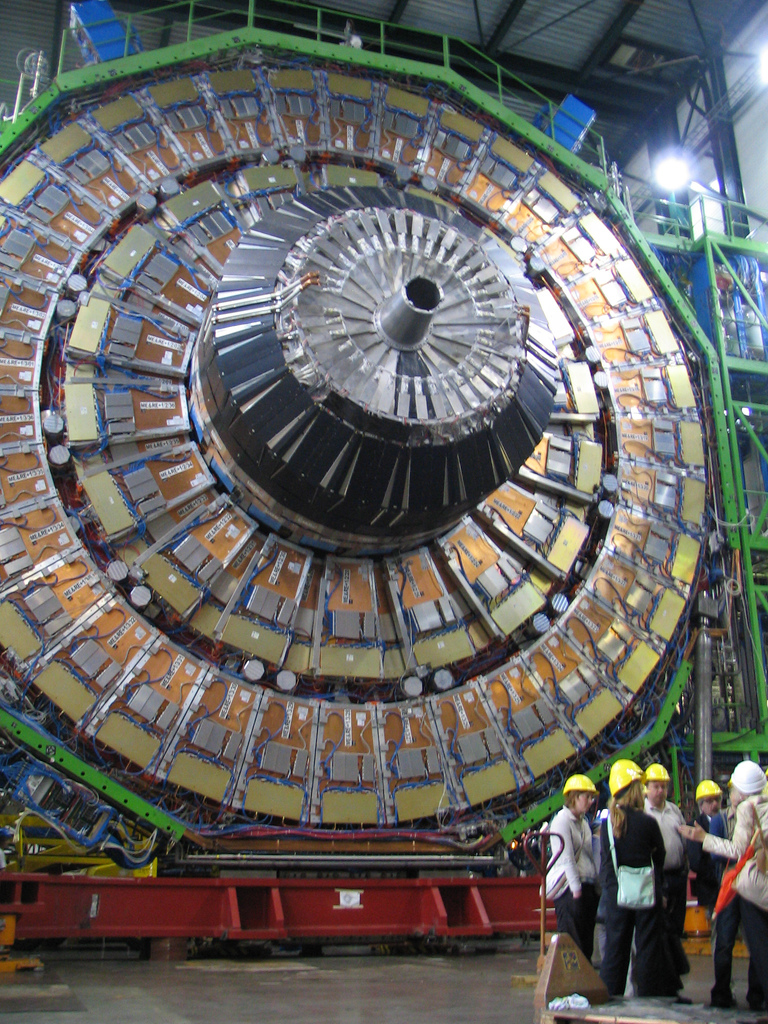
Full steam ahead!
Following the completion of the campaign to improve the reliability of the cabling for the new Quench Protection System, the main dipoles and quadrupoles of the eight LHC sectors have now been commissioned up to a current of 6 kAmps. In the early hours of Sunday 28 February, the beams were circulating again in the LHC: the longest run in CERN’s history has just started!
The beams are interfacing appropriately within acceptable parameters! Excellent. :)
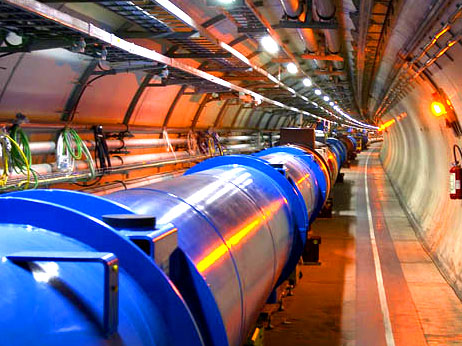 Sending our best hopes that the LHC will not have any more breakdowns as they search for some of the answers in physics and quantum physics that been at the forefront of their respective fields. They ran a test and nothing blew up, a good sign to say the least. Catch the full story at the CBC.
“The operators of the Large Hadron Collider have successfully sent a beam of protons around the ring of the world’s largest particle collider.
It is the first time the Large Hadron Collider, or LHC, has been operational since September 2008, when an electrical connection in the collider’s magnets melted, causing a tonne of super-cooled liquid helium to leak into the tunnel.”
So now we can continue to speculate whether we will create a micro black hole and really mess things up on a planetary scale.











 bleatmop
 Mystro


 Dead Wild Roses
Your opinions…