
You are currently browsing the tag archive for the ‘Media’ tag.
John Pilger does what a journalist is supposed to do. He questions decisions made by those who are in charge and hold them to account for their decisions. As witnessed during the lead up to the Iraq war in 2003 most of the easily accessible media in the West is, for the most part uncritical and (appallingly) accepting of what those in power want us to believe.
This isn’t new information – let’s go back to 1946.
“In 1946, the Nuremberg Tribunal prosecutor said of the German media: “Before every major aggression, they initiated a press campaign calculated to weaken their victims and to prepare the German people psychologically for the attack. In the propaganda system, it was the daily press and the radio that were the most important weapons.”
Stirring up fear and blind patriotism is the first ingredient in the propagandist’s recipe book. For people who are afraid, are all to willing to forget their common humanity when they perceive a “threat” to their future.
The real reasons we fight ‘terrorism’ and ‘defend our freedoms’.
“The attack on Iraq, the attack on Libya, the attack on Syria happened because the leader in each of these countries was not a puppet of the West. The human rights record of a Saddam or a Gaddafi was irrelevant. They did not obey orders and surrender control of their country.
The same fate awaited Slobodan Milosevic once he had refused to sign an “agreement” that demanded the occupation of Serbia and its conversion to a market economy. His people were bombed, and he was prosecuted in The Hague. Independence of this kind is intolerable.
As WikLeaks has revealed, it was only when the Syrian leader Bashar al-Assad in 2009 rejected an oil pipeline, running through his country from Qatar to Europe, that he was attacked.
From that moment, the CIA planned to destroy the government of Syria with jihadist fanatics – the same fanatics currently holding the people of Mosul and eastern Aleppo hostage.”
Actual freedom and actual independence are the official enemies. There is no international glorious commitment to human rights and freedoms, but rather, the economic and political machinations of state that are the true driver of the various ‘humanitarian interventions’ across the globe.
Did you need to see this in action on a smaller scale. Well, there just happens to be a captioned poster for that.

This is why words like ‘power’ and ‘justice’ must be so carefully defined and put into the proper context – because people experience these concepts in vastly different ways depending on their place in the social hierarchy. It is particularly fair? Not even close, but it is how power, and by extension, how our society works.
State terrorism and religious terrorism are directly correlated.
“According to its own records, Nato launched 9,700 “strike sorties” against Libya, of which more than a third were aimed at civilian targets. They included missiles with uranium warheads. Look at the photographs of the rubble of Misurata and Sirte, and the mass graves identified by the Red Cross. The Unicef report on the children killed says, “most [of them] under the age of ten”.
As a direct consequence, Sirte became the capital of ISIS.”
Within most of major media, the results of our violence is almost never mentioned. The silence is deafening with regards to our culpability in committing these atrocities.
“When the truth is replaced by silence,” said the Soviet dissident Yevtushenko, “the silence is a lie.”
The complicity of most of our media means that state power, and the ‘national interest’ remains potently in the background, unchallenged, unexamined, and uncritically accepted.
“The same year, soon after the invasion, I filmed an interview in Washington with Charles Lewis, the renowned American investigative journalist. I asked him, “What would have happened if the freest media in the world had seriously challenged what turned out to be crude propaganda?”
He replied that if journalists had done their job, “there is a very, very good chance we would not have gone to war in Iraq”.
It was a shocking statement, and one supported by other famous journalists to whom I put the same question — Dan Rather of CBS, David Rose of the Observer and journalists and producers in the BBC, who wished to remain anonymous.
In other words, had journalists done their job, had they challenged and investigated the propaganda instead of amplifying it, hundreds of thousands of men, women and children would be alive today, and there would be no ISIS and no siege of Aleppo or Mosul.”
Demand better of your media outlets. Spend time perusing alternate sources of media, be cognizant of the ‘official’ narrative. Ask questions.
Some places to start: Tom’s Dispatch, Counterpunch, Al Jazeera, Media Lens.
Patriarchy is alive and well in 2016. Let’s head over to the Olympics – Exhibit 1:

Oh, look who owns her. Her position of ‘wife’ is obviously relevant information as to HER Olympic achievement.
Ooookay. Maybe this is just a fluke this isn’t a implicit patriarchal norm – we just need to find all the stories that mention a man’s status as “husband” first then his achievement… (good luck with that).
Surely in swimming it must not be the case:

Ah, because the man-stroke is the only stroke that could possibly be responsible for her achievement. Not her ability, her talent, her fucking grit – nope nope nope – manstroke for the winz.
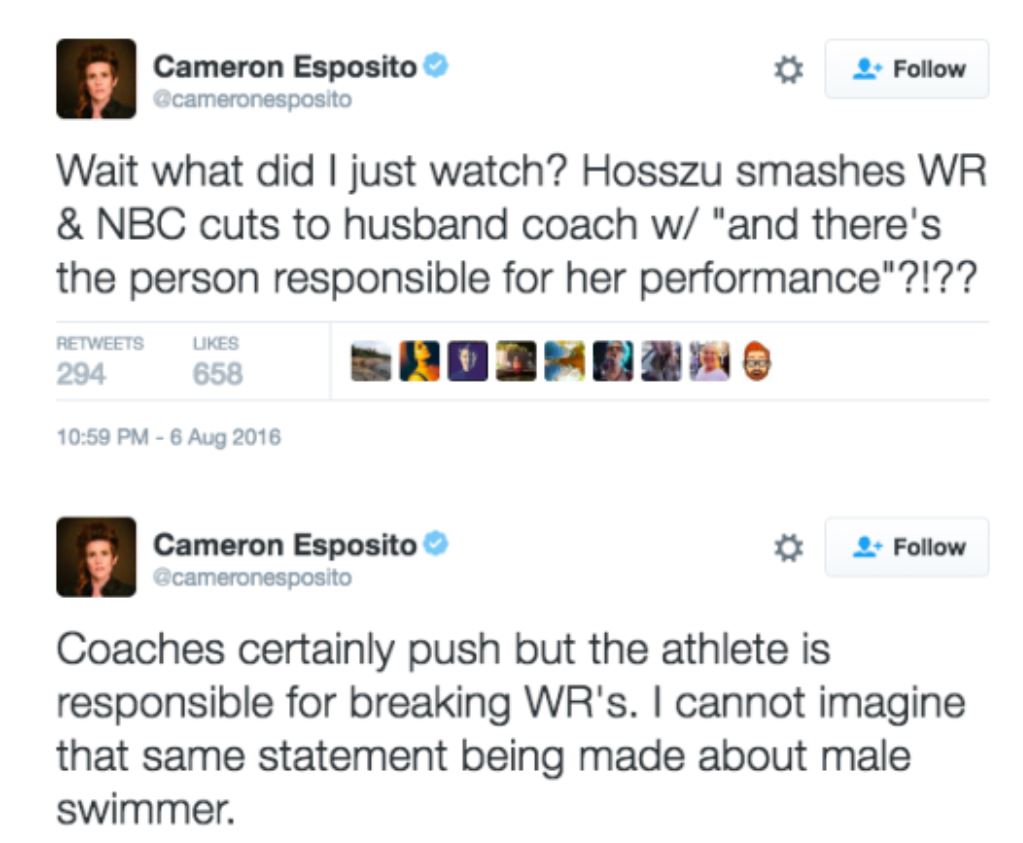
Seeing a pattern here? The systematic denial of female agency and achievement – and attributing said achievement to a man. Feeling the 2016 equality yet?

May as well be, if you happen to be female and good at something. :/
“Oh Arb!” says my skeptical male readership, “These are just rare incidences and are in the realm of sports – sports are known for their male bias you shouldn’t be making hasty generalizations about society based of a few sports clips.”
Maybe popular magazine covers?

Apparently only the male face is appropriate for Magazine covers, females though, as long as you are almost naked, then you are allowed to have a head.
Nope…popular magazine are still all-a-board the patriarchy bus.
Okay dudes, lets change the channel, how about leadership of the Western Free World? Certainly the framing of female success through the patriarchal lens won’t happen here! (oh wait…)
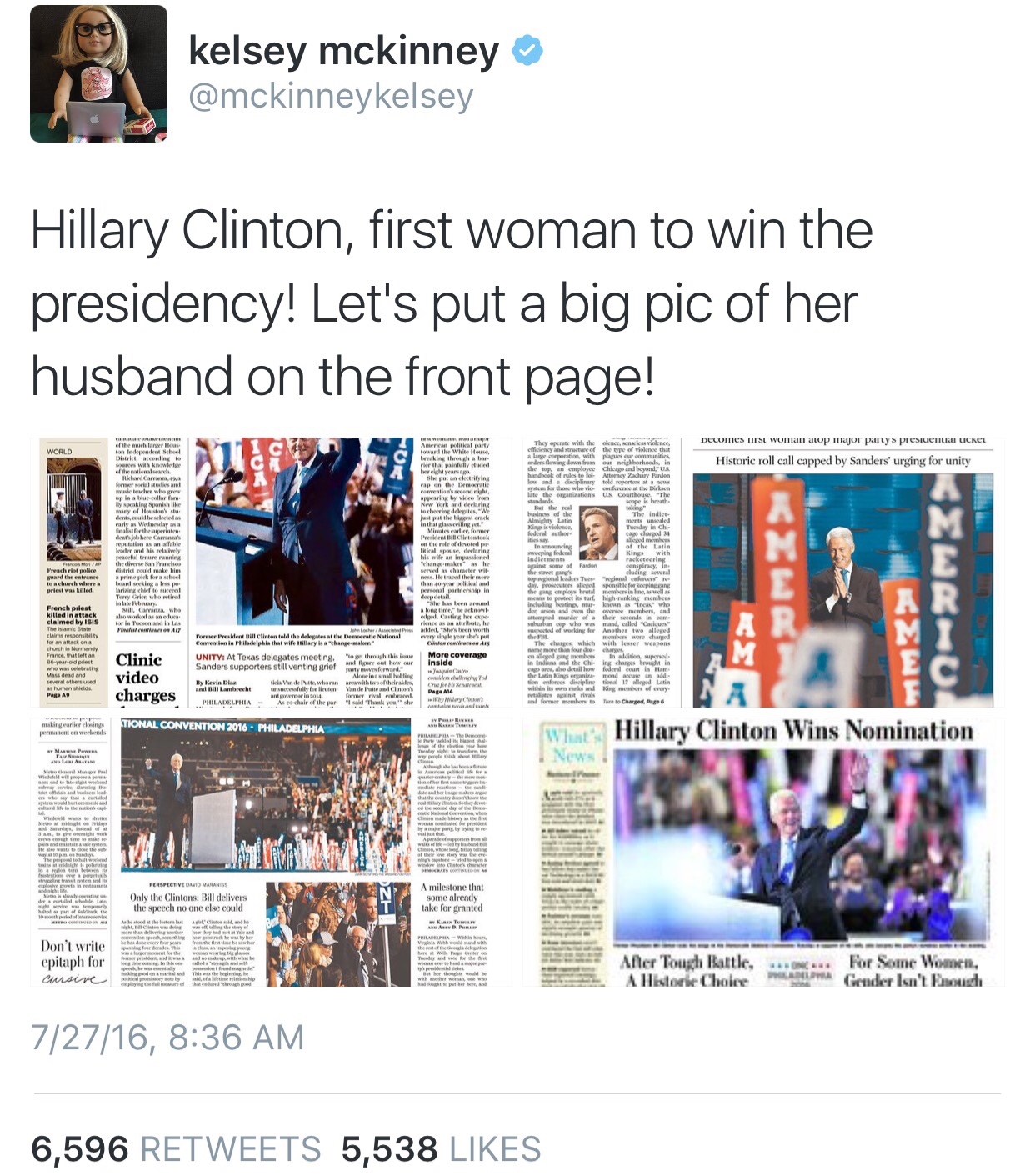
Correction – First female to win the nomination to be president of the US. What do the papers record – her husband at HER nomination victory. I can’t wait to see the pictures if HRC wins the presidency, more pictures of Bill?
Yeah, sooooooo… When you hear people (mostly dudes) prattle on about society becoming a matriarchy or that we’ve achieved equality, kindly refer them to this post and maybe help explain to them that their cluelessness is really quite embarrassing.
Why is it hard for women to achieve in our society? Partially because of the systemic shit like this that denies women their role models and examples of success – you can’t be it, if you don’t see it. So let’s not discount effective feminism and the work that still needs to be done by radical organized groups of females working together to dismantle the patriarchal superstructure that harms women and men.

From Counterpunch:
“Jill Stein, the Green Party’s nominee for president, has been the sudden target of attacks from all corners of online media since the official end of Bernie Sanders’ campaign at the Democratic National Convention. Outlets like the Washington Post, New York Magazine and Gizmodo have assaulted Stein by using out-of-context quotes to assail her, wrongly, for being anti-vaccination and anti-WiFi, which is a code for being “anti-science.” This allows us a unique opportunity to confirm the structural role of the media as hypothesized by Noam Chomsky and Edward Herman in Manufacturing Consent: that the media is a propaganda arm for the elite and powerful, and is used to condition us to accept the bounds of socio-political discourse as set by the ruling class. It also shows us the desperate need we have for an alternative media culture to counteract mainstream discourse.
The attack on Stein (and not, conveniently, on Gary Johnson), is linked to the need by the elite to de-legitimize A.) critics of neoliberal policies and B.) potential alternatives to the political status-quo. Trump and Clinton have had and will have no discussion about thirty years of neoliberalism and austerity. Sanders gave a voice to those within the Democrats who were willing to question, but since his defeat momentum on the left has shifted to Stein and the Green Party. It is, granted, still early, but the outpouring of support means there is a possibility the left could begin to regroup outside the Democratic Party. Real success for Stein could mean a permanent presence on the national stage for the left, to which a president Clinton or Trump would have to answer and which would be able to build an entirely different ideological discourse in the United States.”
The treatment of Jill Stein should be an interesting application of the propaganda model. What we’ve seen during the election cycle confirms much of what Herman and Chomsky hypothesized – issues that affect the public are not being discussed, there is an acceptable line of questions, answers, and responses that are allowed in the media – the rest are swept to the margins and actively ignored.
Is there any wonder left as to why the American people look so dimly on their Congressional representatives? They are supposed to speak for the people, yet strangely enough, once elected other interests seem to take precedence.
You can read about the Propaganda Model of Herman and Chomsky here.
 Don’t feel bad about this, we are all in the same boat when it comes to making bad decisions or being unduly influenced. The science behind advertising and persuasion has come a long ways, and knowing how they manipulate you and the rest of the public is valuable knowledge. James Garvey lists three of the ways we are vulnerable to persuasion the Representative Heuristic, the Availability Heuristic, and the Anchoring Effect. Before we can discuss these systems though a brief overview of how we think and the short cutting our brain does that makes life generally go well but not always thoughtfully.
[…] by distinguishing between two kind of thinking:fast, automatic, intuitive thinking and slow, reflective, rational thinking. You can imagine that these two kinds of mental activities are the work of two parts of your mind, two systems that swing into different kinds of action to accomplish different tasks. The part that is responsible for first kind of thinking is called system 1 or the Automatic System, and the part the engages in slower, more careful thought is called system 2 of the Reflective System.
System 1 operates quickly and automatically, This feels instinctive and intuitive, and it requires no effort on your part. System 1 is in charge when you orient yourself to a sudden sound, wince involuntarily when you see something that disgusts you, read anger in the lines on someone’s face, and recognize written words in your native tongue – it all just clicks fluently and automatically, without you thinking about it at all.
The work of System 2, the Reflective system, takes effort, an act of deliberate concentration on your part. Your deliberative efforts are limited and cannot be sustained for very long without degradation, a phenomenon called ego depletion. System 2’s work is voluntary, slower that your gut reactions, and associated with the experience of choice and agency.
[…]
The two systems interact with each other in a number of surprising ways, System 1 typically engages in a kind of constant monitoring, throwing up a series of impressions and feelings that System 2 might endorse, ignore, check, focus on, act upon, or simply go along with. Much of the time System 2 is in a low power state, aroused only when the Automatic system encounters something it cannot handle.
[…]
Our mental resources are therefore limited. It is an effort to bring System 2 into play, and it can be overloaded by trying to do too much. So evolution has taught us a number of shortcuts, rules of thumb or heuristics, which conserve our mental energies and serve us well most of the time.
[…]
But it also means that we go wrong in systematic, predictable ways – we are constitutionally susceptible to cognitive biases, and in turn, we can be nudged.
[…]
We use shortcuts to arrive at judgments too. […] It’s a large part of the theoretical framework behind contemporary persuasion, and it’s already shaping our world and changing our lives.
Consider this description of Steve.
‘Steve is very shy and withdrawn, invariably helpful, but with little interest in people, or in the world of reality. A meek and tidy soul, he has a need for order and structure, and a passion for detail’
What do you think Steve does for a living? Is he more likely to be a farmer, salesman, airline pilot, librarian, or physician? Once you have an answer to that question , ask yourself what job he is least likely to have.
[…]
Very many people, including me when I first read that description , conclude that Steve is most likely a librarian – how could this shy guy like that possibly be a salesman? – and in coming to this conclusion we make use of what Kahneman and Tversky call the representativeness heuristic. We let our automatic faculties rip and take a short cut to an answer. If one slows down and thinks about it, though, there are a lot more farmers than librarians in the world. That’s extremely pertinent information if you are trying to guess which job on a list is most likely for anybody, and it should lead us to conclude that it’s most likely Steve is a farmer, maybe a shy and withdrawn farmer, but still a farmer. The probability that Steve is a librarian is instead assessed by the extent to which the description of Steve matches up with or is representative of stereotype of a librarian we have in our heads.
[…]
We do this entirely automatically, and it has an effect on a host of judgments – how likely we think politicians are to be good leaders, how likely a new business is to succeed, and how likely our doctor is to be competent.
[…]
People who understand persuasion will take care to fit the right stereotype and make it easier for us to come to conclusions about them automatically.
A second set of biases result from what Kahneman and Tversky call the availability heuristic. When we think about how likely some even is, we’re affected by how readily examples come to mind.
[…]
We are likely to over-estimate the number of wayward politicians, shark attacks and meltdowns at nuclear plants because we can probably easily recall instance of such things. The problem is that how easily we can recall something has less to do with how likely or common or worrying an occurrence is and more to do with what we happen to have heard about in the news recently and how striking that news was to us. The news you choose to watch therefore has a lot of power over you, The stories it repeats reinforce your susceptibility to the availability effect.
[…]
We over-react at first, then under-react as time goes on. […] Because of its salience, we think homicide is more common that suicide, but it isn’t. In fact, Americans are more likely to take their own lives than be murdered or die in a car crash, but because murder and car accidents are more newsworthy, dramatic and available that suicide, we concern ourselves more with home alarm systems and airbags than the signs of depression.
A final kind of bias identified by Kahneman and Tversky, perhaps the most interesting and difficult to accept of the three, is called the anchoring effect. When people first think about a number and try to estimate an unknown quality, the initial number affect their guess, anchors it – the estimate they make tends to stay near by. Again, the rule of thumb in play isn’t too bad a guide, and we use it all the time. What’s the population of Pittsburgh? If you don’t know, but you do know that Philadelphia is the largest city in Pennsylvania, and it has about 1.5 million people in it, you might feel able to guess about Pittsburgh. It’s certainly smaller than Philadelphia – maybe it’s half the size, so perhaps Pittsburgh has a population of few than 750,000, Maybe 600,000?
There are two very weird facts about this familiar process of guessing a quantity, First we tend to undercook the adjustments we make from the original guess. Once we have a number and begin adjusting in the direction we think is right, we tend to stay too close to the anchor, possibly because once we find ourselves in uncertainty, we can’t think of a good raise to carry on, so we play it safe and stop too soon. Pittsburgh is smaller that Philadelphia, so we adjust downwards, but how far downwards? In fact, this example we stayed much too close to the anchor, as we usually do. Just 300,000 people live in Pittsburgh.
Second, it doesn’t matter where the first figure comes from, it will still anchor our estimates, even it has nothing at all to do with the domain in question. According to at least one understanding of what’s going on in such cases, sometimes System 2 is in charge, finding what it hopes to be a reasonable anchor and adjusting off it to estimate an unknown quantity. But sometimes System 1 gets hooked on an anchor and freely associates, without our conscious control, and the cascade of associations ends up affecting our later estimate, whether it’s reasonable or not.
Tversky and Kahneman illustrated this second kind of anchoring with a rigged roulette wheel – it showed numbers from 0 to 100 but it actually stopped on either 10 or 65. They spun the wheel and asked a group of students to write the number down, and then answer two questions.
‘Is the percentage of African nations among the UN members larger or smaller than the number you just wrote?’
‘What is your best guess of the percentage of African nations in the UN?’
The average guess of those who saw the number 10 was 25 percent. The average guess of those who saw the number 65 was 45 percent. A roulette wheel is not a particularly informative thing if you’re trying to work out how many African nations are members of the UN, but still, those who saw the high number guessed higher than those that saw the low number. Even ludicrous anchors have an effect on us”
-James Garvey. The Persuaders pp. 55 – 66

Yeah, so being wary of your System 1 answers is probably a good thing. Bad news for the anchoring effect, as even when you’re told about it, it still works on you. :/
 How I experience the internet is vastly different depending on whether I am at work, or at home. At work, wherever I go, I experience pop-ups, obtrusive ads, and auto-play movies/noise. Let me assure you, that while teaching, having all the distracting advertising going on in the background does not help the learning experience. But meanwhile, at home I can browse the web unencumbered by any of the annoyances listed above. Pages load quickly and are appealing to read with little clutter to distract the eye and the mind. This peaceful repose is achieved primarily through the use of two program plugins that are available to the Firefox browser – Ad Block Plus and Ghostery. Ad block screens out most of the ads and Ghostery stops websites from tracking your movements and preferences as you browse on the internet (oh, and duck duck go is a nice start to increase your privacy while browsing as well). The powers that be though, are not amused by individuals taking control of their internet experience.
“Global ad spending is expected to reach $600 billion US by the end of next year, according to eMarketer, and grow at an annual rate of about five per cent until the end of the decade. Much of that growth is being fuelled by digital advertising, particularly on mobile devices.
But there was one session in Cannes where some very dark clouds managed to intrude on the sunny forecast. It was a panel devoted to the current scourge of the digital advertising industry — ad blocking.
According to a report by PageFair and Adobe, more than 200 million people worldwide have downloaded software that can block virtually all online advertising.
The number of people blocking ads increased by more than 40 per cent last year, and it is estimated that blocking cost cash-starved publishers more than $22 billion last year.”
Oh my goodness. People not wanting advertising to be part of every facet of their life, not a choice, but a scourge.
“Almost everyone in the ad industry acknowledges that most of the wounds that have led to the rise in ad blocking are self-inflicted.
Advertisers got greedy by assaulting users with too many low quality, untargeted ads, too many auto play videos, too much click bait.
Last fall, the IAB launched an initiative called L.E.A.N. Ads (light, encrypted, ad choice supported, non-invasive).
The IAB hopes that by following the L.E.A.N. guidelines, advertisers will create ads that consumers will be happy to see.”
Hmm, so we alienate people to the point where ad blocking is necessary to have a good browsing experience and then complain that ad-blocking is ‘killing’ the internet. Other entities have decided that they won’t let the user in, if ad-blocking is enabled.
“Sites like Forbes and GQ won’t allow access to their content unless users turn them off. At Cannes, Mark Thompson, the president and CEO of the New York Times, announced that his newspaper would soon be offering an ad-free edition to subscribers at a premium price.
Other publishers are appealing to their readers’ sense of fairness and justice, asking them to turn off their blockers and reminding them they are a critical part of the ecosystem that has powered the internet for the past 20 years. Without ads, there would be no free content online.”
Well, GQ and Forbes you can go frack yourself sideways as the content you produce will be reproduced elsewhere on the web without your restrictions. :) The counterpoint to this though is the insidious beast known as ‘native advertising’.
“So-called “native advertising” has been growing in popularity over the past several years. Also known as “sponsored content,” it looks and feels like editorial content, but it comes from advertisers rather than journalists.
Native advertisements can often pass through ad blocking filters because the filters don’t recognize it as advertising. Many readers seem to prefer this kind of content over traditional advertising, provided it’s properly labelled, although there’s no consensus on what constitutes proper labelling.”
Watch your daily paper, there is more this native advertising junk in there everyday. If there is a scourge to be named, it should be that of the advertising editorial or advertorial.
“But the real victims of the ad blocking surge may not be advertisers and publishers, but the “free” web itself.
The money to pay for content has to come from somewhere, and if you take advertising revenue out of the equation, readers will have to pick up the slack themselves, something they have historically been reluctant to do. Without ads, the web may be a poorer and less interesting place.”
Breaking news: The sky is indeed falling. Also: A-Booga-Booga-Booga! The heart of the very internet itself will crumble if ad-blocking continues!
The advertising industry may piss-off right the frack off with their hyperbole; starting yesterday. If the amount of stultifying drek available on the interweebs is halved tomorrow, not a soul would notice. So I say bring on the next internet apocalypse.











 bleatmop
 Mystro


 Dead Wild Roses
Your opinions…