
You are currently browsing the tag archive for the ‘Media’ tag.
The red pen of justice is wiggling, but I’ve run out of time. We’ll make do with this rage building infographic while I see if I can scrape some time together during the week to compose the piece that is swirling in my brain.

Deceptive, misleading and manipulative. That would be the Faux News in a nutshell. Liberal viewer carefully dissects the bullcookery for your viewing pleasure.
 Political theatre harms us all. Issues that are important to public are marginalized while supposedly “important” issues take the spotlight. (Yes, you women, under the bus, stat!)
Noam Chomsky summarizes what elections have become in the US –
“Elections are run by the public relations industry. Its primary task is commercial advertising, which is designed to undermine markets by creating uninformed consumers who will make irrational choices – the exact opposite of how markets are supposed to work, but certainly familiar to anyone who has watched television.It’s only natural that when enlisted to run elections, the industry would adopt the same procedures in the interests of the paymasters, who certainly don’t want to see informed citizens making rational choices. The victims, however, do not have to obey, in either case. Passivity may be the easy course, but it is hardly the honorable one.”
Call to arms or maybe just maybe a little of Mr.Jackson’s “wake the F**k up”, whatever it takes but for goodness sake cut through the noise and get people thinking for themselves again.
I’ve read Pornland by Gail Dines but was unaware of her online presence. Porn is not an easy topic for TV producers and it appears Ms.Dines had been down this road before as she relates her experience of almost getting on the Melissa Harris Perry Show to talk about the effects of pornography on women. The first 3 paragraphs are here, I suggest you follow the link back read the rest of this fantastic article.
When a Feminist Gets Bumped for a Pornographer
by GAIL DINES
Last week, midway through a leisurely Saturday afternoon, I got an email from MSNBC asking me to be on the Melissa Harris Perry Show a week later (July 7th). I was delighted to accept, as MHP is not your usual American journalist. A professor of political science at Tulane University, she is an outspoken African American feminist and a progressive voice in a media landscape dominated by right-wing talking heads. MSNBC is a rare media oasis in the U.S. where one gets to hear some actual critical analysis, so I—mistakenly, it turned out—thought this was going to be one of the few positive experiences I’ve had working with corporate-controlled media. In all honesty, after many years of being on talk shows in the U.S., I have come to expect very little in terms of integrity from the media. Their job is to boost ratings by making stories entertaining and light, and God help anyone who gets in their way.
I spent a long time on the phone with MHP’s producer talking about my research on the harms of porn and the ways women in the industry—especially women of color—are financially exploited and physically and emotionally dehumanized and debased. Given MHP’s feminist politics and her scholarly work on the representation of African American women in U.S. history, I was excited to do a show with an interviewer whom I expected would be engaging and thoughtful, in contrast to the usual adolescent sniggering I get from the male journalist who suddenly finds himself in the awkward position of interviewing a feminist who doesn’t think porn is fun.
 But by the middle of the week things started to go very wrong. My last conversation with the producers was on the Sunday before the show, and I was told that I would get a call by Tuesday to confirm my travel details. Wednesday came, and no call. On Thursday, I got an email saying that the “segment is changing,” so they won’t need me. “Changing”… not canceled. To the uninitiated this might seem like splitting hairs, but I am an old hand at dealing with the media, and I have been in this position more times than I can count.
Let me explain how it often plays out: I get a call from a producer to do a show about porn, and in our pre-show discussion the producer is shocked to hear about what really goes on in the porn industry. He or she had no idea that hardcore porn (called “gonzo” by the industry and fans) is now mainstream on the Internet, that choking with a penis, slapping, hair pulling, and verbal abuse is the norm. The producer is horrified to hear that women in porn suffer repeatedly from rectal prolapse (because of pounding anal sex), and get diseases such as clamidia of the eye, gonorrhea of the throat, and fecal throat infections (because of the ATM act in which the penis goes from the anus to the mouth without washing). As we talk, I know exactly what is going on in the producer’s mind: they see their fun, hot-ratings-driver segment going down the tubes, and they are suddenly in the not-so-fun territory of cruelty, violence, and economic exploitation.
Go to Counterpunch for the rest of the story.
 People still cling to the idea that we have a liberal news bias in the media – Let’s look to the problem of global warming in an example from Media Lens.
“[…] Equally disturbing is the variation in media performance across the globe. A wide-ranging Reuters study on the prevalence of climate scepticism in the world’s media – Poles Apart – The international reporting of climate scepticism – focused on newspapers in Brazil, China, France, India, the UK and the USA. The periods studied were February to April 2007 and mid-November 2009 to mid-February 2010 (a period that included the UN climate change summit in Copenhagen and ‘Climategate’). Remarkably, the study concluded that climate scepticism is ‘predominantly an Anglo-Saxon phenomenon’, found most frequently in US and British newspapers:
‘In general the UK and the US print media quoted or mentioned significantly more sceptical voices than the other four countries. Together they represented more than 80% of the times such voices were quoted across all six countries.’
The study concluded:
‘In general, the data suggests a strong correspondence between the perspective of a newspaper and the prevalence of sceptical voices within it, particularly in the opinion pages. By most measures (but not all), the more right-leaning tend to have more such voices, the left-leaning less.’
But in all ten UK newspapers studied, there was an increase ‘both in the absolute numbers of articles with sceptical voices in them and the percentage of articles with sceptical voices in them’.
And so we find that Britain and the US – the two countries responding most aggressively to alleged ‘threats’ to human security in countries like Afghanistan, Iraq and Libya – are also the two countries least interested in responding to the very real threat of climate change.”
Could it be that because we are actually securing access to fossil sources that we’re not really focusing on the downside of their use?
“As the Reuters study suggests, media reporting is heavily influenced by editorial stance which, in turn, is heavily influenced by commercial interests. In October, the former Daily Star journalist Richard Peppiatt told the Leveson inquiry into the culture and ethics of the British press the truth about about the UK’s newsroom culture:
‘In approximately 900 newspaper bylines I can probably count on fingers and toes the times I felt I was genuinely telling the truth, yet only a similar number could be classed as outright lies. This is because as much as the skill of a journalist today is about finding facts, it is also, particularly at the tabloid end of the market, about knowing what facts to ignore. The job is about making the facts fit the story, because the story is almost pre-defined.
‘Laid out before you is a canon of ideologically and commercially driven narratives that must be adhered to. The newspaper appoints itself moral arbiter, and it is your job to stamp their worldview on all the journalism you do… The ideological imperative comes before the journalistic one – drugs are always bad, British justice is always soft.’
Peppiatt noted:
‘Tabloid newsrooms are often bullying and aggressive environments, in which dissent is simply not tolerated. It is difficult to stand up and walk out the door with a mortgage to pay, knowing another opportunity is unlikely to be waiting beyond.’
The issue that is not being discussed by Leveson is the extent to which these observations generalise to the ‘quality’ corporate media, and why. By contrast, in soft-pedalling the level of interference from owners and advertisers, the Guardian’s Nick Davies wrote:
‘Journalists with whom I have discussed this agree that if you could quantify it, you could attribute only 5% or 10% of the problem to the total impact of these two forms of interference.’ (Davies, Flat Earth News, Vintage 2008, p.22)
Compare this with corporate escapee Peppiatt’s unfettered conclusion:
‘Capitalism is trampling on journalism.’
I happen to agree with this statement. The answer – I suggest more outlets like Al-Jazeera the BBC and the CBC that, although still heavily influenced by corporate and government pressure, they can occasionally still report the truth of matters.
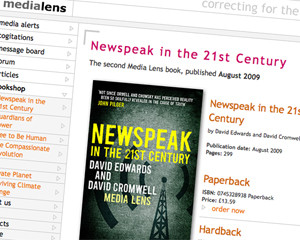 Media Lens has been around for ten years now, continually challenging the view the corporate media presents to people. The authors answer a few common questions as to why they do what they do in a very clear and structured way. Defining the problem is always the first step to finding a solution, so I reprint their words here with the goal of defining the problem for people to see.
“Question: Why did you start Media Lens?
Answer: The media presents itself as a neutral window on the world. We are to believe that the view we see through the window is ‘the world as it is’. It’s ‘All the news that’s fit to print’ because ‘Comment is free but facts are sacred’. What’s to challenge? When you take a closer look at the ‘window’, you realise it’s not a window on the world at all; it’s a kind of painting of a window on the world. And the ‘painting’ has been carefully produced using colours, textures and forms all selected by the media arm of a corporate system that has very clear interests and bias.
And the one issue the media will not seriously discuss is the idea that it is not a neutral window on the world. This silence protects every deception promoting war, destruction of the climate, and the general subordination of people and planet to profit. It has to be challenged.
Q: Are there any media systems in the world that you think work well?
A: Compassion and honesty are found in individuals, not in systems. There are individuals who are sensitive to the suffering of others, to the importance of compassion for the welfare of themselves and others, and who, to a greater or lesser degree, subordinate self-interest (wealth, status) to rational analysis and truthful communication. Honest individuals reject the idea that they need to be trained to understand, and respond productively to, the suffering of others. They understand that the great enemy of dissent is the desire to participate comfortably as part of a system, herd, corporation, which inevitably demand conformity and compromise. They understand that the sense of comfort is illusory and actually a condition of great suffering. The self-centred mind is inherently stressed and dissatisfied. A life spent in the self-centred herd is not a happy one, it comes at great cost to the soul. Norman Mailer observed:
‘There is an odour to any Press Headquarters that is unmistakeable… The unavoidable smell of flesh burning quietly and slowly in the service of a machine.’ (Mailer, The Time Of Our Time, Little Brown, 1998, p.457)”
It is nice to see others engaged in the same struggle fighting the same battles. Cheers Media Lens and may you have 10 more successful years after this.
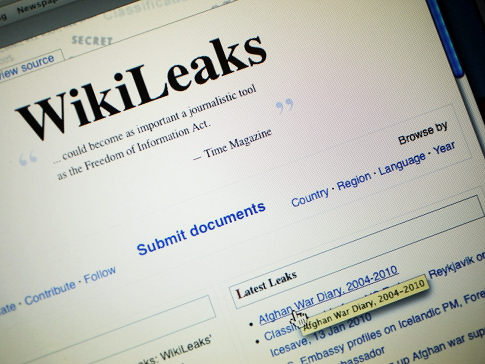 Governments keep secrets. Some important, some not so important. Hopefully with the ushering in of a second major “leaks” site governments around the world will begin to revise their agendas with the threat of pubic examination of the actions they commit and suppress “for interests of the state”.
“A former co-worker of WikiLeaks founder Julian Assange plans to launch a rival website Monday called Openleaks that will help anonymous sources deliver sensitive material to public attention.
In a documentary by Swedish broadcaster SVT, to be aired Sunday and obtained in advance by The Associated Press, former WikiLeaks spokesman Daniel Domscheit-Berg said the new website will work as an outlet for anonymous sources.”
More is better. The efforts to smear/silence Julian Assange have kicked into overdrive and rest assured, Berg will be under similar pressure as well.
“The WikiLeaks site has come under attack, while Assange, who is now in a British jail fighting extradition to Sweden on sex crime allegations, has been threatened. Swiss Postfinance, MasterCard Inc., Visa Inc., PayPal Inc. and others have cut ways to send donations to the group, impairing its ability to raise money.”
Clearly, you can see which side Corporate interests lie. It is unsurprising, as Corporations like States have many ugly secrets that they do not want the public to know about. Wikileaks is a grassroots organization, and I suggest you support an agency (see the side bar for links to the main and mirror wikileaks sites)that is dedicated to increasing the publics knowledge of the workings of their governments. The idea of government for the people by the people should be more than just a mumbled platitude.
Update: Find the openleaks page here, nothing to see yet but a logo.











 bleatmop
 Mystro


 Dead Wild Roses
Your opinions…