
You are currently browsing the tag archive for the ‘Naomi Klein’ tag.
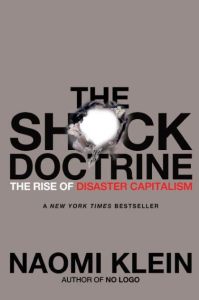 Naomi Klein’s The Shock Doctrine: The Rise of Disaster Capitalism (2007) is a searing indictment of neoliberalism, wielding a scalpel to dissect what Klein terms “disaster capitalism.” With relentless clarity, she argues that crises—natural, military, or economic—are exploited to ram through free-market policies that enrich elites while impoverishing the masses. The book’s 500-plus pages pulse with urgency, weaving history, economics, and geopolitics into a narrative as gripping as it is grim. Yet, its polemical zeal and occasional overreach—stretching causal links to near-conspiracy—risk undermining its rigor. This review outlines Klein’s thesis, summarizes the book’s contents, and critically assesses its claims with precise quotations and citations.
Thesis: Crisis as Capitalist Opportunity
Klein’s central thesis is that neoliberal policies, championed by Milton Friedman and the Chicago School, thrive on chaos. She argues that “the shock doctrine” exploits moments of collective trauma—wars, coups, natural disasters—to impose deregulation, privatization, and austerity, policies that “no one votes for” in free elections (Klein, 2007, p. 140). These shocks create a “blank slate” for corporate interests, as populations, disoriented by crisis, cannot mount effective resistance. “An economic system that requires constant growth… generates a steady stream of disasters all on its own,” she writes, citing financial crashes and wars as both byproduct and enabler of this system (p. 425). Klein challenges the myth of neoliberalism’s democratic triumph, asserting it relies on “violence and shock perpetrated on people, on countries, on economies” (p. 9). While compelling, her thesis occasionally flirts with hyperbole, implying intent where chaos and opportunism may suffice.
Summary of Contents
The Shock Doctrine spans seven parts, tracing neoliberalism’s rise through global case studies. Part 1 draws a provocative parallel between economic “shock therapy” and psychiatric experiments by Ewen Cameron, whose CIA-funded electroshock treatments aimed to “wipe” patients’ minds for reprogramming—a metaphor for neoliberalism’s erasure of existing economic orders (p. 29). Part 2 examines South America in the 1970s, focusing on Chile’s 1973 coup against Salvador Allende. Klein details how “Chicago Boys,” Friedman-trained economists, used Pinochet’s dictatorship to impose “shock treatment” policies like privatization, noting that “torture… was a tool used to build and maintain this free-market laboratory” (p. 105).
Parts 3 and 4 analyze the doctrine’s spread to Poland, Russia, South Africa, and Asia during the 1997 financial crisis, where “the destruction of entire societies” enabled rapid market reforms (p. 237). Part 5 introduces the “disaster capitalism complex,” a network of corporations profiting from privatized disaster response, as seen in post-tsunami Sri Lanka, where “developers… cleared fishing communities off the coasts” for luxury hotels (p. 381). Part 6 dissects Iraq post-2003, described as “the ultimate expression” of the doctrine, with “an orgy of privatization” amid war’s chaos (p. 381). The Conclusion highlights resistance, citing South America’s rollback of neoliberal policies and grassroots activism in Lebanon and South Africa as signs of hope (p. 455). Klein’s narrative is vivid, but her reliance on dramatic examples sometimes overshadows systemic analysis.
Critical Assessment
Klein’s strength lies in her meticulous research—four years of on-the-ground reporting—and her ability to connect disparate events into a coherent narrative. Reviewers like John Gray praise it as “one of the very few books that really help us understand the present,” noting its exposure of neoliberalism’s reliance on crisis (The Guardian, 2007). Stephen Amidon affirms its relevance to Iraq, where “Rumsfeld’s decision to allow the looting of the nation’s cultural identity” aligns with Klein’s thesis (New York Observer, 2007). Yet, critics like Joseph Stiglitz argue that her parallel between Cameron’s experiments and economic policy is “overdramatic and unconvincing,” stretching causality (The New York Times, 2007). The Economist is harsher, calling the book “a true economics disaster” for claims like the Falklands War spurring neoliberalism in Britain, which lack robust evidence (The Economist, 2007).
Klein’s portrayal of neoliberalism as a monolithic force can oversimplify. Her claim that “the Argentinian invasion of the Falklands was done in order to spur neoliberal reforms in Britain” (p. 131) is speculative, as geopolitical motives were more complex. Similarly, her assertion that Tiananmen Square “spurred China’s turn to the market” ignores China’s pre-1989 economic reforms (p. 171). As Shashi Tharoor notes, Klein is “too ready to see conspiracies where others might discern… chaos and confusion” (The Washington Post, 2007). Her focus on corporatism—where “public wealth [is turned] to private companies” (Bookbrowse, 2007)—is incisive, but risks conflating opportunistic profiteering with deliberate orchestration. Still, her evidence of profiteering, like Halliburton’s profits in Iraq’s “ghoulish dystopia” (p. 429), is damning and well-documented.
Conclusion
The Shock Doctrine is a tour de force, exposing the predatory underbelly of neoliberalism with a ferocity that demands attention. Its narrative, as Arundhati Roy declares, is “nothing less than the secret history of what we call the ‘free market’” (Amazon, 2007). Yet, its occasional lapses into exaggeration—casting every crisis as a calculated capitalist plot—dilute its precision. Klein’s call to resist, grounded in examples of grassroots pushback, offers hope, but her vision of systemic change feels underdeveloped. Read it for its revelatory scope, but temper its claims with skepticism: the truth of disaster capitalism is chilling enough without embellishment.
References
- Klein, N. (2007). The Shock Doctrine: The Rise of Disaster Capitalism. Picador.
- Gray, J. (2007). “The Shock Doctrine by Naomi Klein.” The Guardian. Retrieved from https://www.theguardian.com/books/2007/sep/15/politics.
- Amidon, S. (2007). “The Shock Doctrine.” New York Observer. Retrieved from https://observer.com/2007/09/the-shock-doctrine/.
- Stiglitz, J. E. (2007). “The Shock Doctrine by Naomi Klein.” The New York Times. Retrieved from https://www.nytimes.com/2007/09/29/books/review/Stiglitz-t.html.
- The Economist. (2007). “Naomi Klein Smackdown Roundup.” Retrieved from https://www.economist.com/blogs/freeexchange/2007/10/naomi_klein_smackdown_roundup.
- Tharoor, S. (2007). “The Shock Doctrine by Naomi Klein.” The Washington Post. Retrieved from https://www.washingtonpost.com/wp-dyn/content/article/2007/09/28/AR2007092801350.html.
- Bookbrowse. (2007). “The Shock Doctrine by Naomi Klein.” Retrieved from https://www.bookbrowse.com/reviews/index.cfm/book_number/2025/the-shock-doctrine.
 Well you know it is important when Al Gore is in the house:
“Al Gore says there’s a “powerful voice” speaking out about climate change: Mother Nature.
Gore, citing “striking” examples of extreme climate-related conditions, said while scientists have long agreed climate change is real, the real environmental challenges facing people will drive change.”
What you don’t see is the changes being made to our global system of economics and trade that will actually do something to move the planet away from the lovely CO2 oven outcome that we’re building for ourselves. One of the key aspects of the problems surrounding controlling global warm is the compartmentalization of the climate talks and the trade talks.
“Not that there was any question about which side would win should any of the competing pledges to cut emissions and knock down commercial barriers ever come into direct conflict: the commitments made in the climate negotiations all effectively functioned on the honour system, with a weak and unthreatening mechanism to penalize countries that failed to keep their promises. The commitments made under trade agreements, however, were enforced by a dispute settlement system with real teeth, and failure to comply wold land governments in trade court, often facing harsh penalties.
In fact, the hierarchy was so clear that the climate negotiators formally declared their subservience to the trading system from the start. When the U.N. climate agreement was signed at the Rio Earth Summit in 1992, it made clear that “measures taken to combat climate change, including unilateral ones, should not constitute… a disguised restriction on international trade.” (Similar language appears in the Kyoto Protocol.)”
-Naomi Klein. This Changes Everything p. 76 – 77.
So even back in the day we were being screwed over by capitalism (shocked). The notion that we can’t restrict trade in order to preserve our biosphere has underwritten almost every climate agreement the world has put forward. And that is the problem – moving goods all over the globe is carbon intensive and for the necessary work to start in tackling climate change the fundamental economic principles of neo-liberal capitalism and trade need to be rewritten.
So until you see a climate conference that includes the WTO, IMF, and World Bank be prepared for nothing more than important words and no real change in the system.











 bleatmop
 Mystro
 The Arbourist


 Dead Wild Roses
Your opinions…