
You are currently browsing the tag archive for the ‘Patriarchy’ tag.
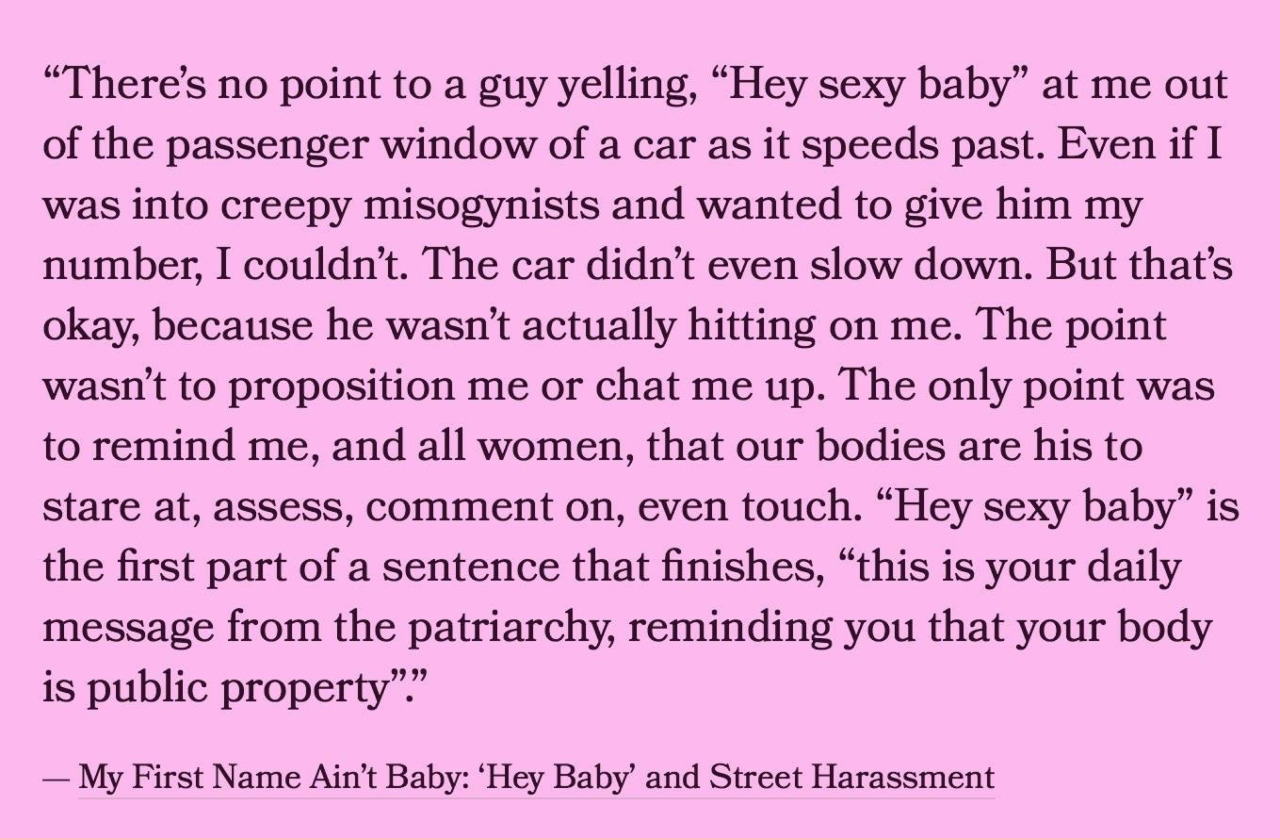
On being female in society.

Boom.



Completely shocking I know…
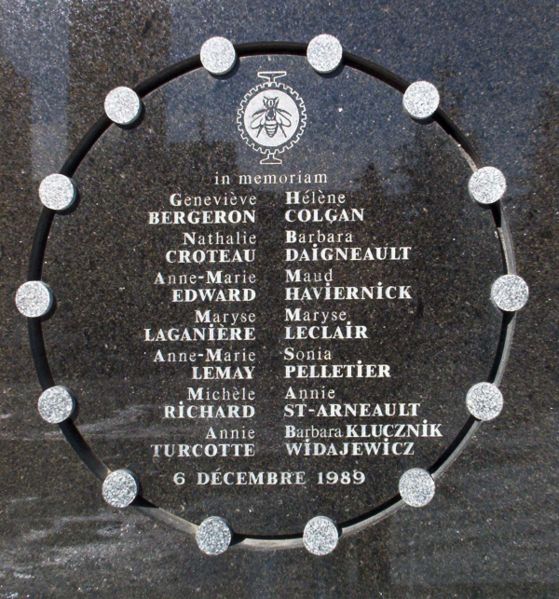 I’m probably already reprinting to much, but frack it. This shit is too important not to repeat. Go to the Ottawa Citizen’s webpage and read the entire article by Shelly Page.
“I was 24, sent by the Toronto Star to write about the slaughter of female engineering students, all around my age; fourteen of them.
Looking back, I fear I sanitized the event of its feminist anger and then infantilized and diminished the victims, turning them from elite engineering students who’d fought for a place among men into teddy-bear loving daughters, sisters and girlfriends.
Twenty-five years later, as I re-evaluate my stories and with the benefit of analysis of the coverage that massacre spawned, I see how journalists— male and female producers, news directors, reporters, anchors — subtly changed the meaning of the tragedy to one that the public would get behind, silencing so-called “angry feminists.” We were “social gatekeeping,” as filmmaker Maureen Bradley later asserted in her 1995 film, Reframing the Montreal Massacre: A media interrogation.”
[…]
“That evening, I thawed my feet in my hotel and watched the late Barbara Frum, one of Canada’s most respected journalists, refuse to admit that the massacre was indeed an act of violence toward women.
“Why do we diminish it by suggesting that it was an act against just one group?” Frum asked on CBC’s The Journal.
Frum was puzzled that so many women insisted the massacre was a result of a society that tolerates violence against women.
“Look at the outrage in our society,” Frum said. “Where is the permission to do this to women?
“If it was 14 men would we be having vigils? Isn’t violence the monstrosity here?”
She refused to even utter the word feminist. But then, her neutralizing of feminist anger must have resonated, and perhaps was reflexive. Bradley, in her documentary, wondered about Frum’s stance: “Was it necessary to deny any shred of feminism in herself in order to get where she was in this bureaucratic, media institution, boys’ club?”
Bradley also pointed out that the national media did not cover an emotional vigil the day after the massacre, where there was an angry confrontation between Montreal feminists and male students from the Université de Montréal. It would have made great content. Intelligent women voicing their outrage. But the story didn’t make it out of campus newspapers and local TV coverage onto a national stage. This story was not allowed to resonate with angry women.
When I review the stories I wrote, I almost never used the word feminist; I never profiled the achievements of one of the slain engineering students or the obstacles she’d toppled. I never interviewed a single woman who was angry, only those who were merely sad. Why? No one told me what not to write, but I just knew, in the way I knew not to seem strident in a workplace where I’d already learned how to laugh at sexist jokes and to wait until a certain boss had gone for the day before ripping down Penthouse centrefolds taped on the wall near his desk.
My stories were restrained, diligent and cautious. For years, I remembered one of my sentences with particular pride. Reading it now, it shows everything that was wrong with how I covered the event:
They stood crying before the coffins of strangers, offering roses and tiger lilies to young women they never knew.
I turned the dead engineering students into sleeping beauties who received flowers from potential suitors.
I should have referred to the buildings they wouldn’t design, the machines they wouldn’t create and the products never imagined.
They weren’t killed for being daughters or girlfriends, but because they were capable women in a male-dominated field.
I should have written that then.”
 The cesspool that is toxic masculinity, the sea we all swim in, had a newsworthy (aka an effect on people other than women) peak at the Planned Parenthood in Colorado.
“Three people were killed and nine others injured after gunfire ripped through a Planned Parenthood clinic in Colorado Springs, Colo., during an hours-long standoff that unfolded Friday afternoon.
Officials announced the casualties — one police officer and two civilians — at a brief news conference Friday evening.”
The resolution was thus:
“The standoff involved at least two exchanges of gunfire and lasted about five hours, before the gunman was taken into police custody.
“We did get officers inside the building. They were able to shout to the suspect and make communication with him, and at that point they were able to get him to surrender and take him into custody,” said police spokeswoman Lt. Catherine Buckley. He was apprehended at 4:52 p.m. MT.”
Well, so we have the murderer in custody, after a shootout, with police casualties. Care to guess the ethnicity of shooter? (Helpful Clue: He’s still alive). He allegedly said the following:
“He uttered the words “no more baby parts” to police after his arrest, according to a law enforcement official, who spoke to The Associated Press on condition of anonymity because the official was not authorized to speak publicly about the ongoing investigation. The official did not elaborate on the comment.”
Ah, motivation for saving babies – You would think that endorsing a violent man’s actions in shooting up a women’s medical centre would bring nothing but anger, shock and censure. You would be wrong.
Welcome gentle readers. Today I ask of thee but a kernel of patience whilst I set up the topic at hand.

Teh Role of teh Female in the Religious Stuff.
Religion and Patriarchy actively conspire against the female half of humanity. We have to look no further than Christian Patriarchy over here and Islamic Fundamentalism over there to see the corrosive effects of religion on females (and everyone else). We’ve missed talking about a segment of the world religious community that, despite a different set of ooga-booga beliefs, shockingly manages to codify and practice misogyny with great aplomb.
Orthodox Judaism. And behold yet another goldmine of misogyny in which to revel in! (?) Let’s take a peek at a small sample of what we are talking about:
“During the 1970s feminist critics began to expose the absence of women’s voices within the male-dominated structures promoted by Judaism’s exclusively male-authored texts. Feminists also strove to reconstruct the lost voices of women, trying to recover evidence of women’s history and self-understanding that would allow a more diversified picture of the multiple Judaisms that have flourished throughout the Jewish past. While Judaism traditionally defines itself as a divinely revealed religion, its beliefs and practices have been interpreted and regulated almost exclusively by male authorities until the modern period. Feminist analysis has pointed out that men have created the legal systems articulated in the Mishnah, Talmud, and codes of Jewish law, and acted as supreme arbiters of its interpretation by reserving the rabbinate for men. Courts of Jewish law were historically run by male rabbis, and women were excluded as witnesses in most court cases. In rabbinic law, men may contract a marriage or divorce a wife, but women can neither acquire a husband nor divorce him. Women enter into rabbinic discourse as objects of discussion, when their ritual purity, sexual control, or marital status impinges upon men’s lives.
Many Jewish feminists have suggested that the insistence on overwhelmingly male imagery for God was a deliberate effort to strengthen the male-dominated institutional arrangements of Jewish life and undergird male authority over women in the religious and societal realms. As a result, feminist analysis views Jewish texts with suspicion for their collusion with societal patriarchy in silencing women’s voices, or, even worse, as creating patriarchal oppression and endowing it with the aura of divine sanction. At the same time, some feminists have culled biblical and rabbinic texts to find counter-patriarchal traditions that support principles of justice and equality, or voices of trickster women seeking to correct halakhic inequities (Pardes; Adler). Even as D. Setel argued that the prophet Hosea’s metaphor of Israel as God’s adulterous wife was pornographic, R. Adler noted that God’s reunion with the adulterous Israel, which violates Deuteronomic law (20:4) mandating a husband’s divorce of an adulterous wife, might be understood as a “constructive violation” of Jewish law – “the metaphor that preserves the covenant breaks the law” (Adler, 163–64).”
I gave up with the highlighting and bolding after the whole “objects of discussion” malarkey (lobe blown). Anyhow, now with a little background established we can talk about the Hunger Games.
What?
This shit is all linked, it doesn’t happen in a vacuum. I have no words.
Highway of Tears email deletion referred to RCMP by B.C. privacy watchdog
Women, mainly Aboriginal, go missing, and government emails about it get not just deleted, but deliberately deleted from backups.
Quebec provincial police are alleged to have been sexually abusing Aboriginal women, going back years.











 bleatmop
 Mystro
 The Arbourist


 Dead Wild Roses
Your opinions…