
You are currently browsing the tag archive for the ‘Progress’ tag.
A classically liberal society survives on habits, not slogans. It needs restraint, due process, toleration, and the willingness to lose without declaring the system illegitimate. Those habits are the machinery that lets disagreement stay political instead of becoming civil war by other means.
Here is the problem: liberalism can be weakened without censorship or coups. You dissolve it by corroding its reflexes. Make truth optional. Make process contemptible. Make opponents morally untouchable. Then the only “honest” politics left is permanent emergency.
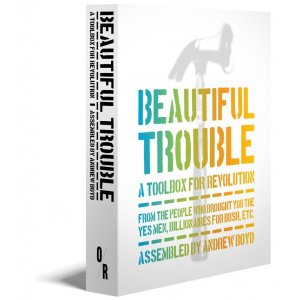
Toolkits like Beautiful Trouble matter because they don’t merely argue for outcomes. They teach a style of conflict that can push a society toward that emergency posture. Not secretly. Openly. Proudly.
The mechanism: reaction as leverage
The core move is simple: the decisive moment is not what you do; it is how the target reacts. Beautiful Trouble states this as principle. Create a situation where the target has only bad options. If the target responds forcefully, you get optics of oppression. If the target hesitates, you get optics of weakness or complicity. Either way, you harvest narrative.
This is not foreign to the Alinsky lineage. The organizing sensibility there is similarly pressure-driven: personalize, polarize, keep heat on, force choices. Whether you call that “empowering the powerless” or “cynical theatre” depends on your politics. But the effect is measurable. It rewards escalation.
In an attention economy, that reward multiplies. The clip travels. The caption hardens. The audience concludes. Process arrives too late to matter.
Why this is corrosive to liberal life
Classical liberalism is not blind to power. It assumes power exists and will be abused. That’s why it builds constraints: rule of law, rights, neutral adjudication, stable procedures, and a civic ethic that treats opponents as citizens.
Revolutionary politics often treats those constraints as camouflage for domination. Once you accept that premise, liberal restraint stops being virtue and becomes collaboration. Due process becomes “violence.” Neutrality becomes “support for the status quo.” Compromise becomes betrayal.
That frame is solvent. It dissolves the very institutions that make peaceful reform possible. Courts become illegitimate. Journalism becomes propaganda. Elections become theatre. At that point, direct action isn’t one tool among many. It becomes the only “authentic” politics. And authenticity is a poor substitute for governance.
Three tactics that act like acid
1) Identity tricks that blur truth and theatre
Impersonation formats, spoof announcements, and “identity correction” are often defended as satire. Sometimes they are. But they also train a destructive habit: truth is what produces the right reaction.
In a low-trust society, that habit is gasoline. It makes people easier to steer. They learn to treat moral satisfaction as verification.
2) Reaction capture that rewards escalation
Media-jacking and engineered dilemmas push institutions into visible confrontation. Institutions then over-respond to avoid losing control. Activists then present the response as the point. The public is invited to judge the system from the most inflammatory ten seconds.
This is why incremental reform struggles. Incrementalism is procedural. It is slow. It is boring. It does not produce good clips. When politics is mediated by clips, boredom becomes political death. And the responsible becomes invisible.
3) Framing that turns disagreement into moral emergency
The most dangerous tool is not a hoax. It is framing that converts disagreement into existential crisis. Once politics is narrated as emergency, restraint becomes treason. Any compromise becomes proof of corruption. The only acceptable posture becomes maximal conflict.
That is how a society stops being governable. Not because people disagree, but because they can no longer share a procedure for disagreement.
The case for incremental progress
Incrementalism is mocked as cowardice. It is not. It is the political expression of two hard truths.
First, institutions are complex. Sudden shocks break things you cannot rebuild at will. Second, moral certainty is a poor engineer. It is good at burning. It is bad at designing.
Classical liberal reform says: specify the harm, propose bounded remedies, build coalitions, accept partial wins, and keep the legitimacy of procedure intact. That is not complacency. It is the recognition that power vacuums don’t stay empty, and that revolutions rarely end with stable liberty.
If you care about justice, you should fear the emergency habit. Emergency is where rights go to die. Emergency is where “temporary” powers become permanent. Emergency is where the loudest faction learns it can rule by accusation.
A prediction worth taking seriously
As these tactics normalize, politics will become less about persuasion and more about provocation. Institutions will either harden into managerial coercion or retreat into paralysis. Both outcomes invite more radicalism, because both outcomes confirm the radical story.
A liberal society that wants to survive has to stop rewarding engineered crisis. That means demanding evidence over captions, procedure over theatre, and reform over revolution, even when reform is unsatisfying. Especially then.
References
-
Beautiful Trouble toolbox and principle page (reaction as leverage).
Beautiful Trouble tactic pages: Identity correction; Media-jacking.
OR Books listing / bibliographic info for Beautiful Trouble editions.
Secondary summaries of Rules for Radicals (Alinsky overview used for comparison of tactical sensibility).
This excerpt is from James Lindsey writing on his blog New Discourses.
Lindsey is very critical of one of the methods used to analyze our culture. Apparently correctly identifying systemic racism, and how it flows through society is a bad thing. Rather, we just need to do better and try harder with the current system and hope that one day we can reach a better place – cue unicorns and gleeful music – where society is just better. (???)
Some of the criticisms Lindsey has can be directly applied to his own prescriptions which are vague and lacking in detail as to how to proceed to the state of having a better society:
“We need to listen; we need to investigate; and we need to use the best methods available to understand and fix the problem.”
Yeah. Okay. So using the best methods available we can probably ascertain that having a police officer kneel on a person’s neck for several minutes isn’t conducive to that person continuing to live. It would seem that this sort of treatment is disproportionately handed out to people that are not white.
So, using the best investigative tools at hand and all of our listening skills we should be able to parse out a reasonable solution to the problem in our liberal society? No?
Is telling minority populations, who are still being incarcerated and extra-judicially murdered at an alarming rate “just be patient, we’re working on it” a viable solution? How many incidents of police discriminate police violence and the corresponding race riots do we need to get a ‘good data set’ to start fixing the disadvantages of being a colour other than white in society?
Go read the entire article – For me, the overall feeling came down to this – Okay, so critical race theory is pessimistic… buuuuut what do you offer to replace the way it exposes the very real and very deep fractures in our society? Like we had Rodney King in 1992 and yet, here we be in 2020 with George Floyd; I’m not seeing anything close to the epoch changing liberal progress Lindsey so tepidly puts forward. Rather, the status quo has been maintained and the system continues as it did before – systemic racism intact and going strong.
“We can do better than Critical Race Theory. We can do better than a sloppy “theoretical” approach that’s really about pushing divisive grievance politics into our society, one that treats people as props for the narrow politics that primarily, if not solely, benefit the elite grifters who know the Theory. Critical Race Theory advances them at everyone else’s expense. And we already know a lot of how to tackle these problems better than Critical Race Theory can. We already know how to be liberals, apply liberalism, judge by the content of character rather than anything to do with identity or color of skin. And we already know that liberal approaches are open to reform and improvement of the societies that employ them.
Sure, we need to listen better. When a black man, or anyone else, says “I can’t breathe,” people need to listen. When people say there are problems, we need to listen. We need to listen; we need to investigate; and we need to use the best methods available to understand and fix the problem. But we also need to see past race, not focus on it. We need to work together, talk together, adopt shared goals, hold shared vision, find shared identities. For those of us in a hurting America, we are all American. We all have a stake in this system and what it can provide, and we’ll all lose if we let these Critical Race Theory wannabe dictators tear it down or take over.
These approaches work. Working together, talking together, sharing goals together, sharing a common vision, finding common ground and common identities. We know they work. So, we should throw out the little tyrants who, with their academic theories, educational influence, and journalistic and political bully-pulpits, are going to tell our country that white people are the cause of everything bad and that black people they have to stay on script if they want to be black. We’re going to reject these race-baiting jerks and reject them just like they reject any honest attempt to help or understand. They are the problem, and their Theory is the problem. We can and will do better.”
Not convinced Mr.Lindsay.
I really enjoy what the RSA does. Taking good ideas and making them better with illustrations and cognitive maps.











 bleatmop
 Mystro
 The Arbourist


 Dead Wild Roses
Your opinions…