
You are currently browsing the tag archive for the ‘Second Order Thinking’ tag.
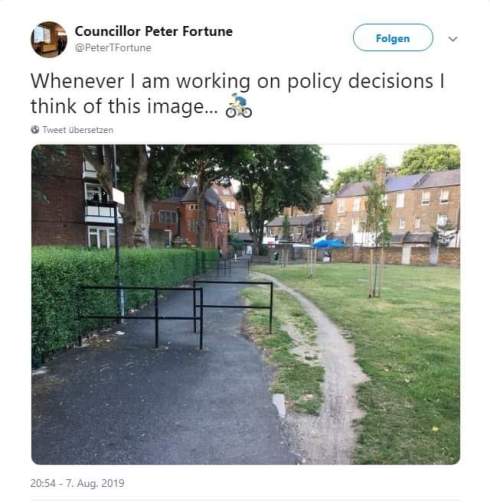
When designers try to overrule human incentives with a barricade, they don’t get obedience. They get a workaround. The meme Councillor Peter Fortune shared shows it in one frame: a paved bike path blocked by metal barriers, and a dirt trail worn smooth beside it where people simply go around. The joke lands because it’s familiar. The system “wins” on paper; the public wins in practice.
The lesson isn’t that people are bad. It’s that people optimize for time, effort, and friction. Put an obstacle in the shortest route and you don’t remove the desire to move—you relocate it. The new path brings second-order costs the designer pretended didn’t exist: erosion, muddier edges, conflicts between walkers and riders, and a steady drift from the “safe” route to the “usable” one. The dirt trail isn’t misbehavior. It’s feedback.
This is why public planning fails in a predictable way. Government systems are often built to defend the plan rather than learn from the result. Once concrete is poured, changing course becomes politically costly, procurement-heavy, and reputation-sensitive. So the incentive is to explain the barrier, not remove it, even when the public has already voted with their feet. You get infrastructure that looks orderly in a report and behaves disorderly in the world.
A competent planner doesn’t start by asking, “How do we force compliance?” They start by asking, “What will people do instead?” Then they design for that answer: align the official route with the desire line, reduce friction where it matters, and treat workarounds as data. Ignore that, and the meme becomes policy. The public routes around you, and you pay twice: once for the plan, and again for the consequences.
Sometimes a concept is so good one must ruthlessly crib from another source – So here ya be, the notion of Chesterson’s Fence and how important it is to understand the reasons why something was done in the first place.
“Second-order thinking will get you extraordinary results, and so will learning to recognize when other people are using second-order thinking. To understand exactly why this is the case, let’s consider Chesterton’s Fence, described by G. K. Chesterton himself as follows:
There exists in such a case a certain institution or law; let us say, for the sake of simplicity, a fence or gate erected across a road. The more modern type of reformer goes gaily up to it and says, “I don’t see the use of this; let us clear it away.” To which the more intelligent type of reformer will do well to answer: “If you don’t see the use of it, I certainly won’t let you clear it away. Go away and think. Then, when you can come back and tell me that you do see the use of it, I may allow you to destroy it.”
***
Chesterton’s Fence is a heuristic inspired by a quote from the writer and polymath G. K. Chesterton’s 1929 book, The Thing. It’s best known as being one of John F. Kennedy’s favored sayings, as well as a principle Wikipedia encourages its editors to follow. In the book, Chesterton describes the classic case of the reformer who notices something, such as a fence, and fails to see the reason for its existence. However, before they decide to remove it, they must figure out why it exists in the first place. If they do not do this, they are likely to do more harm than good with its removal. In its most concise version, Chesterton’s Fence states the following:
Do not remove a fence until you know why it was put up in the first place.
Chesterton went on to explain why this principle holds true, writing that fences don’t grow out of the ground, nor do people build them in their sleep or during a fit of madness. He explained that fences are built by people who carefully planned them out and “had some reason for thinking [the fence] would be a good thing for somebody.” Until we establish that reason, we have no business taking an ax to it. The reason might not be a good or relevant one; we just need to be aware of what the reason is. Otherwise, we may end up with unintended consequences: second- and third-order effects we don’t want, spreading like ripples on a pond and causing damage for years.”











 bleatmop
 Mystro


 Dead Wild Roses
Your opinions…