
You are currently browsing the tag archive for the ‘Societal Norms’ tag.
The wheels of justice are moving slow on this one, as is often the case with rape. It is ‘funny’ that our society won’t take the time to look at the reality of the situation when it comes to rape and the legal system.
One could say that, tacitly, rape is condoned in our society. Not a particularly happy conclusion, but there it is.
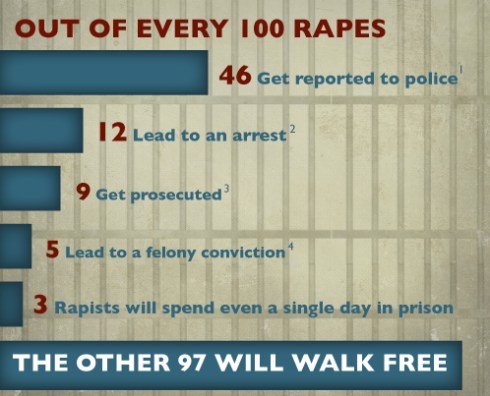

Talk about unintended veracity.
Fascinating don’t you think?
Consider the neat way this dovetails into how relationships in our society are structured and the expectations placed upon those who are male and those who are female.
Pro-tip: The deformed cup or one that isn’t complete without the other is where you should start your discussion blaming. :)
 The really bestest-awesomest part of discussing rape culture with dudes (and select handmaidens of the patriarchy) is their abject denial of rape culture. Yet, objectively, the culture we live in is a rape culture and this study adds even more support to what many feminists have been saying for so many years.
“(April 2014) – New evidence from the journal Gender & Society helps explain what women’s advocates have argued for years – that women report abuse at much lower rates than it actually occurs. According to the Rape, Abuse & Incest National Network (RAINN), 44% of victims are under the age of 18, and 60% of sexual assaults are not reported to police.
The study, “Normalizing Sexual Violence: Young Women Account for Harassment and Abuse,” will appear in the June 2014 issue of Gender & Society, a top-ranked journal in Gender Studies and Sociology. The findings reveal that girls and young women rarely reported incidents of abuse because they regarded sexual violence against them as normal.
Sociologist Heather Hlavka at Marquette University analyzed forensic interviews conducted by Children’s Advocacy Center (CAC) with 100 youths between the ages of three and 17 who may have been sexually assaulted. Hlavka found that the young women experienced forms of sexual violence in their everyday lives including: objectification, sexual harassment, and abuse. Often times they rationalized these incidents as normal.
During one interview, referring to boys at school, a 13 year-old girl states:
“They grab you, touch your butt and try to, like, touch you in the front, and run away, but it’s okay, I mean… I never think it’s a big thing because they do it to everyone.”
The researcher’s analysis led her to identify several reasons why young women do not report sexual violence.
- Girls believe the myth that men can’t help it. The girls interviewed described men as unable to control their sexual desires, often framing men as the sexual aggressors and women as the gatekeepers of sexual activity. They perceived everyday harassment and abuse as normal male behavior, and as something to endure, ignore, or maneuver around.
- Many of the girls said that they didn’t report the incident because they didn’t want to make a “big deal” of their experiences. They doubted if anything outside of forcible heterosexual intercourse counted as an offense or rape.
- Lack of reporting may be linked to trust in authority figures. According to Hlavka, the girls seem to have internalized their position in a male-dominated, sexual context and likely assumed authority figures would also view them as “bad girls” who prompted the assault.
- Hlavka found that girls don’t support other girls when they report sexual violence. The young women expressed fear that they would be labeled as a “whore” or “slut,” or accused of exaggeration or lying by both authority figures and their peers, decreasing their likelihood of reporting sexual abuse.
The young women in the study provided insight into how some youth perceived their experiences of sexual violence and harassment during sexual encounters with men. In particular, the study pointed to how the law and popular media may lead to girls’ interpreting their abuse as normal. According to the author, policymakers, educators, and lawmakers need to address how sexual violence is actually experienced by youth beginning at very young ages in order to increase reporting practices, and to protect children from the everyday violence and harassment all too common in their lives.”
I saw this quote on the Anti-Porn Feminists blog. Too good not to share.
I have seen a sixteen-year-old boy weeping in distress after getting a girl’s pube stuck in his teeth, I hear he was unshaven. I have seen boys showing each other porn on their iPhones on the train home from school, in bars and whilst strolling along the Champs-Elyséés. I have had a boy ask me to text him screenshots of porn films because he was on a wifi-free family holiday. One boy turned to kiss his date in the cinema but not before romantically whispering ‘don’t struggle’. One friend drunkenly walked off into a park in the early hours of the morning and when a male friend brought her back without ‘trying anything’, he was heralded as being ‘soo nice!’ rather than ‘soo normal!’. I have friends whose boyfriends have posted naked pictures of them all over the Internet. I have heard consent described as ‘de-romanticizing’. I have had a shockingly sober boy say to me ‘Why can’t I just slap my dick on your arse? Doesn’t cost you anything!’. This just scratches the surface of my store of depressing anecdotes; the most violent of which I won’t go into out of respect for the girls involved.
2014 is not a good year to be a teenage girl. The last of the 90’s kids are growing up and we are starting to see the effects of being raised with the Internet. For generations before us, hormonal teenage boys looking for sexy images of women had limited options; they could brave the embarrassment of going to the counter and buying Playboy, they could look through their sister’s Cosmo or they could use their imagination. Porn today has rid itself of the embarrassment-factor by embracing the anonymity of the World Wide Web; Playboy isn’t really considered to be porn anymore, the real stuff lives in your phone, on your laptop, your tablet; it is available anywhere, anytime at the touch of a button.
Violence, Teenagers, and Gonzo Porn, Clara Bennathan











 bleatmop
 Mystro
 The Arbourist


 Dead Wild Roses
Your opinions…