
You are currently browsing the tag archive for the ‘The DWR Friday Baroque Interlude’ tag.
Tag Archive
The DWR Friday Baroque Interlude – J.S. Bach Toccata in E Minor BWV 914
April 14, 2017 in Music | Tags: J.S. Bach Toccata in E Minor BWV 914, The DWR Friday Baroque Interlude | by The Arbourist | 2 comments
Toccata in E minor, BWV 914 Johann Sebastian Bach
Bach’s set of seven Toccatas for keyboard date from 1707-11, just prior to and during the first years of his post in Weimar. During these formative years he experimented with a wide variety of compositional models. Overall, these early toccatas lack the profound expression and technical mastery of Bach’s later music and are thus some of the least performed of his works. All too often, they come off as improvisatory and mere virtuosic pieces for keyboard. Nevertheless, they show the steady growth of one of music’s greatest geniuses.
The Toccata in E minor, BWV 914 is one of Bach’s least known works for keyboard. Most likely composed in either 1707 or 1708, it nevertheless portrays Bach’s developing composition style. The brief opening section of the toccata bears an inconspicuous resemblance to Bach’s later organ works, particularly with the octave leap that occurs repeatedly in the left hand. Furthermore, retrograding chords of the sixth with off-beats in the right hand might remind some listeners of a similar passage in the famous Toccata and Fugue in D minor. A fugato section follows with a lively rhythmic figure predominating. This section does not venture far from the E minor tonality, though its strictness of counterpoint causes it to stand out among the other early toccatas.
The following adagio is highly improvisatory. Arpeggios and scalar passage abound with plentiful embellishments. An extended fugue for three voices forms the final movement. The subject of the fugue, four bars in length, is actually identical to that of an anonymous fugue in a previously dated Italian manuscript. Furthermore, the two fugues share a striking number of similarities. While the composer of this earlier fugue is unknown to us, Bach was quite likely familiar with it at the time he composed his own. Today, Bach’s “version” would without a doubt be condemned as plagiarism. However, during the Baroque, the “recomposition” of another composer’s work was not uncommon and, in fact, considered a form of flattery. Bach’s fugue, however, enhances on the original version, by expanding its harmonic scope and conforming more to idiomatic keyboard writing. Joseph DuBose
Part of Elena Kuschnerova’s all-Bach recital that was released on ORFEO in 2001. Rosette in Penguin Guide 2003/04
Share this:
The DWR Friday Baroque Interlude – J.S Bach – Badinerie, BWV 1067
February 17, 2017 in Music | Tags: Badinerie, BWV 1067, The DWR Friday Baroque Interlude | by The Arbourist | Comments closed
The four orchestral suites (called ouvertures by their author), BWV 1066–1069 are four suites by Johann Sebastian Bach. The name ouverture refers only in part to the opening movement in the style of the French overture, in which a majestic opening section in relatively slow dotted-note rhythm in duple meter is followed by a fast fugal section, then rounded off with a short recapitulation of the opening music. More broadly, the term was used in Baroque Germany for a suite of dance-pieces in French Baroque style preceded by such an ouverture. This genre was extremely popular in Germany during Bach’s day, and he showed far less interest in it than was usual: Robin Stowell writes that “Telemann‘s 135 surviving examples [represent] only a fraction of those he is known to have written”;[1] Christoph Graupner left 85; and Johann Friedrich Fasch left almost 100. Bach did write several other ouverture (suites) for solo instruments, notably the Cello Suite no. 5, BWV 1011, which also exists in the autograph Lute Suite in G minor, BWV 995, the Keyboard Partita no. 4 in D, BWV 828, and the Overture in the French style, BWV 831 for keyboard. The two keyboard works are among the few Bach published, and he prepared the lute suite for a “Monsieur Schouster,” presumably for a fee, so all three may attest to the form’s popularity.
A slightly more modern take on BWV 1067 –
Share this:
The DWR Friday Baroque Interlude – D. Scarlatti: Sonata in E Major, K 380 (L 23)
January 20, 2017 in Music | Tags: D. Scarlatti: Sonata in E Major, K 380 (L 23), The DWR Friday Baroque Interlude | by The Arbourist | Comments closed
Domenico Scarlatti began his compositional career following in the footsteps of his father Alessandro Scarlatti by writing operas, chamber cantatas, and other vocal music, but he is most remembered for his 555 keyboard sonatas, written between approximately 1719 and 1757.
It is believed that Domenico received most of his musical training from family members, but his father was the dominant figure in his life. It was Alessandro who arranged Domenico’s first appointment, as organist and composer for Naples’ Cappella Reale, and wanted him to continue with vocal music despite the enormous talent he had shown for keyboard music. Domenico was sent to Venice in 1705, where he met Handel, and in 1708 to Rome to become maestro di cappella to the exiled queen of Poland, Maria Casimira, and later, head of the Cappella Giulia. In these positions, he composed his operas and serenatas, and some sacred vocal works. It was also in Rome where he developed a friendship with the Portuguese ambassador, the Marquis de Fontes, which eventually led to Scarlatti’s being appointed master of the royal chapel by João V of Portugal in 1719. Scarlatti was also teacher to the royal family, particularly princess Maria Barbara. Scarlatti had already written approximately 50 keyboard pieces before coming to Lisbon, but wrote many more for his students, which also included Carlos de Seixas. When Maria Barbara married Spanish prince Ferdinando, Scarlatti followed her to Spain. His first publication, 30 sonatas called “Essercizi,” was issued in 1738 and sold throughout Europe. Although as King and Queen, Ferdinando and Maria Barbara introduced opera into Spain’s cultural life, Scarlatti did not write any for them. However, he did assist in their private musical soirées, again writing cantatas and working with singers such as Farinelli. Scarlatti also continued to teach, and, in the last six years of his life, concentrated on organizing his sonatas in manuscripts.
Share this:
The DWR Friday Baroque Interlude – Bach, Cantata 35, 5. Sinfonia
January 6, 2017 in Music | Tags: Bach, Baroque, Cantata 35, The DWR Friday Baroque Interlude | by The Arbourist | Comments closed
Bach’s Cantata BWV 35, Geist und Seele wird verwirret (Soul and spirit become confused), is one of three alto solo works in Trinity Time of the third annual church cycle of 1726-27 that has an old established and much used text of Georg Christian Lehms. It employs obbligato organ in “conversational galant” manner and has two arias in dance style siciliano and menuet. Its origin and genesis derives from much earlier borrowed instrumental concertos and sonatas in Köthen and Weimar. Questions remain. Just how many of the movements are based on preexisting works? Why does Cantata 35 have two instrumental sinfonias introducing the two parts, performed before and after the sermon (a rare Bach form in Trinity Time)? Was the unfigured organ part for his adolescent first son Emmanuel or for himself? Was Bach motivated to compose so many solo cantatas in the third cycle because he lacked competent resources or was he returning to the Italian style, without biblical dictum and sometimes closing four-part chorales
Share this:
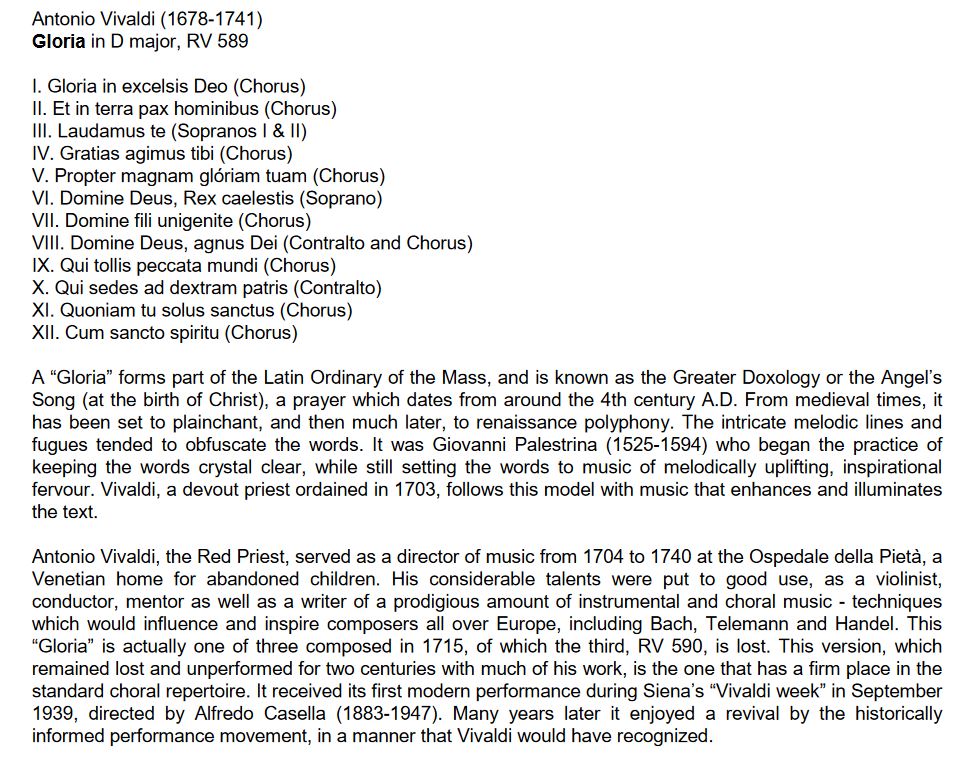
The DWR Friday Christmas-ish Baroque Interlude – A. Vivaldi: RV 589 / Gloria in excelsis Deo in D major
December 16, 2016 in Music | Tags: A. Vivaldi: RV 589 / Gloria in excelsis Deo in D major, The DWR Friday Baroque Interlude, Vivaldi | by The Arbourist | Comments closed

The DWR Friday Baroque Interlude – Telemann Concerto for 4 Violins in G+ TWV40
December 9, 2016 in Music | Tags: Concerto for 4 Violins in G+ TWV40, Telemann, The DWR Friday Baroque Interlude | by The Arbourist | 1 comment
Georg Philipp Telemann was a German Baroque composer and multi-instrumentalist. Almost completely self-taught in music, he became a composer against his family’s wishes. After studying in Magdeburg, Zellerfeld, and Hildesheim, Telemann entered the University of Leipzig to study law, but eventually settled on a career in music. He held important positions in Leipzig, Zary, Eisenach, and Frankfurt before settling in Hamburg in 1721, where he became musical director of the city’s five main churches. While Telemann’s career prospered, his personal life was always troubled: his first wife died only a few months after their marriage, and his second wife had extramarital affairs and accumulated a large gambling debt before leaving Telemann.
Share this:
The DWR Friday Baroque Interlude – Vivaldi – Violin Concerto in A Minor RV356
November 25, 2016 in Music | Tags: The DWR Friday Baroque Interlude, Violin Concerto in A Minor RV356, Vivaldi | by The Arbourist | Comments closed
Antonio Vivaldi
Born: Venice, March 4, 1678
Died: Vienna, (buried July 28, 1741)
Another Italian composer and virtuoso violinist, Antonio Vivaldi is remembered today for the enormous number of concertos he composed throughout his lifetime. He most likely learned the violin from his father, himself a violinist at St. Mark’s in Venice. Antonio took holy orders to enter the Catholic Priesthood, and became known as “The Red Priest” due to the color of his hair. He became a teacher in Venice at the Ospedale della Pietà (a school for foundling girls) in 1703, and later became the director of concerts there. His music was extremely popular, and he traveled a great deal over Europe, spreading his fame as a violinist and composer. During the 1730s, however, his popularity began to abate and in 1738 he was dismissed from the Ospedale. Desperate, he eventually settled in Vienna in 1740, hoping to reclaim his fame. He didn’t, and he died there the next year, to be buried in a pauper’s grave.











 bleatmop
 Mystro
 The Arbourist


 Dead Wild Roses
Your opinions…