
You are currently browsing the tag archive for the ‘The DWR Friday Musical Interlude’ tag.
We are putting this on the list of piano music that is too damn hard right now, but stuff I will eventually be able to play. Watch his hands after the first repeated section – what is going on is that he is alternating quickly between two sets of notes a 6th apart with the same hand. To the piano student, this is akin to trying to wipe your ass with the wrong hand while wearing mittens filled with bees. My piano teacher assured me that, like with all things, practice makes it easier.
A little background on what a Passacaglia is and an example of what J.S. Bach does with it.
Passacaglia – A musical form of the 17th and 18th centuries consisting of continuous variations on a ground bass and similar to the chaconne.
There are 20 variations in BWV 582/1. The first begins with a typical C minor affekt, “a painful longing” according to Spitta, similar to the beginning of Buxtehude’s Chaconne in C minor (BuxWV 159).[9] Numerous attempts have been made to figure out an overarching symmetrical structure of the work, but scholars have yet to agree on a single interpretation.[10] Particularly important attempts were made by Christoph Wolff and Siegfried Vogelsänder.[spelling?][11] Some scholars have speculated that there is a symbolic component to the structure of the work: for instance, Martin Radulescu argues that BWV 582/1 is “in the form of a cross”.[12]
There is agreement among most scholars that the Passacaglia builds up until its climax in variation twelve.[citation needed] This is followed by three quiet variations, forming a short intermezzo, and then the remaining five variations end the work.
Bach performer and scholar Marie-Claire Alain suggested that the 21 variations are broken down into 7 groups of 3 similar variations, each opening with a quotation from a Lutheran chorale, treated similarly to the Orgel-Büchlein written at a similar time:[13]
-
Bars 8–12, the top part spells out the opening notes of “Nun komm’ der Heiden Heiland”
-
Bars 24–48, a cantilena spells out “Von Gott will ich nicht lassen”
-
Bars 49–72, the scales are a reference to “Vom Himmel kam der Engel Schar”
-
Bars 72–96, recalling the “star” motif from “Herr Christ, der Ein’ge Gottes-Sohn”
-
Bars 96–120, ornamented figure similar to that in “Christ lag in Todesbanden” accompanies theme in the soprano then moving successively to alto and bass
-
Bars 144–168 “Ascending intervals in bass recall the Easter chorale “Erstanden ist der heil’ge Christ”.
And yes, this was an organ piece originally.
Oh 1986, what a year you were. It brought us the VSOP and the melding of classical and pop music. Yes friends, lets go back and kick it down with some Rock Me Amadeus.
Listening to the tune again made me laugh at a couple of spots, the sampling is… interesting, but it still awesome as I remember it. :)
Vi Hart is truly amazing. Awe inspiring yet accessible, sublime yet exciting, her videos are strange, wonderful, fun, educational, and so many other great things combined.
Now it’s time to expand your mind with a delightful explanation and demonstration of Shepard Tones
The singing year has started for me as well as the Arbourist. My teacher and I have set two goals for this year:
- That I will develop good practicing habits
- That I will finally let my big voice out at its full size
In furtherance of these goals, she’s assigned me big, challenging repertoire that there’s no way I’ll be able to manage without practicing my butt off. Which, it turns out, means All the Wagner.
Since the theme for this semester is Art Song, I’m working on three of his five Wesendonck Lieder. Two (“Traume” and “Der Engel”) I’ve tried before and found I’d bitten off more than I could chew but maybe I’ll be ready for them now; new into the mix this year is “Stehe Still”. It is an absolute privilege to be challenged with such gorgeous music. Here’s Jessye Norman, my vocal hero, singing “Stehe Still”:
Is it an amazing piece of music or what? All those weird intervals, and completely unexpected chord changes, and yet it just completely works!
Richard Wagner wrote the Wesendonck Lieder while he was staying at the estate of Otto and Mathilde Wesendonck. There’s controversy over exactly what may or may not have transpired between Richard and Mathilde, but there’s little doubt that they were intensely infatuated with one another. Wagner put aside his work on the Ring Cycle during his time at the Wesendonck’s, and wrote his Wesendonck Lieder – settings of Mathilde Wesendonck’s poetry – and Tristan und Isolde during this period. Wikipedia entry
I really like this song. Here’s the problem though, try singing it in the same key that JBJ does. Here is the lead sheet and let’s observe the melodic patterns that are going on in this song.
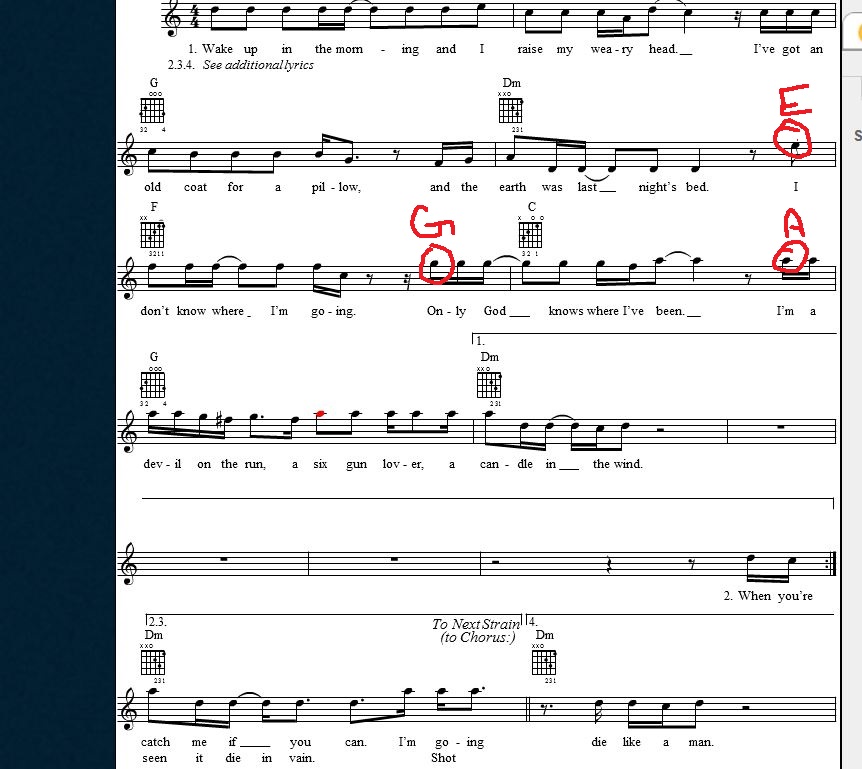
Those black dots keep going up higher on the staff. Damn you JBJ
Male vocal singing comes roughly in three flavours, Bass, Baritone and Tenor. The first highlighted note (E) will raise the eyebrows of most bases. It lies near the upper limit of where they can beautifully sing. Baritones (lazy tenors) are still well within their zone of comfort, however even they are pressed to produce the next series of notes (G). Of course JBJ doesn’t stop there and goes well into tenor territory with long passage of high notes (A’s). The general melodic tendency in this song is a ever increasing ascension of the C major scale. But wait, it get’s better.
If you listen to the song, you’ll notice the music presented here is only the intro and the intro builds into even a higher chorus. We’re now in the famously high C territory of Pavarotti and other classical singing masters. Let me assure you, gentle readers, High C territory is the undiscovered country for many tenors – as a amateur singing I have only once ventured into this land – it was rough and harsh encounter, let me assure you. Yet JBJ bashes out high notes like no ones business.
You may not like Bon Jovi, but one should at least appreciate the musicianship that goes into vocal production of this calibre.











 bleatmop
 Mystro
 The Arbourist


 Dead Wild Roses

Your opinions…