
You are currently browsing the tag archive for the ‘The DWR Friday Musical Interlude’ tag.
I saw this today and I had to put it up. Enjoy some history, some math, some copywrite commentary, and some wonderful music, all delightfully wrapped together by the fantastic ViHart. Enjoy!
I love this piece and in my deepest and darkest piano dreams I’d be able to play it. :)
The prelude is organized into three main parts and a coda:
- The piece opens with a three note motif at fortissimo which introduces the grim C-sharp minor tonality that dominates the piece. The cadential motif repeats throughout. In the third bar, the volume changes to a piano pianissimo for the exposition of the theme.
- The second part is propulsive and marked Agitato (agitated), beginning with highly chromatic triplets. This passionately builds to interlocking chordal triplets that descend into a climactic recapitulation of the main theme, this time in four staves to accommodate the volume of notes. Certain chords in the section are marked with quadruple sforzando.
- The piece closes with a brief seven-bar coda which ends quietly.
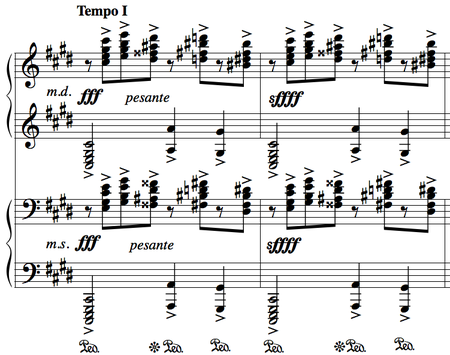
4 staves? Jesus…
I can play the first part. :) If I can find the second part, I’ll work on that too. :)
The Minuet in G major is a keyboard piece included in the 1725 Notebook for Anna Magdalena Bach. Until 1970 it was attributed to Johann Sebastian Bach (BWV Anh 114), but it is now universally attributed to Christian Petzold.[1][2][3] It is a 32-measure piece primarily in the key of G major, but measures 20-23 are in D major.
The symphony is in four movements, with the third movement and the finale played attacca:
- Allegretto – Poco allegro – Tranquillo, ma poco a poco ravvivando il tempo all’allegro – Poco largamente – Tempo I – Poco allegro
- Tempo andante, ma rubato – Poco allegro – Molto largamente – Andante sostenuto – Andante con moto ed energico – Allegro – Poco largamente – Molto largamente – Andante sostenuto – Andante con moto ed energico – Andante – Pesante
- Vivacissimo – Lento e soave – Tempo primo – Lento e soave – (attacca)
- Finale: Allegro moderato – Moderato assai – Meno moderato e poco a poco ravvivando il tempo – Tempo I – Largamente e pesante – Poco largamente – Molto largamente
The duration is approximately 45 minutes.
In Finland, this popular work with its grandiose finale was connected by some with the struggle for Finland’s independence, even being popularly dubbed the “Symphony of Independence”, as it was written at a time of Russian sanctions on Finnish language and culture. Sibelius’s reaction to this has been widely debated; some claim that he had not intended any patriotic message and that the symphony was only identified by others as a nationalist composition, while others believe that he wrote the piece with an independent Finland in mind.
Tying in with Sibelius’ philosophy on the art of the symphony (he wrote that he “admired [the symphony’s] severity of style and the profound logic that created an inner connection between all the motifs…”), the work grows almost organically out of a rising three-note motif heard at the opening of the work, which, after appearing in many guises throughout the entire symphony (and indeed forming the basis for most of the material) forms the dramatic theme of the finale. Interestingly this first theme is to be heard in a very similar passage in Rubinstein’s symphony nr. 4 from 1874. This prominent motif has the same melody, rhythm, and orchestration and is repeated in different permutations throughout Rubinstein’s symphony.
Catchy Melody – Check.
Fantastic Rhythm – Check.
Meaningful Lyrics – Check.
Paul Simon and company lay down another great track for you and me to listen too. Mission Accomplished. :)
And of course some history:
Following the success of 1986’s Graceland, on which he worked principally with South African musicians, Simon broadened his interests in diverse forms of music from around the world. He turned to Latin America for the musicians and rhythms which characterize much of this album, partnering with Afro-Brazilian superstars Grupo Cultural Olodum, masters of the heavily percussive sub-style of samba called Batuque or Batucada. The group’s drumming is featured on the opening song and first single, “The Obvious Child”. Brazilian singer-songwriter Milton Nascimento co-wrote “Spirit Voices” and contributed some vocals. Guest appearances were also made by mandolin- and “guitarra baiana” master Armandinho, another Bahia musician, and by Afro-Cuban drummer Francisco Aguabella, and Puerto Rican-born drummer Giovanni Hidalgo. Another collaborator was jazz percussionist and master of the berimbau, Naná Vasconcelos; jazz guitarist Rafael Rabelo also played on the album, along with many other Brazilian musicians.
Leave it to Beethoven to capture the keen spirit of melancholic grief.
” The famous A-minor Allegretto is framed by the same unstable chord to open and close the movement. The form is ABABA with the opening section using a theme that is once again more distinctive for its rhythmic profile than for its melody. The movement builds in intensity and includes a fugue near the end.”
As you read this right now, our choir is on tour in Iceland. One of the songs we are singing is Heyr himna smiður, an Icelandic hymn, with the text of an 800-year-old poem, that was set to music in the 20th century. The harmonies are achingly, spine-tinglingly beautiful.
This performance of Heyr himna smiður, by an Icelandic vocal group playing with the acoustics in a train station late at night after a concert, went viral a few years ago. Please enjoy.











 bleatmop
 Mystro
 The Arbourist


 Dead Wild Roses
Your opinions…