
You are currently browsing the tag archive for the ‘United States’ tag.
 A double-quick quiz to see if need to read this article or not – Is the following statement true? – Egalitarian societies are in general are more economically, socially and politically sound than those where inequality more pronounced.
If you answered false go here and evaluate the evidence for yourself. If you answered true, then the following will make sense. :)
“Washington, DC – As evidence mounts that income inequality is increasing in many parts of the world, the problem has received growing attention from academics and policymakers. In the United States, for example, the income share of the top one per cent of the population has more than doubled since the late 1970s, from about eight per cent of annual GDP to more than 20 per cent recently, a level not reached since the 1920s.
While there are ethical and social reasons to worry about inequality, they do not have much to do with macroeconomic policy per se. But such a link was seen in the early part of the twentieth century: Capitalism, some argued, tends to generate chronic weakness in effective demand due to growing concentration of income, leading to a “savings glut”, because the very rich save a lot. This would spur “trade wars”, as countries tried to find more demand abroad.
From the late 1930’s onward, however, this argument faded as the market economies of the West grew rapidly in the post-World War II period and income distributions became more equal. While there was a business cycle, no perceptible tendency toward chronic demand weakness appeared. Short-term interest rates, most macroeconomists would say, could always be set low enough to generate reasonable rates of employment and demand.
Now, however, with inequality on the rise once more, arguments linking income concentration to macroeconomic problems have returned. The University of Chicago’s Raghuram Rajan, a former chief economist at the International Monetary Fund, tells a plausible story in his recent award-winning book Fault Lines about the connection between income inequality and the financial crisis of 2008.”
This is not about “socialism” or “communism” or any of the other words the business press has corrupted. This is about what has happened and what is happening now.
“Rajan argues that huge income concentration at the top in the US led to policies aimed at encouraging unsustainable borrowing by lower – and middle-income groups, through subsidies and loan guarantees in the housing sector and loose monetary policy. There was also an explosion of credit-card debt. These groups protected the growth in consumption to which they had become accustomed by going more deeply into debt. Indirectly, the very rich, some of them outside the US, lent to the other income groups, with the financial sector intermediating in aggressive ways. This unsustainable process came to a crashing halt in 2008.
Joseph Stiglitz in his book Freefall and Robert Reich in his Aftershock have told similar stories, while economists Michael Kumhof and Romain Ranciere have devised a formal mathematical version of the possible link between income concentration and financial crisis. While the underlying models differ, the Keynesian versions emphasise that if the super-rich save a lot, ever-increasing income concentration can be expected to lead to a chronic excess of planned savings over investment.
Macroeconomic policy can try to compensate through deficit spending and very low interest rates. Or an undervalued exchange rate can help to export the lack of domestic demand. But if the share of the highest income groups keeps rising, the problem will remain chronic. And, at some point, when public debt has become too large to allow continued deficit spending, or when interest rates are close to their zero lower bound, the system runs out of solutions.”
So, consider the implications of a monetary policy that encourages people not to hold onto gratuitous wealth. The 90% tax rate on 3 million and above seems a little less unseemly if it can spurn economic growth and development.
“This story has a counterintuitive dimension. Is it not the case that the problem in the US has been too little savings, rather than too much? Doesn’t the country’s persistent current-account deficit reflect excessive consumption, rather than weak effective demand?
The recent work by Rajan, Stiglitz, Kumhof, Ranciere and others explains the apparent paradox: Those at the very top financed the demand of everyone else, which enabled both high employment levels and large current-account deficits. When the crash came in 2008, massive fiscal and monetary expansion prevented US consumption from collapsing. But did it cure the underlying problem?
Although the dynamics leading to increased income concentration have not changed, it is no longer easy to borrow and in that sense another boom-and-bust cycle is unlikely. But that raises another difficulty. When asked why they do not invest more, most firms cite insufficient demand. But how can domestic demand be strong if income continues to flow to the top?
Consumption demand for luxury goods is unlikely to solve the problem. Moreover, interest rates cannot become negative in nominal terms and rising public debt may increasingly disable fiscal policy.
So, if the dynamics fuelling income concentration cannot be reversed, the super-rich save a large fraction of their income, luxury goods cannot fuel sufficient demand, lower-income groups can no longer borrow, fiscal and monetary policies have reached their limits, and unemployment cannot be exported, an economy may become stuck.”
Is this a hate the rich tract? No, it is not. It is an article merely identifying a probable framework behind what is going on in the US economy.
“The early 2012 upturn in US economic activity still owes a lot to extraordinarily expansionary monetary policy and unsustainable fiscal deficits. If income concentration could be reduced as the budget deficit was reduced, demand could be financed by sustainable, broad-based private incomes. Public debt could be reduced without fear of recession, because private demand would be stronger. Investment would increase as demand prospects improved.
This line of reasoning is particularly relevant to the US, given the extent of income concentration and the fiscal challenges that lie ahead. But the broad trend toward larger income shares at the top is global and the difficulties that it may create for macroeconomic policy should no longer be ignored.”
This article supports the idea that a more egalitarian society is a more healthy economic society. I just wonder if the US policy makers have enough political will to enact this possible solution to some of the economic problems facing the US.

 Afghanistan destroys Empires. Ask Great Britain, ask the Russians. The US is well along the same course, but rather than being blinded by nationalism, or ideology the American poison of choice is the continued mismanagement of priorities by the corporate elite. The corporate elite are running the foreign policy bus off a cliff and bankrupting the US in the process.
“Among multiple layers of deception and newspeak, the official Washington spin on the strategic quagmire in Afghanistan simply does not hold.
No more than “50-75 ‘al-Qaeda types’ in Afghanistan”, according to the CIA, have been responsible for draining the US government by no less than US $10 billion a month, or $120 billion a year. “
120 billion is a tidy sum that would go a long way in the ‘butter’ rather than the ‘guns’ department.
“A recent, detailed study by the Eisenhower Research Project at Brown University revealed that the war on terror has cost the US economy, so far, from $3.7 trillion (the most conservative estimate) to $4.4 trillion (the moderate estimate). Then there are interest payments on these costs – another $1 trillion.
That makes the total cost of the war on terror to be, at least, a staggering $5.4 trillion. And that does not include, as the report mentions, “additional macroeconomic consequences of war spending”, or a promised (and undelivered) $5.3 billion reconstruction aid for Afghanistan.
Who’s profiting from this bonanza? That’s easy – US military contractors and a global banking/financial elite.”
Well, it is good to see that someone is making money during this downturn of the economy, although I’d hate to be the person having to explain the American public why the coffers fly open so easily when it comes to Military contractors and yet seem welded shut when it comes to public expenditures such as social security and health care.
“In the famous November 1, 2004 video that played a crucial part in assuring the reelection of George W. Bush, Osama bin Laden – or a clone of Osama bin Laden – once again expanded on how the “mujahedeen bled Russia for 10 years until it went bankrupt and was forced to withdraw in defeat.” That’s the exact same strategy al-Qaeda has deployed against the US; according to Bin Laden at the time, “all that we have to do is to send two mujahedeen to the farthest point East to raise a piece of cloth on which is written al-Qaeda in order to make the generals race there to cause America to suffer human, economic, and political losses without their achieving for it anything of note, other than some benefits to their private companies.”
The record since 9/11 shows that’s exactly what’s happening. The war on terror has totally depleted the US treasury – to 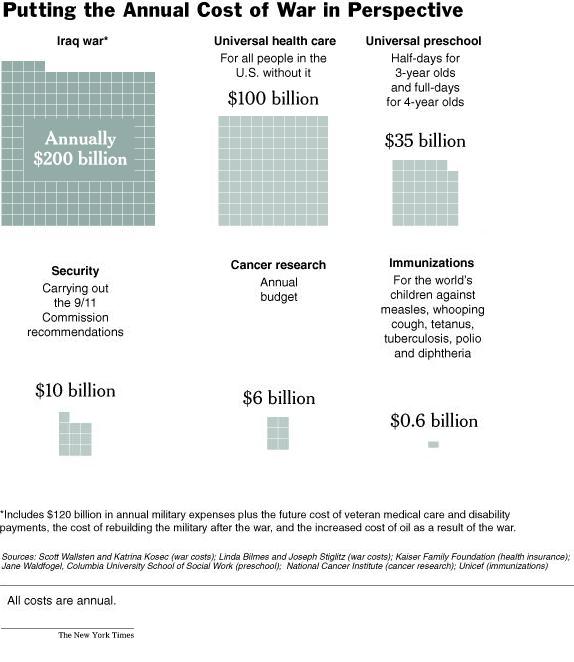 the point that the White House and Congress are now immersed in a titanic battle over a $4 trillion debt ceiling.
What is never mentioned is that these trillions of dollars were ruthlessly subtracted from the wellbeing of average Americans – smashing the carefully constructed myth of the American dream.”
The problem, back in the US, is that ordinary people are not being represented in Congress. Americans, for the most part are a kind, generous people. They may hold some funny notions about egalitarianism (and religion and…), but on the whole they are not the ignorant, jingoistic warmongers that the media often paint them to be. If the interests of the majority of American’s were actually respected, instead of a small section of the elites, the US would truly be that ‘shining city on the hill’. Yet the prosperity of the average American is being sacrificed on the altar of war so that a narrow slice of the populace can profit.
 “It all comes back, once again, to Pipelineistan – and one of its outstanding chimeras; the Turkmenistan/Afghanistan/Pakistan (TAP) gas pipeline, also known once as the Trans-Afghan Pipeline, which might one day become TAPI if India decides to be on board.
The US corporate media simply refuses to cover what is one of the most important stories of the early 21st century.
Washington has badly wanted TAP since the mid-1990s, when the Clinton administration was negotiating with the Taliban; the talks broke down because of transit fees, even before 9/11, when the Bush administration decided to change the rhetoric from “a carpet of gold” to “a carpet of bombs”.
TAP is a classic Pipelineistan gambit; the US supporting the flow of gas from Central Asia to global markets, bypassing both Iran and Russia. If it ever gets built, it will cost over $10 billion.
It needs a totally pacified Afghanistan – still another chimera – and a Pakistani government totally implicated in Afghanistan’s security, still a no-no as long as Islamabad’s policy is to have Afghanistan as its “strategic depth”, a vassal state, in a long-term confrontation mindset against India.”
Is the War all about the pipeline as the article suggests? More research is needed into the topic, but it would be hardly surprising to observe that this is one of the overarching goals of the war in Afghanistan.
“It’s mind-boggling that 10 years and $5.4 trillion dollars later, the situation is exactly the same. Washington still badly wants “its” pipeline – which will in fact be a winning game mostly for commodity traders, global finance majors and Western energy giants.
From the standpoint of these elites, the ideal endgame scenario is global Robocop NATO – helped by hundreds of thousands of mercenaries – “protecting” TAP (or TAPI) while taking a 24/7 peek on what’s going on in neighbours Russia and China.
Sharp wits in India have described Washington’s tortuous moves in Afghanistan as “surge, bribe and run”. It’s rather “surge, bribe and stay”. This whole saga might have been accomplished without a superpower bankrupting itself, and without immense, atrocious, sustained loss of life, but hey – nobody’s perfect.”
Are the strategic resources in the region worth the devastation of the Western world’s largest economy? The movers and the shakers in the US seem to think so.
 The American public is starved for actual news. The conservative propaganda mill that masquerades as fox news is the premier example of a society that is becoming insular and uncritical of its policy and place in the world. For a country that purports to value the idea of freedom of speech and the marketplace of ideas, the US certainly seems to define Al-Jazzera outside the acceptable limits of discourse for the public.
“The network has been targeted by the US government since 2003, when former vice president Dick Cheney and former defence secretary Donald Rumsfeld described it as tantamount to an arm of al-Qaeda.
Two of its reporters were later killed in Baghdad when US missiles hit its office. Al Jazeera and others voiced suspicions that the channel’s reporters had been deliberately targeted.
And, to this day, Al Jazeera, which, together with BBC News, has become one of the premier global outlets for serious television news, is virtually impossible to find on televisions in the US.
The country’s major cable and satellite companies refuse to carry it – leaving it with US viewers only in Washington, DC and parts of Ohio and Vermont – despite huge public demand.”
Ah, that must be the market making the correct decision about the needs and wants of its consumers. Or perhaps it is the politics that actually drive the market as a opposed to the cherished notion of supply demand.
“The station’s US push could hardly be more necessary – to Americans. By being denied the right to watch Al Jazeera, Americans are being kept in a bubble, sealed off from the images and narratives that inform the rest of the world. Consider the recent scandal surrounding atrocity photos taken by US soldiers in Afghanistan, which are now available on news outlets, including Al Jazeera, around the globe.
In America, there have been brief summaries of the fact that Der Spiegel has run the story. But the images themselves – even redacted to shield the identities of the victims – have not penetrated the US media stream. And the images are so extraordinarily shocking that failing to show them – along with graphic images of the bombardment of children in Gaza, say, or exit interviews with survivors of Guantanamo – keeps Americans from understanding events that may be as traumatic to others as the trauma of the terrorist attacks of September 11, 2001.”
Not surprising, as the forces of the status-quo do not need inflammatory images stirring up the population. Seeing the actual face of American foreign policy and what it is responsible for might waken the good altruism in the American people and have them demand a stop to the atrocities committed in their name.
“For example, the leading US media outlets, including the New York Times, have not seen fit to mention that one of the photos shows a US soldier holding the head of a dead Afghan civilian as though it were a hunting trophy.
So, for America’s sake, I hope that Al Jazeera penetrates the US media market. Unless Americans see the images and narratives that shape how others see us, the US will not be able to overcome its reputation as the world’s half-blind bully.
Indeed, Egyptians are in some ways now better informed than Americans (and, as Thomas Jefferson often repeated, liberty is not possible without an informed citizenry). Egypt has 30 newspapers and more than 200 television channels.
America’s newspapers are dying, foreign news coverage has been cut to three or four minutes, at most, at the end of one or two evening newscasts, and most of its TV channels are taken up with reality shows.”
The people of America are good decent people, but are purposefully being kept in the dark about what their role in the world is and how their corporations and government are acting internationally.
“Americans have a hunger for international news; it is a myth that we can’t be bothered with the outside world. Maybe Americans will rise up and threaten to boycott their cable and satellite providers unless we get our Al Jazeera – and other carriers of international news.
We would then come one step closer to being part of the larger world – a world that, otherwise, will eventually simply leave us behind.”
Sometimes you smile when you hear the misrepresentations of what Universal Heathcare. Other times you get righteously pissed off. This is neither. I knew the teabaggers were ass-hats, through and through, talking foolish nonsense, and being blindingly ignorant of history, but the picture below goes too far.

Yes, that really is a picture from a concentration camp, victims of state murder. And they(our tinfoil hat wearing, retarded-ignorant-hate-spewing-monkey-bile-for-brains- teabagging representatives) are equating state sponsored mass murder with Universal Health Care.
Un-frakking- believable. The ignorance demonstrated by these people is mind shattering.











 bleatmop
 Mystro


 Dead Wild Roses

Your opinions…