
You are currently browsing the tag archive for the ‘W.E.B. Du Bois’ tag.
Can we draw parallels between the political experience of Du Bois and our present time? The situation the Du Bois describes can easily be translated into a commentary of what is happening in 2016 – the message is clear – reputable people cannot abandon the political realm despite what the chattering classes say, as it each citizen’s duty to take part in the political process and attempt to make things better not only for themselves, but for the following generations.
Our democracy has been moving further and further away from the participatory citizen model that we like to claim we have. Interests that do not represent the common people strive to gerrymander our democracy to suit their narrow band of self-aggrandizing goals.
“Meantime, new thoughts came to the nation:the inevitable period of moral retrogression and political trickery that ever follows in the wake of war overtook us. So flagrant became the political scandals that reputable men began to leave politics alone, and politics consequently became disreputable. Men began to pride themselves on having nothing to do with their own government, and to agree tacitly with those who regarded public office as a private perquisite. In this state of mind it became easy to wink at the suppression of the Negro vote in the South, and to advise self-respecting Negroes to leave politics entirely alone. The decent and reputable citizens of the North who neglected their own civic duties grew hilarious over the exaggerated importance with which the Negro regarded the franchise.
Thus it easily happened that more and more the better class of Negroes followed the advice from abroad and the pressure from home, and took no further interest in politics, leaving to the careless and the venal of their race the exercise of their rights as voters. The black vote that still remained was not trained and educated, but further debauched by open and unblushing bribery, or force and fraud; until the Negro voter was thoroughly inoculated with the idea that politics was a method of private gain by disreputable means.
And finally, now, to-day, when we are awakening to the fact that the perpetuity of republican institutions on the continent depends on the purification of the ballot, the civic training of voters, and the raising of voting to the plane of solemn duty which a patriotic citizen neglects to his peril and to the peril of his children’s children, – in this day, when we are striving for a renaissance of civic virtue, what are we going to say to the black voter of the South? Are we gong to tell him still that politics is a disreputable and useless form of human activity? Are we going to induce the best class of Negroes to take less and less interest in government, and give up their right to take such an interest, without a protest? I am not saying a word against all legitimate efforts to purge the ballot of ignorance, pauperism, and crime. But few have pretended that the present movement for disfranchisement in the South is for such a purpose; it has been plainly and frankly declared in nearly every case that the object of the disfranchising laws is the elimination of the black man from politics.”
-W.E.B. Du Bois. The Souls of Black Folk p.105 – 106.
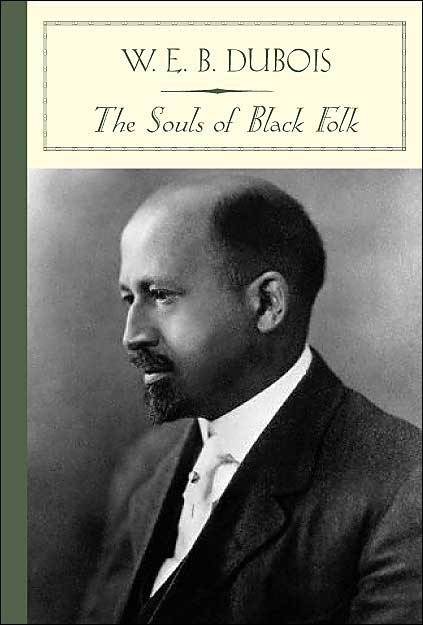 Du Bois has a talent for using his prose to sift directly to the root of the problem, and then offer an equally elegant solution. The problem of race in America continues to this day, but Du Bois has already blazed the trail toward a possible just solution – in one paragraph.
“Again we must decry the colour prejudice of the South, yet it remains a heavy fact. Such curious kinks of the human mind exist and must be reckoned with soberly. They cannot be laughed away, nor always successfully stormed at, nor easily abolished by act of legislature And yet they must not be encouraged by being let alone. They must be recognized as facts, but unpleasant facts; things that stand in the way of civilization and religion and common decency. They can be met in but one way, – by the breadth and broadening of human reason, by catholicity of taste and culture. And so, too, the native ambition and aspiration of men, even thought they be black, backward, and ungraceful, must not be lightly dealt with. To stimulate wildly weak and untrained minds is to play with mighty fires; to flout their striving idly is to welcome a harvest of brutish crime and shameless lethargy in our very laps. The guiding of thought and the deft coordination of deed is at once the path of honour and humanity. “
-W.E.B. Du Bois. The Souls of Black Folk. pp.56-57
The story from the other side, to feel what others feel and appreciate and understand what their experience is like is the first step in resolving the injustices that mar our history and continue to sicken our experiences as we move forward.
“I remember well when the shadow crept across me.
I was a little thing, away up in the hills of New England, where the dark Housatonic winds between Hoosac and Taghkanic to the sea. In a wee wooden schoolhouse, something put it into the boys’ and girls’ heads to buy gorgeous visiting-cards – ten cents a package – and exchange. The exchange was merry, till one girl, a tall newcomer, refused my card, – refused it peremptorily, with a glance.
Then it dawned upon me with a certain suddenness that I was different from the others; or like, mayhap, in heart and life and longing, but shut out from their world by a vast veil. I had thereafter no desire to tear down that veil, to creep through; I held all beyond it in common contempt, and live above it in a region of blue sky and great wandering shadows.
That sky was bluest when I could beat my mates at examination time, or beat them at a foot-race, or even beat their stingy heads. Alas, with years all this fine contempt began to fade; for the worlds I longed for, and all their dazzling opportunities, were theirs, not mine. But they should not keep these prizes, I said; some, all, I would wrest from them.
Just how I would do it I could never decide: by reading law, by healing the sick, by telling the wonderful tales that swam in my head, – someway. With other black boys the strife was not so fiercely sunny: their youth shrunk into tasteless sycophancy, or into silent hatred of the pale world about them and mocking distrust of everything white; or wasted itself in a bitter cry, Why did God make me an outcast and a stranger in mine own house? The shades of the prison-house closed round about us all: walls strait and stubborn to the whitest, but relentlessly narrow, tall, and unscalable to sons of night who must plod darkly on in resignation, or beat unavailing palms against the stone, or steadily, half hopelessly watch the streak of blue above.
After the Egyptian and Indian, the Greek and Roman, the Teuton and Mongolian, the Negro is a sort of seventh son, born with a veil, and gifted with a second-sight in this American world, – a world which yields him no true self consciousness, but only lets him see himself through the revelation of the other world. It is a peculiar sensation, this double-consciousness, this send of always looking at one’s self through the eyes of others, of measuring one’s soul by the tape of the world that looks on in contempt and pity.
One ever feels his two-ness, – an American, a Negro; two souls, two thoughts, two unreconciled strivings; to warring ideals in one dark body, who dogged strength alone keeps it from being torn asunder.”
– The Souls of Black Folk. W.E.B. Du Bois p.2
Women share this double-consciousness, with different actors, but the results are the same.











 bleatmop
 Mystro
 The Arbourist


 Dead Wild Roses
Your opinions…