
You are currently browsing the tag archive for the ‘Woke Tactics’ tag.
Activists use polysemy to make their corrosive ideas sound palatable to people not versed in their conversational inanity. The play is usually a cloak and dagger affair where they use the commonly accepted definition of a particular word, in this case ‘Diversity’ and use it in a dishonest setup that is really about pushing their specialist meanings into society and society’s institutions.
Here is great example.
Diversity (M1): Generally refers to the presence of variety within an organizational workforce, encompassing differences in identity, such as race, gender, sexual orientation, disability, age, culture, class, religion, or opinion. It’s about having a mix of different people.
Diversity(M2): Some critics argue that in “woke” contexts, diversity might be seen more as a means to an end rather than an end in itself, potentially focusing on increasing representation of certain politically aligned marginalized groups. This view suggests that diversity is less about broad inclusion and more about specific group representation.
The woke will push M1 and be morally outraged if you speak against Diversty(M1). How could you oppose having a different mix of people involved in a situation/task?
How could one indeed? But the pushback isn’t against Diversity(M1) it is pushback against Diversity(M2) which is infused with identity politics and the oppressor/oppressed narrative. It is the Diversity(M2) narrative that calls for a diversity of group identities with the proviso that they share the same ideological beliefs. This idea is illustrated by the fact that, for example, Black Conservatives are not considered to be a ‘diverse choice’ since they often opposed the oppressor/oppressed narrative.
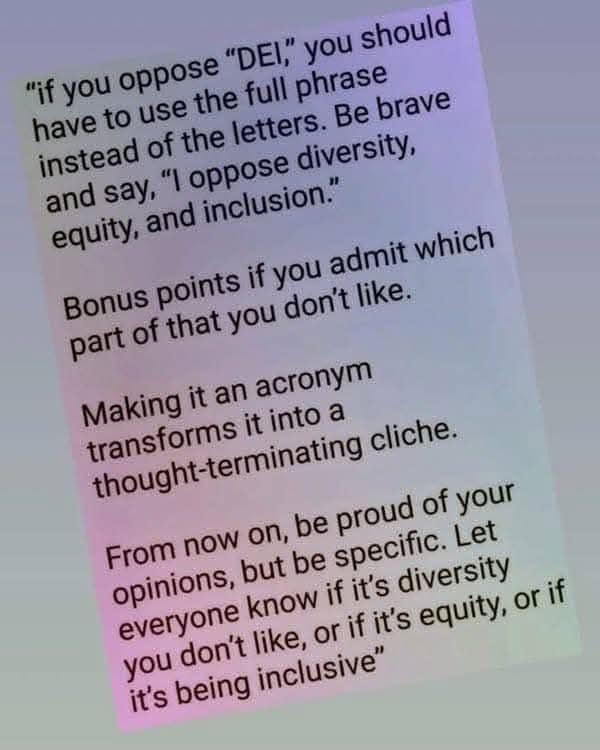
How deep does the polysemic rabbit hole go? Well…
The term “diversity” in the context of social justice advocacy often exhibits polysemy, where the word has multiple related or unrelated meanings. Here are three examples of how the term “diversity” is used:
Diversity as Representation: Meaning: This refers to the inclusion of different racial, ethnic, gender, and sexual orientation groups within organizations, institutions, or media.
Usage: In this context, “diversity” is often used to describe efforts to ensure that various demographic groups are represented in workplaces, schools, and public life. For example, a company might strive for diversity in its hiring practices to reflect the broader community’s composition.
Diversity as Ideological Uniformity:
Meaning: Some critics argue, as seen in posts on X, that “diversity” in certain circles is used to mean a variety of backgrounds but with a uniform set of political or social views, particularly those aligned with progressive or “woke” ideologies.
Usage: This interpretation suggests that while there might be diversity in appearance or demographic markers, there’s an expectation of conformity in thought, especially in terms of social justice issues. This usage is often highlighted in debates over free speech and ideological diversity.
Diversity as a Tool for Inclusion vs. Exclusion:
Meaning: “Diversity” can sometimes be perceived as inclusive when it pertains to groups historically underrepresented or marginalized, but it can also be seen as exclusive if it’s interpreted as excluding certain groups (like straight white males) from consideration for diversity initiatives.
Usage: This dual interpretation can lead to confusion or contention, where diversity initiatives are praised for broadening perspectives but criticized by others for being exclusionary based on identity rather than merit or broader inclusivity.
These examples show how “diversity” can be a multifaceted term within social justice discourse, with its meaning shaped by context, intent, and perspective. The web results and posts on X suggest that while the term is generally used positively to advocate for broader representation, there’s a significant debate around its implications and actual practice.











 bleatmop
 Mystro


 Dead Wild Roses
Your opinions…