
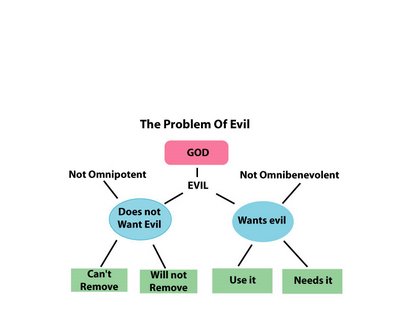
 I’m tired of people saying that one cannot prove the non-existence of their god. Not only can one do it, but its already been done. I’m referring to the problem of evil. The fact that evil exists negates the possibility of an omniscient, omnipotent, omnibenevolent, and omnipresent deity. Those are very important qualifiers, the problem of evil does not disprove the existence of any deity that is not completely perfect or is lacking in someway. I admit that the existence of any deity lacking, even slightly, in any perfection, in any way, cannot be disproven. On the other hand, any such deity would then be in the category of leprechauns, the boogey man, the tooth fairy, and the large invisible pink bunny that “actually” created everything, but only reveals this to asylum patients. And while this category, filled with an infinite amount of characters limited only by our imagination, cannot be disproven, no rational person would ever believe in such entities, as there is no evidence to support their existence. Or, if you prefer, they all have equal evidence in their favor, so each has a 1 in infinity chance of being correct. Not exactly zero, but close enough for any one with the cognitive capabilities of a codfish.
So now that we’re clear that we are dealing with solely an Omni-X god, I’d like to address the two recurring and horribly weak responses to the problem of evil that are continuously regurgitated by believers. The first, slightly stronger yet less prevalent, is the greater good defense. An omni-X god would allow evil if it resulted in a greater good. The analogy to parenting is often used. Parents should not shield their children from all suffering, for then the child does not learn to cope and therefore cannot develop into self sufficient adults. The small evil of suffering as a child helps the individual obtain the good of being independent and self guarding in later years. There are countless other examples that show how a little sacrifice here and a little suffering there can bring about great and wondrous things.
Now then, I will not be relying on the usual retort that there is much suffering from which no benefit is gained (ie cases of torture, rape, and an endless list of others). While I see this as a valid response, believers just point out it cannot be proven that there is no possible benefit, as our sight is limited and cannot fully understand the mysterious ways of their god. This is unprovable like the leprechaun category is unprovable, but unprovable none the less. And so I will instead point out that the entire defense of the greater good is guilty of gross equivocation. There is a reason that parents do not shield their children from all suffering. It is because the parent is finite. If it was possible for said parent to give his/her child the ultimate gifts of self sufficiency, autonomy, etc, but without them having to go through the suffering that is currently required, they would. Same with any other example. If any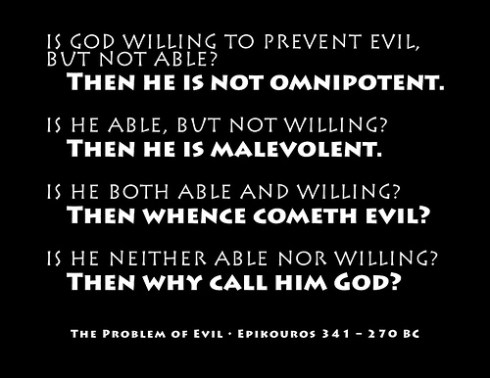 prerequisite suffering/evil could be avoided without losing the desired goal, it would be a good thing. This is usually an unobtainable good because we are finite. An omni-x god, however, would not be restrained as we are. Humans are subject to the greater good defense because of the way things are and our inability to change laws of nature and development. But there is absolutely nothing logically necessary about the way things are. The greatest goods in any possible universe could be ever present and not cost one iota of suffering, if only an omni-x god were actually in existence to make it so. But there isn’t.
The contradiction of putting human limitations on a supposed infinite being continues in the second response to the problem of evil: free will. “God doesn’t do evil, humans do” say the believers. Kind of my point actually, but you some how perverted it into yours. But, as theistic imagination tends to stop dead after their invented sky faerie, allow me to illustrate a few options available to an omni-x god that are much preferable to what currently exists.
Option 1. Don’t create anything. In this scenario, the omni-x god encompasses all of existence, therefore all of existence is perfectly good in every way. Making the world as it is would make all of existence less than perfectly good, and therefore an undesirable option to an omni-x god. Yet here we are.
Option 2. Create beings capable of handling free will. Especially weak versions of the free will defense claim that evil is a necessary byproduct of free will. Theists cannot claim this, however, as their Omni-X god has free will yet is void of any evil whatsoever. Evil cannot be intrinsic of free will for their god to exist. Now to my actual point, whatever abilities that Omni-X has that allows it to have free will and still never do any evil should be passed on to Omni-X’s creations. Failure to pass on this ability would be a deliberate act to create evil, impossible for an omni-x entity. Depriving humans of these abilities would require a lacking in power, goodness, and/or knowledge, specifically the lack of an omni-x entity. Simply put, there is no good reason for all of god’s creations to start out as anything but omni-x entities themselves.
Option 3. Create humans without free will. This option is for those who somehow see having lesser beings about as necessary. We see oppression as bad and free will as good because any human tyrant will either a) value their happiness over that of their subjects’ b) know less than the subjects about what is good for them individually and/or collectively c) be unable to provide what the subjects need d) be limited in a myriad of other ways e) some combination or all of the above. Not a single one of these would ever apply to an omni-x god. It would know exactly what is best and be able to provide it better than any human could. With eternal joy, love, and peaceful euphoria, which is not (as previously shown) logically dependent on suffering, as an option, free will would be meaningless aside from morally irrelevant flights of fancy (which an omni-x could allow humans, I suppose).
 As shown, criticisms of the problem of evil require feats of horrendous double think, that god is both perfect in every way yet, at the same time, is constrained by the limitations that daunt us lesser, finite creatures. God is either perfect or god isn’t. Respectively, god cannot logically coexist with the universe as it is or god belongs in the same category as boogey men and invisible pink bunnies. In either case, god is a ludicrous notion and god’s existence ought to be dismissed by anyone with even an inkling of rationality.











 bleatmop
 Mystro


 Dead Wild Roses
1 comment
September 5, 2009 at 12:25 pm
The Arbourist
LikeLike