
This post is dedicated to debunking the whole “harsh punishment on criminals is good” mentality. This post will have nothing to do about ‘prisoner rights’ or ‘criminal coddling’, but rather it will look at the efficacy of ‘harsh punishment’ on crime in general and how efficient longer jail sentences would be. Does it actually work? To what degree? Is that degree of success worth what it costs to citizens? Lets take a look.
 For as long as there have been communities, murderers and thieves have been seen as criminals. Indeed, non-human primates share this with us as they will also punish, banish or kill deviants of this kind. And since the birth of the community, punishment for these crimes has been vast, varied, ingenuitive, brutally painful, and many have been fatal. So what we have is a near perfect case study. Thousands of years worth of experiments where two specific crimes have met with the pinnacle exemplars of the object of our study, harsh punishment. If harsh punishment really had any effect whatsoever on deterring or reducing crime, after those many thousands of years of diligent application we should find that the social problems of murder and theft are all but solved, strange memories of an era long past away. As we don’t seem to be any closer to a crime free utopia than early communities (indeed, most would argue we are further away) the only conclusion is that harsh punishment is contending for the rank of ‘most ineffective idea ever actualized by any government’, which is a highly competitive race. But for those that find this thought experiment a bit too neat, lets break it down a bit and look at our system of imprisonment.
There are a number of views on what jail is supposed to do. Lets look at them and see if making jail sentences longer will aid in these different endeavors.
Some see prison as way to rehabilitate deviants. Criminals go there so the government can put them through a program that will reduce their deviant tendencies, turning them into 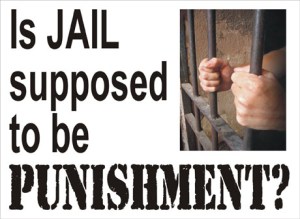 worthwhile members of society. If this is the case, then longer jail sentences make no sense. If they are rehabilitated in, for example, 5 years, there is no reason at all to keep them for 10. Once the job is done, stop.
Another view is that jail time deters crime, so longer jail time deters more. Our history example above kinda shot that one down, but I’d like to expand a bit. “Time Out” as a punishment for children has found much success in correcting behaviour, but results are not proportionate to the length of time the child spends in Time Out. To the contrary, the most effective Time Out’s last at most 5 minutes. Why? Well after that, the child’s attention span can no longer fixate on feeling bad about being in Time Out, so instead they make the best of the situation, they read a book, play drums on whatever is readily available, or pull out imaginary images out of wallpaper and textured ceilings.
Same thing in prisons. People will get used to it, adapt, and move on. After a while inmates will naturally lose the initial shock and misery (the only effective part of time out type punishment) and seek out what they can in their new environment. And as they are surrounded by criminals, you sometimes get a result opposite of rehabilitation.
I imagine some don’t get over that initial shock and misery. Those would be the prisoners who get broken by jail and become plagued with bonus psychological problems to add to whatever they came in with. So long jail sentences result either in criminals who are desensitized to the deterrence of jail or dangerously unstable personalities or both. Harsh punishment loses again. These results also apply to those who think prisons are for keeping harmful people away from society.Longer incarceration is more likely to make inmates worse and therefore more of a danger.
 And lastly, there are those that see prison as agents of restitution. Murderers and thieves owe society for their crimes and must pay up via longer stays in prison. This is the stupidest of them all. Society gains not one iota of benefit from having someone in jail. Rather, we pay through the teeth to put people up in prisons. We give up billions of dollars that could be spent on infrastructure, development, social services, anything at all that actually helps society, but instead we have to waste it on prison walls, prison food, prison maintenance, prison supplies, prison employees, etc. Jail makes criminals take MORE from society, not give anything back. Again, longer sentences are worse for society.
No matter your views on what prison is supposed to do, millenia of experience has shown that longer jail sentences are at best grossly wasteful of our resources and at worst devistatingly counter productive to its aims. I am bewildered by those who say “Well, this prison thing isn’t working, let’s do it more!” One would think that after futilely beating societies’ collective head against the wall for thousands of years, people would start warming up to alternatives.











 bleatmop
 Mystro


 Dead Wild Roses
2 comments
August 24, 2009 at 12:55 pm
I hate junk mail, especially from my MP. « Dead Wild Roses
[…] Absolutely ridiculous. Possibly related posts: (automatically generated)Couple Trapped Inside Historic PrisonAny mail today?Why Libby’s Sentence Was So Tough TAG CLOUD:What is growing at DWRCanada Education Feminism Gaming Gender Issues Housekeeping Humour Medicine Music Politics Religion Science Uncategorized […]
LikeLike
October 9, 2010 at 9:04 am
Vic “The Warden” Toews – Master of Unreality « Dead Wild Roses
[…] you ever wondered when the Conservative Government would stop adhering to reality? One would think that they would not just come out and admit they base their policy squarely on […]
LikeLike