
 Media Lens offers a valuable service of presenting the news that does not make the front page of the newspapers (or even the back page) and providing analysis and edification that does not come with the mandatory business class prism. This excerpt can be found on their web page.
Beyond Corporate Propaganda
In his latest excellent book, ‘Beyond the Profits System’, the British economist Harry Shutt observes that one of the most striking features of the financial crisis has been:
“… the uniformly superficial nature of the analysis of its causes presented by mainstream observers, whether government officials, academics or business representatives. Thus it is commonly stated that the crisis was caused by a combination of imprudent investment by bankers and others […] and unduly lax official regulation and supervision of markets. Yet the obvious question begged by such explanations – of how or why such a dysfunctional climate came to be created – is never addressed in any serious fashion.”
Shutt continues:
“The inescapable conclusion […] is that the crisis was the product of a conscious process of facilitating ever greater risk of massive systemic failure.” (Harry Shutt, ‘Beyond the Profits System: Possibilities for a Post-Capitalist Era’, Zed Books, London, 2010, p.6)
In several books and articles, David Harvey, a social theorist at the City University of New York, has cogently written of how capitalism has shaped western society, risking and even destroying nations, populations and ecosystems. Not only are periodic episodes of “meltdown” inevitable, but they are crucial to capitalism’s very survival. The essence of capitalism is self-interest; and any talk of reforming it through regulation or by imposing morality – a kinder, gentler capitalism – is both irrational and deceitful.
The bankruptcy of investment bank Lehman Brothers in September 2008 triggered the latest crisis of capitalism. Drastic action was required to save the system. And so, observes Harvey, a few US Treasury officials and bankers including the Treasury Secretary himself, a past president of Goldman Sachs and the present Chief Executive of Goldman, “emerged from a conference room with a three-page document demanding a $700 billion bail-out of the banking system while threatening Armageddon in the markets.”
Harvey continues:
“It seemed like Wall Street had launched a financial coup against the government and the people of the
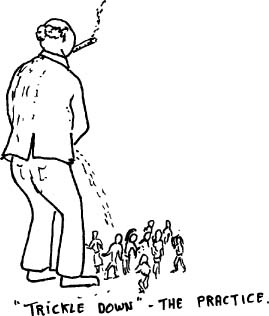
Things they do not teach you in Economics 101.
United States. A few weeks later, with caveats here and there and a lot of rhetoric, Congress and then President George Bush caved in and the money was sent flooding off, without any controls whatsoever, to all those financial institutions deemed ‘too big to fail’.” (David Harvey, ‘The Enigma of Capital: And the Crises of Capitalism’, Profile Books, London, 2010, p. 5)
Shutt translates “too big to fail”, that over-used defence employed by capitalists and their cheerleaders, as meaning that a tiny super-wealthy clique recognised that they risked losing vast fortunes if the markets were allowed to take their course free of intervention from the state. Wholesale nationalisation of insolvent banks would have posed an existential threat to elite power; or even led to the collapse of the capitalist profits system in its entirety. Rather than accept such a fate, rich investors tried to ensure that their toxic assets be “largely transferred to the state, thereby adding unimaginable sums – officially estimated at $18 trillion world-wide – to already excessive public debt.” (Shutt, op. cit., p. 36)
As ever, the public were made to pay the price for private greed. In simple terms: it’s socialism for the rich, and capitalism for the rest of us.”
Make no mistake, capitalism for the rest of us, is no happy place.











 bleatmop
 Mystro


 Dead Wild Roses
6 comments
June 25, 2010 at 7:16 pm
Alan Scott
The Arbourist,
As they say about Democracy, so it is true of Capitalism. It is absolutely the worst system ever devised, except for all of the others.
LikeLike
June 26, 2010 at 11:00 am
The Arbourist
I would not disagree with your comment. I’m not a big fan of capitalism, and as currently reside on the long end of the stick when it comes to who is getting exploited by it I live reasonably well under it.
What bothers me is that those who have ‘made’ it almost always attempt to game the system in their favour. There needs to be a set of strictly enforced rules that keeps people greed in check, or otherwise we get to suffer, as the article suggests, more banks/institutions that are too big to fail.
LikeLike
June 27, 2010 at 9:49 am
Alan Scott
The Arbourist,
Too big to fail. Like Fannie and Freddie. I keep saying that blaming the banks for the collapse is blaming the flies for the smell coming off the manure piles. The government in my country, under Barney Fwank and company set up a structure with the GSEs that Wall Street and the Banks merely followed to maximize profits.
The problem with the collapse is that Socialists are not just regulating Capitalism, they want to replace it with a Control economy that has always failed. Obama, Frank and Dodd are the ones who engineered the banking mess through Fannie and Freddie. Now they get to blame greedy Capitalism and the Banks while they pose as Saviors.
The trouble is, their blame Capitalism campaign has worked far better than their reforms will.
LikeLike
June 27, 2010 at 11:55 am
The Arbourist
The government in my country, under Barney Fwank and company set up a structure with the GSEs that Wall Street and the Banks merely followed to maximize profits.
Maximizing profits is not holy writ. The relationship between shareholders and stakeholders needs to be reevaluated because it is out of balance as it currently sits.
The problem with the collapse is that Socialists are not just regulating Capitalism, they want to replace it with a Control economy that has always failed.
That is a large leap from regulating the excesses of Capitalism to instituting a Command Economy. I think it is too far a leap to make a reasonable argument from.
Regulation of the Banking Industry has largely protected the people of Canada from the economic meltdown the US is experiencing. The Banks of Canada are not suffering under a ‘command economy’ but rather flourishing as they continue to post record profits year after year. The types of regulation that work in Canada do not strangle the economic engine, but rather mediate the highs and lows of the business cycle and prevent the outright piracy which more deregulated systems are prone to experience.
Capitalism concentrates wealth; to counter this feature governments must regulate and redistribute the wealth of society so that more people can benefit from the overall wealth of society. Progressive taxation, strong social programs and universal healthcare are all factors of advanced civilized societies.
The trouble is, their blame Capitalism campaign has worked far better than their reforms will.
I agree with this to a certain extent, because blaming Capitalism is an easy ideological target and it helps maintain the status quo. The people who benefit the most from Capitalism are not stupid, they have a great deal invested in keep the current mostly unregulated system in place in the the US. They would much rather let the blowhards on both sides sling mud and cry foul, but most importantly, nothing changes while the debate continues.
I know it is hard for you to believe, but Obama is not a socialist. If anything, he is centre-right accommodationalist who like the president before him, represents those who brought him into power. The reforms he has proposed and some that have passed are pale ghosts of what social democratic reforms actually are. Obama has done little to alter the fundamental power structure in the US, nor will he (I assume) because you need to dance with those who brung ya.
LikeLike
June 28, 2010 at 10:29 am
Alan Scott
The Arbourist,
” Capitalism concentrates wealth; ”
Capitalism CREATES wealth.
” to counter this feature governments must regulate and redistribute the wealth of society so that more people can benefit from the overall wealth of society. ”
I can give you examples of how redistribution destroys wealth, but how about you first give me examples to prove your point.
LikeLike
June 29, 2010 at 10:42 pm
The Arbourist
It does both and rather effectively I may say.
One need not look far for examples of the concentration of wealth. The media concentration map on Ben’s site is an excellent pictorial overview of what I am talking about. Another prime example is Microsoft or GE or really, pick whatever large conglomerate you like. Consider the Robber Baron era in the US, that is what unregulated capitalism is.
The reasonable redistribution of wealth is a necessary counterbalance to what capitalism does.
LikeLike