
One of the most frustrating parts of attempting to discuss White Male Privilege (WMP) with oh say white males is the  denial of the fact that it exists and it is an intrinsic characteristic woven into the fabric of our society. It is nice when another study is done (adding to the large body of work) to show its existence and how thoroughly embedded it is in our culture. A big hat-tip to Sociological Images for the leg work (which I am reposting it its entirety) in condensing the study originally found on Fairness and Accuracy in Reporting.
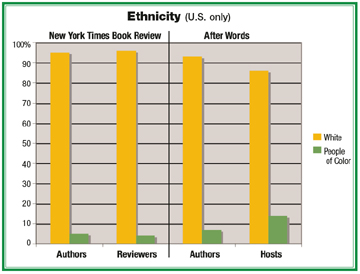
In a post at Fairness and Accuracy in Reporting, Steve Rendall and Zachary Tomanelli investigated the racial breakdown of the book reviewers and authors in two important book review venues, the New York Times Book Review and C-SPAN’s After Words. They found that the vast majority of both reviewers and authors were white males.
“Overall, 95% of the authors and 96% of the reviewers were non-Latino white (compared to 65% of the population).
Women accounted for between 13 and 31% of the authors and reviewers:
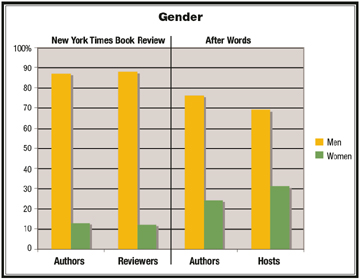
This is some hard data showing that white men’s ideas are made more accessible than the ideas of others, likely translating into greater influence on social discourse and public policy. These individuals certainly don’t all say the same thing, nor do they necessarily articulate ideas that benefit white men, but a greater diversity of perspectives would certainly enrich our discourse.”
It is really hard to argue against the substantive data collected about the influence of WMP on our culture and how it conditions us to think and act. As the quoted material says, just imagine if more people were able to influence our culture how much more rich and diverse our culture would be.











 bleatmop
 Mystro


 Dead Wild Roses
3 comments
September 17, 2010 at 12:43 pm
Vern R. Kaine
Not as convinced of this WMP animal wreaking havoc and causing mass destruction in Western culture as seems to be suggested. Depending on where one chooses to look, you can find evidence for almost anything, whether it be WFP, BMP, BFP, WSP, etc. etc. etc..
In contrast to the concept of “WMP”, the majority of my school was female, which didn’t influence the quality of education either myself or anybody else there received. The majority of my bank’s employees are female, which doesn’t influence my access to savings or investment vehicles. For the most part, it’s a matter of what environment one chooses to be in (male or female), and what meaning they want to attach to the events that occur around them which I think truly decides the matter of “privilege” or not.
Do I think WMP exists and does have an influence on culture? Yes I do. Most recently I saw “This Film is Not Yet Rated” (http://en.wikipedia.org/wiki/This_Film_Is_Not_Yet_Rated). I wouldn’t say that the bias was male, but I would say that wherever the bias came from, it was definitely against feminine expression.
The impact of this influence overall, however, can be exaggerated and overblown which creates a vicious circle (i.e. downward spiral) of excuses for both men and women that stunt their emotional and intellectual growth. It’s not unlike guys like Al Sharpton making everything a race issue.
LikeLike
February 9, 2011 at 3:37 pm
Which Writers Helped to form your Concept of Nationalism?
[…] homophobic, xenophobic and nazi". GOT IT? Oh how I cannot wait to see the end of "white male privilege". Diversity And Equality At All Costs Reply With Quote + Reply to […]
LikeLike
February 10, 2011 at 8:04 am
The case against all-women shortlists
[…] men altogether. Probably for at least fifty years to make up for centuries of oppressive WMP. Here, why not try out the white male privilege checklist to see how you score? Diversity And […]
LikeLike