
Rick Salutin should not have been dismissed as an op-ed writer at the Canada’s ‘national’ newspaper the Globe and Mail. His spot taken by religious apologist Irshad Manji has left a gaping hole in coverage of news and events from the perspective of the working class. However, one and awhile they allow Jim Standford to add a bit of reality to the generally rightward op-eds that are par for the course in the Globe and Mail.
Jim lays the smack down in an article that tells about how our society is being (has been) structured to benefit the wealthy and their interests and how new movements such as the Tea Party seemed to have missed the target when it comes to where they lay their righteous anger. This post will be quote heavy as I intend to reference it as a basis for economic discussions in the future, so please bear with the meticulous quoting as to what Mr. Standford had to say.
 “American economist Emmanuel Saez has painstakingly assembled a century-long statistical series on U.S. income distribution. On two occasions, the share of income captured by the richest 1 per cent reached about a quarter of the national total. The first time was in 1928, the second in 2007. As we all know, both peaks in wealth concentration were followed by financial catastrophe and depression. Indeed, maldistribution clearly contributed to both meltdowns.”
Not to harp on a point but progressive taxation addresses this problem well and at one point in time was actually in the tax code of the US.
“But there’s a startling difference in the political reverberations that followed the two conflagrations. In the 1930s, outrage at the pre-Depression extravagance of the rich, contrasting with the dislocation experienced by masses of Americans, sparked a decade of left-leaning foment. Government expanded income security, directly hired millions of unemployed, and actively supported a new generation of unions to fight for the common folk. Meantime, it reined in business excess through tough financial rules, anti-trust policies, and high taxes on the rich.”
So what is different this time around? Why are we not getting the limitations put back on the business class?
“This time around, there’s been plenty of populist anger – but (so far) it’s been steered in exactly the opposite direction. Social supports and public employment are being cut dramatically (especially by U.S. state and local governments). Barack Obama’s election promise to modernize labour laws and rebuild unions was dead – even before he lost Congress. And several state governments are now preparing a full assault on union rights: Recent proposals in Ohio and Wisconsin would virtually outlaw collective bargaining across broad swaths of the public sector.”
It seems like this is the road that has brought us to ruin, let’s go faster! The important questions to keep in mind is economic disaster and ruin for whom and which segments of society are not being as dramatically effected.
“The richest 1 per cent almost tripled their share of U.S. national income since 1978, gobbling two-thirds of the income gains generated in the whole economy over the past decade. With numbers like these, highlighting the incomes of the ultra-rich is no longer an idle, envious pastime. The concentration of wealth at the top has become macroeconomically significant.”
Two thirds of all the income gains, to the top 1%. This is not equitable, rational or even reasonable. Why does emergent political policy look the way it does? Political influence of this nascent oligarchy is the answer.
‘Recession or no recession, the gravy train at the top hasn’t paused for breath: Executive bonuses keep rising, and the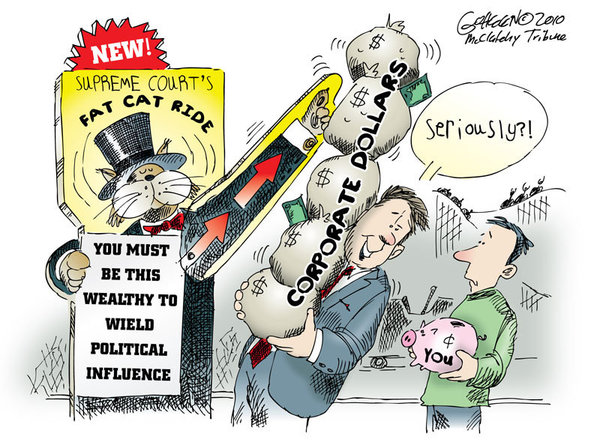 top 25 hedge-fund managers made a staggering $1-billion each in 2009. Nevertheless, the trend in U.S. politics is not to challenge the contrast between the top and the bottom, but to reinforce it. The Tea Party portrays government itself as the problem. And rather than empowering average workers to improve their lot (like the Wagner Act did in 1935), America’s rightward lurch in labour relations will reinforce the stagnation at the bottom.”
I would speculate that measures that increase social and economic equality such as Universal Healthcare were derailed precisely because of this misplaced furor of the Tea party and other people, who wrongly blame the government rather than elites for their current economic situation. It certainly was not the government that took 2/3 of all the economic income gains from 1978. Indeed it is pretty bad in the US, but does Canada fare any better?
“Canada is a kinder, gentler, fairer place. So the numbers aren’t as extreme. Or are they? Here, the richest 1 per cent (less than 250,000 tax filers) capture 17 per cent of total income, and that share has merely doubled (not trebled) since the egalitarian 1970s. A full third of all income gains across Canada since 1987 have gone to that lucky group. For the ultra-ultra-rich (the top 0.1 per cent of families, 25,000 in total, with average income of $1.5-million), their share of national income has trebled to 6.5 per cent.”
Erm. Well… Yeah, we are a little better of as the egalitarian principles in Canada are eroding at a slower rate than those of the US.
“Despite this largesse, in Canada, too, the political bandwagon lurches to the right. There’s been infinitely more hot air expended since the financial meltdown over the salaries of unionized garbage collectors than those of high-flying financiers. Our home-grown plutocracy, meanwhile, keeps raking it in. Bonuses at the Big Six banks alone reached $8.9-billion in 2010, the highest ever. The Canadian Centre for Policy Alternatives recently documented that the typical Canadian CEO made as much by 2:30 p.m. on Jan. 3 as the average worker makes all year long.“
It is not rational for this sort of imbalance to exist in an economy. This is not the market determining a fair price for work done, this is naked avarice strutting though Canadian society as if nothing was wrong.
“Imagine a city the size of Saskatoon hogging a third of all the new income generated by the entire country. Imagine folks who earn as much in a few hours as the rest of us do in a year – yet still lecture us on the need to tighten our belts. Imagine 25,000 families earning as much as the bottom seven million tax filers put together. How long will these excesses fly under the public’s radar, while we bicker over wage gaps between unionized garbage collectors and non-union fast-food workers? Not long, I hope.”
The belt tightening needs to start at the top, competent leaders, lead by example and from the front. Did we see during this latest recession the business classes calling for more social programs and higher taxes on their cohort? Not even a faint whisper. Why? Because when rapacious avarice is the name of the game, sharing the pain and helping others is not even in the playbook.
Feathering the nests and nest eggs on the backs of the rest of society is par for the course of North American elites. Witness the wage stagnation that is still with us since the 1970’s. And who (are we told to) do we blame for this? The penuriousness of the burgeoning plutocracy? Of course not. The blame goes to the Government and the Unions, two public institutions that have mandates to actually protect, rather than exploit, people. A tip of the hat for the propaganda program that has set the people against themselves rather than those who are actually running the show.











 bleatmop
 Mystro


 Dead Wild Roses
13 comments
January 22, 2011 at 10:01 am
Tweets that mention Jim Standford G&M – Redirecting our Rage at the Real Gravy Train « Dead Wild Roses -- Topsy.com
[…] This post was mentioned on Twitter by Progressive Bloggers, The Arbourist. The Arbourist said: Jim Standford G&M – Redirecting our Rage at the Real Gravy Train: http://wp.me/pyhFw-KY […]
LikeLike
January 22, 2011 at 12:24 pm
Alan Scott
Always interesting. People with no business background preaching the evils of capitalism. Strange how they never cite those great economic socialism success stories like Venezuela, Cuba, N. Korea, and the USSR.
LikeLike
January 22, 2011 at 12:31 pm
The Arbourist
People with no business background preaching the evils of capitalism.
Ah, so it take specialist knowledge to see the gap between the rich and poor and the concentration of wealth in societies. Noted.
Strange how they never cite those great economic socialism success stories like Venezuela, Cuba, N. Korea, and the USSR.
Red Herring. Your argument fails. Try again.
LikeLike
January 22, 2011 at 6:32 pm
Vern R. Kaine
Is this what passes for justification of mediocrity these days?
This whole “blame the rich” thing is nothing but a shell game that both Big Business and Government use to keep the middle class continually misdirected, in one place, and continually voting, borrowing, and buying themselves into perpetual servitude. Always has been that way, and always will be because ultimately 95% of the population are followers, not leaders, and that’s exactly the way the followers want it. Otherwise, if they really wanted to change their incomes that bad and take a bigger piece of the pie, they’d take advantage of the many ways we all have to do so (unless of course, we’re in a union).
Standford wants to put the blame off of government here. Really? Because big business isn’t supposed to work for the people, and neither are unions. The only institution that’s built for the specific purpose of doing so is the government. Level the playing field, put in anti-trust policies, rein in favoritism and unearned excesses to prevent us from harm. That’s exactly what government should do, and exactly what capitalists, true free market advocates, and libertarians want it to do, but unfortunately, we’re in the minority while the rest of the kool-aid drinking middle class who thinks big business and government are separate keeps drinking the kool-aid and doing nothing (and debate without action is doing nothing).
Blaming big business is projection, and easy to do. It’s also useless. And blame what, exactly? That the billionaires in society are all businesspeople? That they grew richer while the general public didn’t? If these billions were earned through risk and reward, then the rich have earned it, and if the employees were paid regularly and on-time in the meantime taking no additional risk of their own, then they got what they both wanted and deserved, too. If these riches were acquired illegally or unfairly, on the other hand, then that’s exactly where the citizens and the government are to step in, but they don’t. Why? Because the majority doesn’t want to – only the minority does.
And here’s why else why “blaming the rich” is a joke – what’s the excuse at the top for the excesses, that it’s not their fault for taking advantage of the opportunity they’re given, or that they’ve earned the right to do so? Funny, but that’s the same excuse people give at the bottom regarding abusing entitlement benefits, and the same thing that the middle class said when asked why they got in over their heads with credit and their mortgages. How many middle class rack up their credit cards only to demand credit card relief from the government? Eat poorly, smoke, drink, etc. while bitching about health care premiums? It’s all the same thing.
And how are unions the answer here? How can one claim them to be the solution to wage disparity when they’ve basically done nothing to obviously change it the past 20 years? All the unions were great at, and have done exceptionally well (besides thuggery), is guaranteeing that the true value of an employee would never improve over that time. (Check out wage disparity between union bosses and union members, btw.)
We can bitch about this sort of thing all we like, but until a middle class person actually wants to get elected or people actually want to elect one, none of it will change. In the meantime, the fact remains that nobody wants it to. Middle class people are powerless to protect entitlements, the general public knows that, so they’ll never get elected.
LikeLike
January 23, 2011 at 12:52 pm
The Arbourist
Is this what passes for justification of mediocrity these days?
I’m thinking probably not, because nowhere in either my writing or Mr.Standford’s was there a statement justifying or even encouraging mediocrity. This is an outside assumption brought to the table by you, as it seems, you have categorized and perhaps already pre-judged the conclusions of what was said. I understand that you come from a much different background and have had a much different experience that me, however that does not mean your opinion or point of view takes precedence over mine. Vern, you make several assertions and I’ll try and put them in context of the article and add my thoughts to what you have said.
This whole “blame the rich” thing is nothing but a shell game that both Big Business and Government use to keep the middle class continually misdirected, in one place, and continually voting, borrowing, and buying themselves into perpetual servitude.
I’m not really sure where the shell game aspect comes into play. Have real wages for workers stagnated since the 70’s? yes or no? Has income growth disproportionately been for the slim majority of people in our societies? Yes or no? Has inequality increased or decreased since the 1970’s yes or no? The answer, backed by some of the statistics in the article and google-fu’d by me at the end show the answer to be yes. Is there a correlation of the general health of society and the concentration of wealth? I think most people would say yes and that when inequalities become significant, the standard of living of the vast majority goes down. I argue for egalitarianism Vern, certainly not mediocrity. As a corollary to that argument I argue that the Market is not the best arbiter of income distribution in a society.
Please explain, how a doctor who saves lives, makes significantly less than a banker who shuffles money around and makes returns for his investors? That is not rational, yet we seem to accept it as normal in our market dominated societies, even though it is a clear perversion of what is valuable to society.
Otherwise, if they really wanted to change their incomes that bad and take a bigger piece of the pie, they’d take advantage of the many ways we all have to do so (unless of course, we’re in a union).
Well damn Vern, it just sounds like the libertarian non-solution of “if people were just more responsible and more greedy we would all be in the money and good times would magically happen.” Unfortunately, like Utopian Socialism, most Libertarian thought is based on fairy dust and wishful thinking. Capitalism concentrates wealth by its very nature. This is another one of those key points that if you do not accept it, then we need to stop talking on this issue because it is fundamental (not to mention fundamentally real) to why I take the positions I do. Another key point of Capitalism is that it requires a pool of exploitable labour to work, without said labour, then the things you abhor so much (see unions, welfare, rights for workers) tend to spring up and start cutting into profit. Boiling down your argument, because 95% of the middle class is not starting their own business and innovating, it is their own damn fault, and should continue to support the plutocracy that continues to game the system for their benefit. Starting your own business/inventing is a costly venture frought with risk and uncertainty. You might succeed, but then again you might not and it is awfully hard to feed your family with coulda, woulda’s and shoulda’s. Placing the burden on the middle class for not “getting out there and demanding more of pie” is unrealistic at best.
If these billions were earned through risk and reward, then the rich have earned it, and if the employees were paid regularly and on-time in the meantime taking no additional risk of their own, then they got what they both wanted and deserved, too.
It almost like it happens in a vacuum, these noble capitalists making the world better as their wealth trickles down through the economy… Trickle-down economics has been thoroughly discredited and aptly renamed socialism for the rich. The people taking these risks rely on the superstructure of the society build around them that actually allows and facilitates the risks they take to happen. Without these supports (aka society) the entire process does not start. Everyone in society contributes to this cohesive force that allows people to take risks and make things happen. Proportionately everyone should benefit from being part of said system. Hence income redistribution and progressive taxation. The other way sends us spiralling away from democratic rule and a free society as the concentration of wealth (one of the key features of capitalism) lurches us toward plutocratic/autocratic rule.
And here’s why else why “blaming the rich” is a joke – what’s the excuse at the top for the excesses, that it’s not their fault for taking advantage of the opportunity they’re given, or that they’ve earned the right to do so?
And who makes the rules? Do you really think that the people who run the system are going to make rules that hurts their profitability and well-being? Taking advantage of opportunity, more like rigging the system to make it work for you. It is most certainly their fault, and it is a disservice to portray them as “just taking advantage of opportunity”. It is like how American foreign policy works, protectionism and subsidies for the homeland and “free trade” and market discipline for everyone else.
How can one claim them to be the solution to wage disparity when they’ve basically done nothing to obviously change it the past 20 years?
Considering that in unionized jobs wage disparity is less I think they are at least working toward a solution.
All the unions were great at, and have done exceptionally well (besides thuggery), is guaranteeing that the true value of an employee would never improve over that time. (Check out wage disparity between union bosses and union members, btw.)
Damn unions doing nothing – Paid Vacations, Holidays, Sick Leave, Seniority Rights, Wage Increases, Health and Insurance Plans, Safety Laws, Workers Compensations Plans, time and half for hours worked in excess of 8 hours a day or 44 hours in one week, unemployment benefits, and job security. Like many libertarian debates I enter you seem to pine for the days when workers were literally worked to death and treated at best as replacement parts in the industrial machine. These improvements to the workers were all fight for, and paid for in blood, because it was not only the owners they went on strike against it was often the coercive apparatus of the state, namely the army and the police that went against the common working people. So if you’re not down with what has been won for you though years of bloody labour struggle, your sense of entitlement blinding you from what was done for you (hey isn’t personal responsibility all big with the libertarian crowd) then renounce those benefits listed above. Good on ya, but the rest of us will respect what has been bought and paid for in human misery and death, and most emphatically do not want to return to time when good ole capitalism was unconstrained and noble business owners overtly ruled society. (Been here before, but I cannot let your union bashing go unmentioned :) )
Unions are a response to unfettered business control and power in society and are a necessary part of a society that takes the civilized label seriously.
We can bitch about this sort of thing all we like, but until a middle class person actually wants to get elected or people actually want to elect one, none of it will change.
And how do you propose one does that? The rules, made by the plutocracy punitively discriminate against everyone except those in the ruling class. Obama raised 875 million when he took his first election, his goal for the 2012 is a billion dollars. Why a billion, because the republicans purportedly have a war chest near the half billion mark. If the first number seems outrageous the second most certainly qualifies. Also consider the Supreme court ruling where now $$=Free Speech. Where exactly does a member of the middle class even begin to compete in this arena? Why is the public financing legislation derailed or relegated to a limbo like status? Some plucky entrepreneur will never be President, not under the current system. Why, because the system has been tilted unfairly in favour of one class over another. Until that changes, the status-quo will remain.
LikeLike
January 24, 2011 at 10:08 am
Vern R. Kaine
I’m thinking probably not, because nowhere in either my writing or Mr.Standford’s was there a statement justifying or even encouraging mediocrity.”
You are correct, here, Arb. It is an inference by me, drawn from Standford’s and others’ specific offering as to what’s wrong, but very vague and impotent offering as to what’s right. I don’t think my inferences are incorrect or inaccurate here, even if Standford or you do not state them explicitly. Here we’re talking about a “gravy train”. OK. What is it that is being proposed specifically to curb it, or stop it? All I read here is the ideological argument that it “should” be curbed, and that it’s “unfair.”
When someone knows they “should” quit smoking, but they don’t, they’re effectively justifying their smoking as there are clearly more compelling reasons for them to keep smoking. They’re accepting themselves as smokers, even though they’ll say time and time again how much they hate it and want to quit. I see the same thing here. 1,5,10 years from now, people will still be complaining about the same thing and their lives will be no different. Because of what the government didn’t do or what the rich didn’t do? No, because of what they didn’t do. If they hated mediocrity so bad, they’d do things to get out of it. If they don’t see any options, they’ve let fear of risk blind them.
I argue for egalitarianism Vern, certainly not mediocrity. As a corollary to that argument I argue that the Market is not the best arbiter of income distribution in a society.
Again, you are correct that I have made a superseding point here (I see both as part of an enmeshed issue, so that’s perhaps why), so I’ll go back to yours.
Specifically to this point, I would agree with your observations about the current wealth distribution, however I disagree with what (or who) you attribute the cause to. The Market has worked in the rich’s favor because, I argue, that the general public has effectively let it happen. The rich have been active and involved in politics, and the rich have taken risks to increase the amount and speed of their reward. The general public, however, hasn’t. The fastest, most effective vote people can make is with their dollar, the second fastest is their voice (not blogging, but calls and letters to their representatives), and the third is their ballot. All three have been largely underutilized. Why? “Too busy”, “too powerless”, etc. Just excuses, I believe, to avoid taking any risk or any action towards what they really believe in. Look what’s happening as a result of WikiLeaks – nothing. The robbery by Wall Street – nothing. How many customers have left AIG, Citibank, Morgan Stanley? Haven’t heard of any. Anybody wanting to shut down Fannie May and Freddie Mac? Nope. Did they avoid the bulk of financial reform? Yep. Why? Because we let it happen, I believe, not because we are powerless.
Standford and it seems yourself are arguing that something’s been “taken” from the middle class. I disagree – I believe it has been voluntarily handed over, and deep down, people know it. I believe they’re also fine with it, so long as they can maintain the illusion that they’re living “upper class”.
And who makes the rules? Do you really think that the people who run the system are going to make rules that hurts their profitability and well-being?
Those who SHOULD be running the system, the majority, hand over power to the minority. Why? It protect their mediocrity, which keeps them safe, and in their comfort zone (they hope). Society rewards those who take risks, they take none, and yet they still want more than their share because they believe they’re entitled to it.
Now the financial sector is a different animal. That was exploitation, and in my opinion, illegal, but even still, the middle class had a chance to go after them, and they didn’t. They didn’t speak up enough, and they’re once again, not voting with their dollars. I think it’s convenient and disingenuous simply to blame the upper class for this.
Please explain, how a doctor who saves lives, makes significantly less than a banker who shuffles money around and makes returns for his investors? That is not rational, yet we seem to accept it as normal in our market dominated societies, even though it is a clear perversion of what is valuable to society.
Because the doctor is paying the banker to get crazy return on his investments, but I get your point, and agree with you. We do accept it as normal, and we shouldn’t. If you want to know why I actually think this happens (and why cops, teachers, firemen, etc. don’t get paid as much as brokers), it’s how directly attributable a clear and immediate profit is to that person. If a teacher got paid for how much a person makes later in their life, or a doctor got a portion of someone’s earnings every year after they saved their life, the payscales would be different. Brokers can show direct, immediate, nominal value. That’s why they make the big bucks.
Damn unions doing nothing – Paid Vacations, Holidays, Sick Leave, Seniority Rights, Wage Increases, Health and Insurance Plans, Safety Laws, Workers Compensations Plans, time and half for hours worked in excess of 8 hours a day or 44 hours in one week, unemployment benefits, and job security.
You believe credit for that goes to unions? Hardly. This is the exact same thing any non-union employee asks for, and gets, without unjustifiably inflated wages which in turn unjustifiably increases the price of consumer goods in 99% of the cases. You want to pay a large premium for some fat-ass to sit at the same job for 50 years straight learning and doing nothing, go ahead, but the rest of us should have a choice, as should any employee who wants to let the merits of their own work stand out over others. Your beloved union laws, at their core, want to remove that choice from the employer, the employee, and the consumer. How does the rights of some union get to automatically override my own rights when I’ve already got a work contract agreed to with my company?
Capitalism is that it requires a pool of exploitable labour to work, without said labour, then the things you abhor so much (see unions, welfare, rights for workers) tend to spring up and start cutting into profit.
Wrong, wrong, wrong. “exploitable”? A charity exploits worse, so explain that? No, the worker and the employee have VOLUNTARILY agreed to an exchange, unless either has been illegally coerced. I don’t abhor unions, I just believe they are largely a lie which has effectively convinced people that they have far less power individually than they actually do. Respectfully, I think your perspective is far too limited being in the public sector and in a union environment to see that. The only way a worker is “exploited” is if they were promised something that wasn’t delivered. 99.999% of the time, that never happens, yet you seem to believe that it must be the reverse. Unions DO have their place, in my opinion, it’s just not everywhere, and my opinion is also that they should not have a position on the political stage, and neither should corporations. That GE is up there with Obama on TV makes my stomach knot just as when the SEIU is.
And as for “cutting into profits”, the statement is naive. It suggests behavior akin to someone starving themselves to lose weight. It may help reach a short-term goal, but it can make things far worse in the long term, and businesspeople all over are smart enough to know that. They don’t make decisions based on 30-day windows, they have short-range and long-range forecasting that is continuously under review at all times.
That being said, they do take things too far sometimes, slashing 50,000 jobs day one before the impact of a downturn has even hit a company. Morally wrong, absolutely. But here’s what works against the suits making those decisions: they raise money through the stock market. If stock prices go down, more lose their jobs. Less capital is available to reinvest. Shareholders jump ship, and the company falls into serious financial straits. Now 100,000 more jobs are at risk. Should the government then bail them out? No – not if you think like a capitalist. Either way, those decisions are less driven by “corporate greed” at the top than you might think. A large part of the greed that drives those decisions in the background comes from the middle class demanding the most from their pension, stock, and 401(k) returns. Look at how quickly people jumped from “ethical mutual funds” when they stopped performing back in the 90’s.
Trickle-down economics has been thoroughly discredited and aptly renamed socialism for the rich. The people taking these risks rely on the superstructure of the society build around them that actually allows and facilitates the risks they take to happen.
Please, Arb, I’m not buying the victimhood here for a second. Yes, reward from risk requires an infrastructure, but that infrastructure is both paid for and voluntary. Who doesn’t know that the 1% interest that they earn in a bank doesn’t go out and earn that bank 15% or more? Yet it’s a voluntary deposit, in the same way that our work efforts are voluntary at a company. The bank sells us “safety” just as an employee sells us safety, and we buy it, hook, line, and sinker. Effectively, in the end, however, we go broke safely, and only when that reality sets in do we realize it’s our own fault. But we don’t want it to be, so instead, we decide we want to blame instead – the banks, or blame our bosses. Unless they’ve skipped a payday, or unless the banks skipped a 1% interest payment, the only people we can truly blame is ourselves. As a society we’re addicted as a society to avoiding risk, and avoiding pain, so we get what we deserve.
Where exactly does a member of the middle class even begin to compete in this arena?
No one in the middle class wants to take the risk, same as most never want the risk of trying to start their own business to earn extra income, but that is what it is.
As for where to start, though, I’d say politically, start by getting more involved than just coffee shop chatter. How many have actually scheduled a time to meet with anyone who’s ran, or volunteered for a campaign? Financially, by learning more about what happens to their money. Corporately, by reading an annual report once in a while, or attending an AGM of any one of their mutual fund investments. Socially, by volunteering time actually hands-on in a charity.
If we spent as much time learning about business and politics as we did reading entertainment news, things would be different, I’m sure of it.
LikeLike
January 24, 2011 at 3:32 pm
samsung jet
i love, love, love the last one!!!
LikeLike
January 24, 2011 at 4:55 pm
Vern R. Kaine
Thank you! Arb has a way of saying those things in a much nicer way, though. :)
LikeLike
January 25, 2011 at 7:52 am
Titfortat
I have no business credentials, but how hard can it be to see that our brand of Capitalism doesnt work? The Americans are roughly 14 TRILLION dollars in debt and per capita we’re not that far behind. Call me stupid, but I would say something is definately broken.
LikeLike
January 25, 2011 at 11:02 am
Vern R. Kaine
I think you’re right, T4T, there model has failed, but what I think gets mistaken is that it’s not actually a free market Capitalist model that has caused all that debt and the problems. Letting financial institutions take all that risk knowing that ultimately, if it failed, the government would step in and bail them out is not the capitalism that legitimate capitalists subscribe to. Lobbyists protecting certain businesses or industries is not Capitalism.
Those calling themselves “capitalists” at the elite levels are capitalist in name only – the minute they expected government bailouts (or took them), they are socialists or fascists. They have failed in their role as leaders, and as citizens.
Government has also failed in their role as well, having a responsibility to protect its citizens from harm.
Both government and big business jumped into bed together to achieve a mutual goal – to stay in power, which goes against every free market principle there is. Capitalism to maximize profits and socialism to minimize risk is not “Capitalism”, and never was. The intent of Capitalism is to level the playing field and ensure individual rights are maximized and respected at all levels. As we can see in the US, this hasn’t happened.
LikeLike
January 25, 2011 at 11:05 am
Vern R. Kaine
*their
LikeLike
January 27, 2011 at 8:27 pm
The Arbourist
I have not forgotten this thread Vern, it just work is really cutting into my free time at the moment. :/
LikeLike
January 28, 2011 at 7:15 am
Vern R. Kaine
No problem, Arb. Don’t work too hard! :) I’m traveling as of this afternoon, anyways, back to the U.S.. Away from the snow I go.
LikeLike