
You are currently browsing the monthly archive for January 2011.
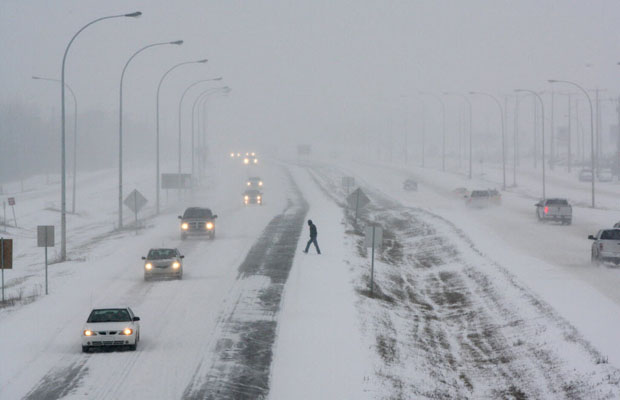
Ah yes, the Alberta Blizzard Season, the most wonderful time of the year.
I like a clean sidewalk.
Nature has provided me yet another series of opportunities to show the world how much I really prefer my snow to be in neat piles rather than unruly drifts on my parking spot or in front of my house. After work yesterday, I spent the better part of 2 hours pushing too much damn snow around creating 5 to 6 foot piles of snow at various points near my house.
Poor Intransigentia she was also caught up in the madness and was eventually tasked with digging the first pile of snow out and transferring it to the new second pile, in an effort to make room for the next snowfall. She almost disappeared into the mighty drifts that were accumulating, but did a heroic job in fighting her way out and giving me more space to put the new snow.
It is now, the next morning, it is still snowing and my back has more than a few things to say about yesterdays orgy of shovelling and scraping. It is the dull throbbing pain that makes me write this particular post and the amusing fact that I seemed to have frozen my posterior yesterday so much so that I made cold spots wherever I landed, sitting inside for at least three hours.

Not me but I can relate.
The best part is that, it is still snowing, so I have more good times to look forward to after work.
Intransigentia sent me this comic and it really brightened my morning. :) Go to Subnormality to see the rest of the comics there. :>

I would speculate that the internet is also for people who have too much time on their hands…
Liberal viewer is one of my favorite youtube commentators. I reproduce yet again, another video of his on the mendacity of what Fox News stands for and what can be done to combat the egregious effects.
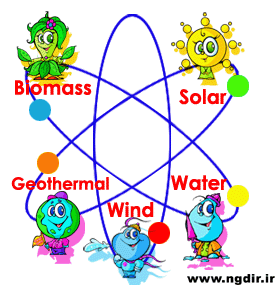 It is encouraging to see capitalism used to actually do something, as opposed to swish money around a hollow economy and proclaim “Profit!” at the end as what has been the North American trend since the 1980’s.
“Researchers in China, the world’s leading provider of wind turbines and solar panels, are working toward making renewable energy cheaper, more efficient and a bigger part of the country’s power grid. But despite China’s rapid leap to being a global leader in the renewable energy field, more government investment is needed for research and development if China is to truly blaze a path toward a clean energy future, researchers say.
Zhao Xingzhong, professor at Wuhan University’s School of Physics and Technology, is researching dye-sensitised solar cells, a low-cost, high-efficiency alternative to more prevalent solid-state semiconductor solar cell technology.”
Go go China. The dependence on fossil fuels will be with us for awhile, but it nice to see some nations actually take the future seriously and begin to plan for it.
“Although Zhao’s team’s research is unique at home and abroad, he says support from the Chinese government is far from enough. He notes that Japan and South Korea have jointly invested about 1.6 billion U.S. dollars on research on third-generation solar technology since 2000. In China, however, Zhao says there have been just five native projects in the solar field in the last decade, with spending of around 4.5 million dollars per project.
“It is difficult to break through the technological bottleneck because of the inadequacy of (financial) input,” Zhao says”
Like most breakthrough products and technologies, renewable power innovation has come through the spending of the state who pays for the R&D of projects and then farms them out to the private sector where they can be made readily available to the public. (Although boo on China for what seems to be, at least in Zhao’s case underfunding his work.) It is one of the great myths of capitalism that private business is the dynamo that runs the economy, it is significant but far from the primary driver. It is the State, through Universities and publicly funded R&D institutes that contribute a great deal to the ‘innovation’ of our economies and societies.
“In recent years, China has become the global leader in renewable energy technology manufacturing, surpassing the United States in terms of both the number of wind turbines and solar panels it makes. The accounting firm Ernst & Young in September named China the best place to invest in renewable energy.
Chinese companies, led by the Jiangsu-based Suntech, have one-quarter of the world’s solar panel production capacity and are rapidly gaining market share by driving down prices using low-cost, large-scale factories. China’s 2009 stimulus package included subsidies for large solar installation projects.
In terms of wind power, home-grown companies have rapidly gained market share in recent years after the government raised local partnership requirements for foreign companies to 70 percent from 40 percent (the government has since removed local partnership requirements) and introduced major new subsidies and other incentives for Chinese wind power companies.”
The day is approaching when solar panels will not be out of range of most people. That will be a good day.
“Critics say China’s interest in renewable energy is essentially a business opportunity – most of what it produces is sold abroad – and that it is less interested in applying the more expensive technology at home. China has not yet caught up to the United States in terms of renewable energy production. The country is the biggest consumer of coal in the world and is expected to burn 4.5 billion tonnes of standard coal by 2020, according to figures from the National Energy Administration.
While coal will still make up two-thirds of China’s energy capacity in 2020, the government has promised to invest billions of dollars into the development of wind, solar and nuclear power. The country’s top legislature, the National People’s Congress, now requires power grid companies buy 100 percent of the electricity produced from renewable energy generators.”
For all the strides China has made in renewable energy, the magnitude of their economy and power needs dictates they well need to rely on coal well into the foreseeable future, as we do in North America. Hopefully, with another major power taking the lead in the development and manufacture of solar panels a renewable energy race might start and really kick things off here in North America where we have both the know how and the consumer base to make renewable energy feasible.
 Like every US president to date, Ronald Reagan is responsible for prosecutable war crimes. Of course, we being the “good-guys” do not apply the same standards to ourselves that we expect the rest of the world to follow. It is little wonder you see the ironic smirks in the UN and other international bodies when the US is discussing “law and order” and commitment to human rights, because outside of the memory hole that defines our imperial culture the picture is quite clear cut. The national interest of the US trumps human rights, justice and law almost every time. We just do not get to hear about it here in fortress North America. What we also do not get to easily see is how we sow the seeds of our own discord, as in the case of Afghanistan and the current imperial war taking place there.
Here is what Rasil Basu, UN Developmental Program, senior advisor to the Afghan government for women’s development (1986 – 88) had to say.
“She reported “enormous strides” for women under the Russian occupation:
“Illiteracy declined from 98% to 75%, and they were granted equal rights with men in civil law, and in the Constitution… Unjust patriarchal relations still prevailed in the workplace and in the family with women occupying lower level sex-type jobs. But the strides [women] took in education and employment were very impressive… In Kabul I saw great advances in industry, factories, government offices, professions and the media. With large numbers of men killed or disabled, women shouldered the responsibility of both family and country. I met a woman who specialized in war medicine with dealt with trauma and reconstructive surgery for the war wounded. This represented empowerment to her. Another woman was a road engineer. Roads represented freedom – an escape from the oppressive patriarchal structures.”
By 1988, however, Basu “could see the early warning signals” as Russian troops departed and the fundamentalist Islamist extremists favoured by the Reagan administration took over, brushing aside the more moderate mujahideen groups. Saudi Arabian and American arms and ammunition “have been vital in giving fundamentalist groups an edge over the  moderates,” providing them with military hardware used,” according to Amnesty International, to target unarmed civilians, most of them women and children.” Then followed much worse horrors as the U.S – Saudi favorites overthrew the Najibullah government. The suffering of the population was so extreme that the Taliban were welcomed when they drove out Reagan’s freedom fighters. Another chapter in the triumph of Reaganite reactionary ultranationalism, worshiped today by those dedicated to defaming the honourable term “conservative”.
– Noam Chomsky, Hopes and Prospects pages 245 – 246.
Hardly surprising considering the gross injustices wrought in Central America by Reagan and the United States. The 1980’s were grim years for Central America plagued by torture, terrorism and death all sponsored by the US.
More people need to educate themselves and do the reading into what exactly their foreign policy entails, because the American populace would certainly not endorse the terror wrought in their name if it was properly publicized and discussed realistically.
 The first mass produced electric cars have made their way to market. Sales are still slow and availability is limited. Is this the first step toward reducing individual contributions to green house gasses? Perhaps. Depends where you live and get your power from. B.C or Quebec Hydro you would be laughing. The rest of coal fired Canada, probably not so much.
“GM sold between 250 and 350 Chevy Volts in December and Nissan’s sales totalled less than 10 Leaf sedans in the past two weeks. Production for both is slowly increasing.
It will be well into 2012 before both the Volt and Leaf are available widely. And if you’re interested in buying one, you’ll need to get behind the 50,000 people already on waiting lists.
It’s still unclear just how large the market for electric cars will be once those early adopters are supplied. The base sticker price is $40,280 US for the Volt and $32,780 US for the Leaf, much higher than most similar-sized, gas-powered cars. Canadian pricing has not been announced for either car.”
Price is going to be a big hurdle once the cars are more readily available. The other choice is a pure electric or gas/electric hybrid.
“The Leaf is the only all-electric car on the market. It can travel about 160 kilometres on battery power before needing to be recharged. Using a standard outlet, that takes 16 to 18 hours. Nissan recommends that Leaf owners install a 220/240-volt outlet in their homes so they can recharge in about seven hours. The Volt goes about 65 kilometres on battery power alone before needing to be recharged. But it comes with a backup gas engine that GM says can extend its range to 600 kilometres as it kicks in to recharge the batteries on the fly. GM believes the backup generator will make it a hit with customers who worry about being stranded with a dead battery.”\
It seems to me that not having to worry about running out of charge would be a good thing. At least on the surface , but one must factor in maintenance and reliability into the decision on which, if either, car to buy.











 bleatmop
 Mystro


 Dead Wild Roses

Your opinions…