
 The primacy of this lesson can not be overstated. The lovey-dovey notion that the US spreads democracy and peace throughout the world exists only within the borders of the US to keep its population ignorant of the injustice and violence committed in their name. The US, as with every great power, is largely imperialistic by nature and therefore promoting democracy and its associated freedoms is not particularly high on the US’s foreign policy agenda. Al-Jazeera, unlike the corporate media in North America, actually reports critically on the West’s policy decisions. Educating people on important topics though, is also a ways down the list for most of North America’s corporate media as well, so we will have to continue to look to independent media organizations for critical views of our policies.
“It’s incredible, really. The president of the United States can’t bring himself to talk about democracy in the Middle East. He can dance around it, use euphemisms, throw out words like “freedom” and “tolerance” and “non-violent” and especially “reform,” but he can’t say the one word that really matters: democracy.”
Of course not. Government for the people tends to make policies, well, for the people and that dear friends is most certainly not business friendly policy.
“How did this happen? After all, in his famous 2009 Cairo speech to the Muslim world, Obama spoke the word loudly and clearly – at least once.
“The fourth issue that I will address is democracy,” he declared, before explaining that while the United States won’t impose its own system, it was committed to governments that “reflect the will of the people… I do have an unyielding belief that all people yearn for certain things: the ability to speak your mind and have a say in how you are governed; confidence in the rule of law and the equal administration of justice; government that is transparent and doesn’t steal from the people; the freedom to live as you choose. Those are not just American ideas, they are human rights, and that is why we will support them everywhere.”
“No matter where it takes hold,” the president concluded, “government of the people and by the people sets a single standard for all who hold power.”
Simply rhetoric?
Of course, this was just rhetoric, however lofty, reflecting a moment when no one was rebelling against the undemocratic governments of our allies – at least not openly and in a manner that demanded international media coverage.
Now it’s for real.”
Obama just speaking to hear the sound of his lovely words, I’m completely shocked.
“And “democracy” is scarcely to be heard on the lips of the president or his most senior officials.
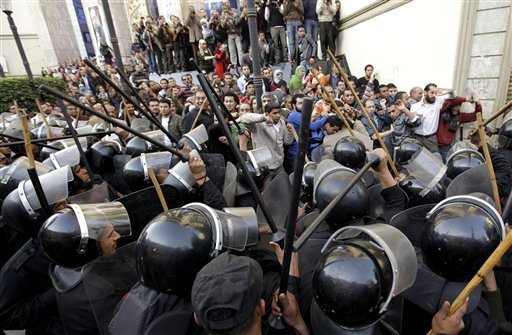 In fact, newly released WikiLeaks cables show that from the moment it assumed power, the Obama administration specifically toned down public criticism of Mubarak. The US ambassador to Egypt advised secretary of state Hillary Clinton to avoid even the mention of former presidential candidate Ayman Nour, jailed and abused for years after running against Mubarak in part on America’s encouragement.
Not surprisingly, when the protests began, Clinton declared that Egypt was “stable” and an important US ally, sending a strong signal that the US would not support the protesters if they tried to topple the regime. Indeed, Clinton has repeatedly described Mubarak as a family friend. Perhaps Ms Clinton should choose her friends more wisely.
Similarly, president Obama has refused to take a strong stand in support of the burgeoning pro-democracy movement and has been no more discriminating in his public characterisation of American support for its Egyptian “ally”. Mubarak continued through yesterday to be praised as a crucial partner of the US. Most important, there has been absolutely no call for real democracy.”
Well of course not, real democracy is a messy people-centric process that does not ensure a business friendly stable environment.
“Rather, only “reform” has been suggested to the Egyptian government so that, in Obama’s words, “people have mechanisms in order to express legitimate grievances”.
“I’ve always said to him that making sure that they are moving forward on reform – political reform, economic reform – is absolutely critical for the long-term well-being of Egypt,” advised the president, although vice-president Joe Biden has refused to refer to Mubarak as a dictator, leading one to wonder how bad a leader must be to deserve the title.
Even worse, the president and his senior aides have repeatedly sought to equate the protesters and the government as somehow equally pitted parties in the growing conflict, urging both sides to “show restraint”. This equation has been repeated many times by other American officials.
This trick, tried and tested in the US discourse surrounding the Israeli-Palestinian conflict, is equally nonsensical here. These are not two movements in a contest for political power. Rather, it is a huge state, with a massive security and police apparatus that is supported by the world’s major superpower to the tune of billions of dollars a year, against a largely young, disenfranchised and politically powerless population which has suffered brutally at its hands for decades.
The focus on reform is also a highly coded reference, as across the developing world when Western leaders have urged “reform” it has usually signified the liberalisation of economies to allow for greater penetration by Western corporations, control of local resources, and concentration of wealth, rather than the kind of political democratisation and redistribution of wealth that are key demands of protesters across the region.”
Damn, but is nice to see geopolitical reality being espoused by a major news outlet.
“An Al Jazeera English interview on Thursday with US state department spokesman PJ Crowley perfectly summed up the sustainability of the Obama administration’s position. In some of the most direct and unrelenting questioning of a US official I have ever witnessed, News Hour anchor Shihab al-Rattansi repeatedly pushed Crowley to own up to the hypocrisy and absurdity of the administration’s position of offering mild criticism of Mubarak while continuing to ply him with billions of dollars in aid and political support.
When pressed about how the US-backed security services are beating and torturing and even killing protesters, and whether it wasn’t time for the US to consider discontinuing aid, Crowley responded that “we don’t see this as an either or [a minute later, he said “zero sum”] proposition. Egypt is a friend of the US, is an anchor of stability and helping us pursue peace in the Middle East”.
Each part of this statement is manifestly false; the fact that in the midst of intensifying protests senior officials feel they can spin the events away from openly calling for a real democratic transition now reveals either incredible ignorance, arrogance, or both.”
Ah yes, stability. We kill and torture to maintain it, and if we are doing it, it simply must be just and interests of the “greater good”. The world really is a nice place when you are at the friendly end of the sharp stick.
“Moreover, Crowley, like his superiors, refused to use the word democracy, responding to its use by anchor al-Rattansi with the word “reform” while arguing that it was unproductive to tie events in Egypt to the protests in other countries such as Tunis or Jordan because each has its own “indigenous” forces and reasons for discontent.
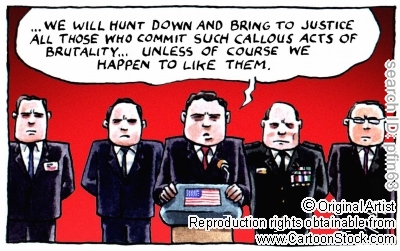 That is a very convenient singularisation of the democracy movements, which ignores the large number of similarities in the demands of protests across the region, the tactics and strategies of protest, and their broader distaste and distrust of the US in view of its untrammelled support for dictatorships across the region.
Of course, autocracies are much more stable than those messy democracies, no?
“The most depressing and even frightening part of the tepid US response to the protests across the region is the lack of appreciation of what kind of gift the US, and West more broadly, are being handed by these movements. Their very existence is bringing unprecedented levels of hope and productive activism to a region and as such constitutes a direct rebuttal to the power and prestige of al-Qaeda.
Instead of embracing the push for real democratic change, however, surface reforms that would preserve the system intact are all that’s recommended. Instead of declaring loud and clear a support for a real democracy agenda, the president speaks only of “disrupting plots and securing our cities and skies” and “tak[ing] the fight to al-Qaeda and their allies”, as he declared in his State of the Union address.
Obama doesn’t seem to understand that the US doesn’t need to “take the fight” to al-Qaeda, or even fire a single shot, to score its greatest victory in the “war on terror”. Supporting real democratisation will do more to downgrade al-Qaeda’s capabilities than any number of military attacks. He had better gain this understanding quickly because in the next hours or days the Egypt’s revolution will likely face its moment of truth. And right behind Egypt are Yemen, Jordan, Algeria, and who knows what other countries, all looking to free themselves of governments that the US and its European allies have uncritically supported for decades.”
Ah yes, but then what external enemy could the US scapegoat to cover its domestic failures at home? I mean, actually decreasing the amount of terrorist activity would mean resources could be used to make life better for the average American rather than the military industrial complex and other conglomerates that make a goodly amount of profit on war and strife.
“If president Obama has the courage to support genuine democracy, even at the expense of immediate American policy interests, he could well go down in history as one of the heroes of the Middle East’s Jasmine winter. If he chooses platitudes and the status quo, the harm to America’s standing in the region will likely take decades to repair.”
I believe that for Obama supporting any genuine democracy will happen right after denouncing the corrosive effects of religion , declaring his atheism, and then re-regulating the business sector.
Honest.











 bleatmop
 Mystro


 Dead Wild Roses
15 comments
February 4, 2011 at 7:26 am
Tweets that mention The US supports Stability, not Democracy the World Over. « Dead Wild Roses -- Topsy.com
[…] This post was mentioned on Twitter by Progressive Bloggers, The Arbourist. The Arbourist said: The US supports Stability, not Democracy the World Over. http://wp.me/pyhFw-LE […]
LikeLike
February 4, 2011 at 8:38 am
tildeb
I think respecting the local customs and cultures is a foreign policy mistake made too often by western secular democracies for the sake of avoiding domestic political criticism. If one wishes to support the enlightenment values that we have brought into being within our own borders, then that means holding in contempt any cultures and local customs that are contrary to establishing and protecting these ideals. So it goes with democracy.
But the political cost at home makes this export an easy target to make political hay. For example, to make the kind of democratic and human rights change happen in Afghanistan, a policy would have to be implemented based on unconditional surrender first and then a complete overhaul by force of national institutions, politics, and law enforcement aligned to support and implement with power secular enlightenment values. This, of course, looks exactly like conquest.
If western countries tried to implement this kind of effective and lasting change on foreign soil, I have absolutely no doubt that public condemnation at home would quickly follow, led by people who continue to hold our governments to an impossible double standard: support values yet support the right of others to maintain contrary customs and cultures that impede exactly this.
Support for other leaders who offer stability and general peace that such stability offers is not to be undervalued as a foreign policy position in domestic political terms. (Profitable business links are also important for many reasons beyond corporate greed but I won’t go into that for now.) This support, however, invariably leads to the charge of our governments supporting regimes that suppress the kinds of domestic rights and freedoms we value. And that’s a fair charge. But supporting the rights and freedoms of others in foreign lands invariably leads to the charge of interference and imperialism, cultural intolerance, religious persecution, and so on. And this , too, is a fair charge.
So which one do you want to support?
It takes much more than ‘courage’ for domestic leaders to export domestic values through policy: it takes grass roots and widespread political support that includes the use of armed conflict. I sincerely doubt any such support will ever be forthcoming from the wide middle ground of our population who always find it so easy to criticize whatever foreign policy position is implemented without having to actually take a firm personal stand and be on the receiving end of this never-ending domestic criticism by never-satisfied critics. What we as individuals lack is the courage of our convictions: that our values are the right ones, the ones that bring about the greatest freedoms and the most respect for the dignity of all, that such values are worth exporting and shoving down the unwilling throats of those who would prefer to support the wrong ones. It is this lack of conviction by the average critical citizen that is responsible for dooming our political representatives to not have the mandate necessary to implement what we know is right… even though they merely articulate it to the applause of the governed. Blaming ‘business’ for this foreign policy failure is a convenient scapegoat used all too often by those who remain willfully blind to their own duplicity in allowing that failure to be ongoing.
LikeLike
February 4, 2011 at 10:03 am
Vern R. Kaine
Tildeb,
I agree completely. Nice to find someone on here that can articulate my own viewpoints far better (and more pleasantly!) than I can. :)
For example, to make the kind of democratic and human rights change happen in Afghanistan, a policy would have to be implemented based on unconditional surrender first and then a complete overhaul by force of national institutions, politics, and law enforcement aligned to support and implement with power secular enlightenment values. This, of course, looks exactly like conquest.
Sometimes conquest is necessary. Democracy came about because of war. Slavery ended because of war.
I have absolutely no doubt that public condemnation at home would quickly follow, led by people who continue to hold our governments to an impossible double standard: support values yet support the right of others to maintain contrary customs and cultures that impede exactly this.
It’s a glaring double-standard to me as well. They support the values of natives to have right to their land, for example, yet none of them are walking over and handing over THEIR titles to their home and land, so how against conquest could they actually be? These same people also support the enemy more than they support our own soldiers.
LikeLike
February 4, 2011 at 11:24 pm
The Arbourist
It’s late, and I do not want to hazard a reply, to such a thoughtful comment. I shall reread and respond Sunday, when I have time to properly do so.
Although not a direct reply to what you’ve said tildeb, Noam Chomsky sounds a similar chord with his recent op-ed in the Guardian.
LikeLike
February 5, 2011 at 11:09 am
Titfortat
I personally think that until we as citizens decide that our habits(good and bad) directly affect the rest of the world, the same shit will continue. The main reasons we are invested in most other nations is because of our gluttony. Our leaders know this and because of their gluttony it makes us easy to be used in their power game. One person at a time, I will start after the Superbowl……..Maybe. ;)
LikeLike
February 6, 2011 at 1:33 pm
The Arbourist
If one wishes to support the enlightenment values that we have brought into being within our own borders, then that means holding in contempt any cultures and local customs that are contrary to establishing and protecting these ideals.
I can support Enlightenment values quite easily without having to feel contempt for cultures that do not share my particular set of values. One Enlightenment value, autonomy and freedom from coercion, should play an important role in dictating how we deal with other cultures.
Encouraging them to move toward our values is one thing, having our boot on their neck and force-feeding them our values is entirely another. The first option may have a chance of working, the second almost never does.
LikeLike
February 6, 2011 at 1:42 pm
The Arbourist
For example, to make the kind of democratic and human rights change happen in Afghanistan, a policy would have to be implemented based on unconditional surrender first and then a complete overhaul by force of national institutions, politics, and law enforcement aligned to support and implement with power secular enlightenment values. This, of course, looks exactly like conquest.
Unconditional surrender of whom? The sectarian clans and warlords do not behave as a single “state” which we can bring to heel and impose our demands. The fragmented nature of Afghanistan precludes solutions such as those you mention.
If western countries tried to implement this kind of effective and lasting change on foreign soil, I have absolutely no doubt that public condemnation at home would quickly follow, led by people who continue to hold our governments to an impossible double standard: support values yet support the right of others to maintain contrary customs and cultures that impede exactly this.
And here lies the consequentialist conundrum, what is a reasonable price is to be paid for an overall increase in the expression of our values? Is it worth sacrificing 15,000, or how about 100,000 people for progress? We threw some 2 million Vietnamese into the meat-grinder for negligible progress toward “our style” of governance. I’m thinking that exporting our values forcibly even if they are the “right” ones does not make for any sort of palatable moral calculus.
LikeLike
February 6, 2011 at 2:04 pm
The Arbourist
Support for other leaders who offer stability and general peace that such stability offers is not to be undervalued as a foreign policy position in domestic political terms. (Profitable business links are also important for many reasons beyond corporate greed but I won’t go into that for now.) This support, however, invariably leads to the charge of our governments supporting regimes that suppress the kinds of domestic rights and freedoms we value. And that’s a fair charge. But supporting the rights and freedoms of others in foreign lands invariably leads to the charge of interference and imperialism, cultural intolerance, religious persecution, and so on. And this , too, is a fair charge.
So which one do you want to support?
This statement seems to almost fall into the realm of a false dichotomy. Let’s break it down.
Support for other leaders who offer stability and general peace that such stability offers is not to be undervalued as a foreign policy position in domestic political terms.
Stability is the nice way of saying autocracy and dictatorial rule. Features of dictatorships include, repression, torture and human rights abuses. If we are committed to expanding human rights and freedom would it not be logical not to support regimes that offer “stability” because the price in terms of the Enlightenment values which we wish to spread is simply to high?
Why I mention the business angle is because Commerce and capitalism thrive under autocratic regimes. With no press, unions, or civil representation people can be exploited at will for the benefit of business and the state.
Would it not be better to support regimes that are trying the democratic route in the first place? Would not the example of the US helping people choose their future, even if it was not in the interest of the US, be an example of dedication to actual democracy, that by its very nature is a unruly, chaotic system?
But supporting the rights and freedoms of others in foreign lands invariably leads to the charge of interference and imperialism, cultural intolerance, religious persecution, and so on. And this , too, is a fair charge.
Supporting rights and freedoms of others in foreign lands is phrase that needs to be unpacked. There are many types of “support” some which is definitely not need such as the US funded terrorist group known as the Contras. If we define that as support than yes, it would qualify as imperialism etc. On the other hand, instruments that would bring an impartial and more egalitarian set of values to the table, such as the UN and the International Court of Justice could circumscribe the dilemma you present if they were properly supported and their jurisdiction respected by all nations.
Lending our aide to regimes that are not actively quashing human rights for stability’s sake and supporting multinational organizations that embody Enlightenment values would seem to ways around the choice you offer.
LikeLike
February 6, 2011 at 2:25 pm
The Arbourist
What we as individuals lack is the courage of our convictions: that our values are the right ones, the ones that bring about the greatest freedoms and the most respect for the dignity of all, that such values are worth exporting and shoving down the unwilling throats of those who would prefer to support the wrong ones.
Except that the values currently exported, corporatism and autocratic rule are being forced on people and unsurprisingly they are resisting. Would they resist the move toward self-determination and open society without the baggage that is currently part of the ‘democracy and freedom’ package? I’m guessing yes.
Another point is the timeframe necessary for these changes to happen. The democratic impulse has taken hundreds of years to form and coalesce. We cannot expect other nations and peoples to find Enlightenment values overnight. It is a slow incremental process that happened under a very specific set of conditions. Those conditions do not exist today. Is it reasonable to think that we can export our values successfully to other cultures without an adequate amount of time?
It is this lack of conviction by the average critical citizen that is responsible for dooming our political representatives to not have the mandate necessary to implement what we know is right… even though they merely articulate it to the applause of the governed.
Although we seem to be able to mobilize our politicians to mandate bombing countries back into the stone age. That does not seem to be a problem. Conviction does not win over a democratic system that has been gamed for the benefit of the elite. When money is considered free speech, you can be have as much conviction as you would like, your message will be drowned out in the cacophony of elite opinion (which presently is corporatist and for the most part amoral).
The Libertarian overtones of this particular argument ring with futility as it encourages the illusion of the heroic individual changing society with the strength of his mere convictions. What a hobby-horse for the elite to have the common people blaming themselves and feeling powerless to change their situation, as it is their own fault.
It also allows conveniently a blame the victim mentality ( a phrase I get all the time from Vern) that allows individuals to simply throw up their hands in defeat when they see the enormity of the problem presented to them.
Institutions such as Unions that bring people together, out of their libertarian induced atomized state, can actually work together to affect change in society.
Blaming ‘business’ for this foreign policy failure is a convenient scapegoat used all too often by those who remain willfully blind to their own duplicity in allowing that failure to be ongoing.
Assigning blame where it is rightfully due is certainly not scapegoating business. Business is often a amoral practice and to ignore the close big business/state partnership that currently exists in the US (the fact that it currently has two business class parties is a prime example of this) is denying the reality of the situation.
LikeLike
February 7, 2011 at 9:58 am
TitforTat
Assigning blame where it is rightfully due is certainly not scapegoating business. Business is often a amoral practice and to ignore the close big business/state partnership that currently exists in the US (the fact that it currently has two business class parties is a prime example of this) is denying the reality of the situation.(Arbourist)
Most businesses make their money off someone purchasing the product or service they provide. Seeing that it is mainly the average person doing the bulk of the purchasing or even investing in the different businesses, wouldnt it be smart to point to that fact also. In a capitalist culture businesses are just a relflection of the population both good and bad. Im not sure too many people are prepared to give up there cars and walk though. It would be to inconvient and so much easier to blame the oil companies.
LikeLike
February 9, 2011 at 8:52 am
tildeb
The contempt I think we need to hold front and centre must be aimed directly and without apology at those aspects of another culture that stand in conflict with the specific enlightenment value of reason and equality of human rights for all. I think one is deluded to believe that some ‘movement’ will naturally occur against elements of a culture that are based on specific inequities and inequalities.
It is difficult for me to appreciate the restructuring of a society I think of as being forced to deal with each other on the basis of legal respect of individual autonomy to have a ‘boot on the neck’. It is easier for me to appreciate the current culture as the ‘boot on the neck’ that is being removed by force if necessary. And herein lies the same empowerment from you that that I accuse of enabling duplicity: an attitude that forced change is automatically negative because it must be coerced that thwarts foreign policies from doing what is necessary to bring about the kind of effective and lasting change that allows nations to stand together as respectful equals.
As for you assertion that such use of force and coercive change “almost never works” I beg to differ. There is ample historical evidence that such forced change not only works, but brings about lasting and positive benefit to the populace. There is also ample historical evidence that doing less and appeasing those who hold power (as a foreign policy) and allow legal inequities and inequalities to remain unchanged brings about lasting problems.
LikeLike
February 9, 2011 at 10:13 am
tildeb
By ‘unconditional surrender’ what I mean is the imposition of a foreign government, foreign law enforcement, foreign courts, the literal takeover of compatible institutions and the creation of new ones run by foreigners, and so on. Only after a period of civic stability will personnel be replaced over time by nationals. I’m talking about the destruction of the clan network, the arrest and imprisonment of war lords, the confiscation of weaponry, and so on, replaced by a better way of doing local business, a better way of making regional connections, a completely new system of government and the implementation of reconstruction projects. I think we have a pretty good idea how to do this by examples such as the Marshal Plan and the reconstruction of Japanese society.
You assume a high casualty rate to put this kind of foreign policy into place. That may be true. WWII took six years to accomplish on a global scale. We’ve been in fighting and dying in Afghanistan for ten. But what is the price of doing the job right, of conquest that makes lasting and effective changes compared to the merit of a lower death toll for doing a half-ass job that will see a return of exactly the same problems a decade after intervention?
Some calculus has to be used. And palatability is exactly the problem I’m pointing out: by making conquest unpalatable, we doom the interventionist cause and allow nationals to die in massive numbers for our half-hearted commitment that plays well to our local electorate. After all, it’s EASY to be against war, EASY to be against violence and civilian deaths, EASY to tsk tsk local problems in foreign lands and accompany that duplicitous concern with a buck and a shrug and best wishes for a brighter future, all the while blaming the lack of success on ‘Big Business’ and the evils of capitalism for its obvious contribution for interventionist failures and graft. Who really cares, after all, that Haiti stays mostly as rubble for a decade after an earthquake as long as the US and its terrible ‘Big Business’ stays the hell out.
It’s seems rather apathetic to me that it seems tolerable for too many of us to watch real people suffer and die in abject poverty and filth as a Haitian, with such good neighbours as dysentery and cholera, for rape to be a normal part of a woman (or girl’s daily life), as long as no foreigners step into the governmental void and enforce changes. It’s all part of the same mind set that intervention is always bad because it’s disrespectful of such vague notions of ‘culture’ and ‘religion’ ‘ways of life’ – as if respecting these notions was justifiably more important than the health and welfare of real people suffering today because of the political force that can be roused when this apathetic mind set is disturbed by meaningful action.
It’s EASY to pretend that values are just relative biases… right up until we are smacked in the face by the results of their absence.
I mean, seriously, how can you listen to so many young people in Egypt tell us that these same values we hold to be central to human rights and dignity as citizens here are as important and worth dying for there and then try to pretend that supporting these exact values in our foreign policies is equivalent to ‘putting’ a boot on their necks’? The fundamental bias to rationalize this perspective reveals the duplicity I am talking about, the lack of intestinal and intellectual fortitude to actually stand FOR something (and accept responsibility for its inevitable local problems and shortcomings) rather than take the easy and lazy path of always being AGAINST something. That amounts to being committed to always remaining non-committal.
The Right in the US and Canada recognize this terrible weakness in the Left’s psyche and capitalizes on it politically. It’s an unnecessary and even willful blind spot in the liberal camp and a dangerous one when translated into all kinds of policies that subvert fundamental values in the name of respect and tolerance for contrasting notions. The Left needs to wake up and stop pretending that a good round of singing Kum Ba Ya is a meaningful substitute for promoting and protecting these enlightenment values by a citizenry willing to take up arms in their defense… WHEREVER these values are trying to be implemented. We can have a very positive role to play in our global responsibility to our neighbours by granting our politicians the power to represent that which allows us the right to be against war and foreign intervention: our values.
LikeLike
February 12, 2011 at 2:29 pm
The Arbourist
I mean, seriously, how can you listen to so many young people in Egypt tell us that these same values we hold to be central to human rights and dignity as citizens here are as important and worth dying for there and then try to pretend that supporting these exact values in our foreign policies is equivalent to ‘putting’ a boot on their necks’?
I think my analogy holds. The qualms I am having with your argument is that to impose any set of conditions on another people, good ones/bad ones violates one of the fundamental rights we claim to hold dear. Self determination and autonomy. Countries do not take kindly to having a foreign set of values being forced on them *even if they are the right ones* and will vigorously resist the outside entity doing so. Not because the reforms or idea or wrong, but because it was not their choice to make. Authentic progress is a long, painful, drawn out process that can be aided, but not forced. The best policy is one of a being a good example and exposing people to that example so they may want to emulate it, but on their terms not ours.
The fundamental bias to rationalize this perspective reveals the duplicity I am talking about, the lack of intestinal and intellectual fortitude to actually stand FOR something (and accept responsibility for its inevitable local problems and shortcomings) rather than take the easy and lazy path of always being AGAINST something.
Being against imperialism is a moral and just stance. Promoting an egalitarian world governing structure and a set of rules that everyone plays buy seems to be a rather lonely stand to take and will most likely continue to be until states can rationalize treating others the way they would want to be treated.
LikeLike
February 12, 2011 at 3:28 pm
The Arbourist
I think one is deluded to believe that some ‘movement’ will naturally occur against elements of a culture that are based on specific inequities and inequalities.
Ah, so the movements in Tunisia, Egypt, Algeria are delusional. Check.
As for you assertion that such use of force and coercive change “almost never works” I beg to differ. There is ample historical evidence that such forced change not only works, but brings about lasting and positive benefit to the populace.
I would like to see said evidence that forced change works in societies.
Perhaps you are referring to the Philippines as the country was civilized by American forces or Iran or maybe Algeria under the French? Or maybe the Beligum’s work in the Congo. Let us not forget India under the wise tutelage of the British. How about East Timour we certainly waved the flag of human decency and democracy there. How about the lovely job we did in the Middle East pre-WWI and the state system we set up certainly were/are bastions of freedom and democracy. Chile? Nicaragua? El Salvador? Honduras pray-tell? Vietnam? Afghanistan under the British, Russians and now the Americans? Iraq perchance as a shining example of what invading, bombing, and then occupying a country and imposing your values does in the name of progress and freedom? I’m *very* curious as to the “ample historical evidence” of your claim.
There is also ample historical evidence that doing less and appeasing those who hold power (as a foreign policy) and allow legal inequities and inequalities to remain unchanged brings about lasting problems.
Make a general enough claim and of course the evidence will support it. Here is another, we claim to support freedom and democracy the world over. In reality, we support *any* regime that will profitably do business with us. Our support for autocratic regimes is well documented, we support and continue to support states that abuse human rights, disappear and torture their citizens and generally represent the antithesis of what we claim to the world of what we stand for.
Let’s forget about what we can add to the world through our enlightenedly-benevolent foreign policy. How about we as the upholders of enlightenment civil values take the bold step and stop perpetuating the direct evil we cause, not worry about anyone else, just stop what we do that goes against the values we purport to esteem. Would the world be a markedly better place You bet it would. There is no need to worry about relativism or supporting movement “X” or whatever, just stop what we do and things would get better. There is echos of this idea in Noam Chomsky’s work, the quote below is from an article entitled “The Evil Scourge of Terrorism”. It is a illuminating read and much can be gleaned from it with regards to the matter at hand and how I approach arguments like the one we are currently having.
“If we seriously want to end the plague of terrorism, we know how to do it. First, end our own role as perpetrators. That alone will have a substantial effect. Second, attend to the grievances that are typically in the background, and if they are legitimate, do something about them. Third, if an act of terror occurs, deal with it as a criminal act: identify and apprehend the suspects and carry out an honest judicial process. That actually works. In contrast, the techniques that are employed enhance the threat of terror. The evidence is fairly strong, and falls together which much else. ”
Given the reality of the situation and maybe parsing away some of the halcyon notions of American Exceptionalism we can reframe the argument to more closely resemble what is happening in the world today. The argument so far, has some strong theoretical points and idea’s (I sense the moral landscape of Mr.Harris being evoked as a moral vehicle for some of your statements) but much of what you propose will most likely not happen given the current geopolitical framework.
LikeLike
May 14, 2012 at 6:25 am
We Need “Conservative Math” for Social Spending. « Dead Wild Roses
[…] job, fostering democracy and stability in the Middle East, doesn’t come cheap, or even measurable when it comes to […]
LikeLike