
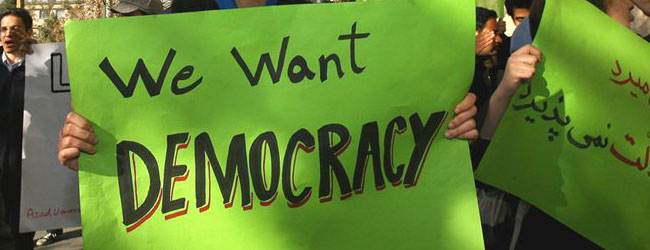
 The parallel between the official line for public consumption and the actual realpolitik is quite thin, if you are willing to look. And therein lies the problem, we are not rewarding for looking, for being curious, for wanting to know what our policy actually is in the Middle East. Noam Chomsky discusses our role in the Middle East in a recent article posted at Mother Jones.
“The US and its Western allies are sure to do whatever they can to prevent authentic democracy in the Arab world. To understand why, it is only necessary to look at the studies of Arab opinion conducted by US polling agencies. Though barely reported, they are certainly known to planners. They reveal that by overwhelming majorities, Arabs regard the US and Israel as the major threats they face: the US is so regarded by 90% of Egyptians, in the region generally by over 75%. Some Arabs regard Iran as a threat: 10%. Opposition to US policy is so strong that a majority believes that security would be improved if Iran had nuclear weapons—in Egypt, 80%. Other figures are similar. If public opinion were to influence policy, the US not only would not control the region, but would be expelled from it, along with its allies, undermining fundamental principles of global dominance.”
Whoops, public opinion or what the people want is ignored in our client states, how surprising. The very last thing we want in the Middle East is Democracy.
“Support for democracy is the province of ideologists and propagandists. In the real world, elite dislike of democracy is the norm. The evidence is overwhelming that democracy is supported insofar as it contributes to social and economic objectives, a conclusion reluctantly conceded by the more serious scholarship.
Elite contempt for democracy was revealed dramatically in the reaction to the WikiLeaks exposures. Those that received most attention, with euphoric commentary, were cables reporting that Arabs support the US stand on Iran. The reference was to the ruling dictators. The attitudes of the public were unmentioned. The guiding principle was articulated clearly by Carnegie Endowment Middle East specialist Marwan Muasher, formerly a high official of the Jordanian government: “There is nothing wrong, everything is under control.” In short, if the dictators support us, what else could matter?
The Muasher doctrine is rational and venerable. To mention just one case that is highly relevant today, in internal discussion in 1958, president Eisenhower expressed concern about “the campaign of hatred” against us in the Arab world, not by governments, but by the people. The National Security Council (NSC) explained that there is a perception in the Arab world that the US supports dictatorships and blocks democracy and development so as to ensure control over the resources of the region. Furthermore, the perception is basically accurate, the NSC concluded, and that is what we should be doing, relying on the Muasher doctrine. Pentagon studies conducted after 9/11 confirmed that the same holds today.”
Dig a little deeper, read more about the Middle East and history from a variety of sources. Educate yourself about what you know or think you know about, questioning base assumptions is the all hallmark of the critical thinker and rational citizen.











 bleatmop
 Mystro


 Dead Wild Roses
Your opinions…