
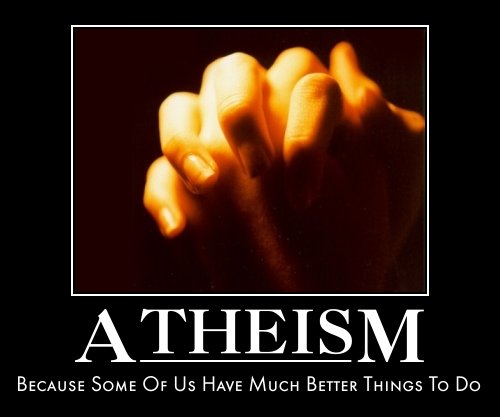
 Responding to criticism and arguing coherently are the hallmarks of reasonable, mature debate. Browsing the articles on Alternet my attention was drawn to the article that shares the same moniker as this post, minus the question mark. I was hoping for some meaty, thought-provoking arguments by Scofield. I was disappointed. The 5 points seem to be weak caricatures of common atheist arguments, and if they can rebutted by the relative small fry of the atheist community like me, they most certainly do not hold much weight.
5. Liberal and Moderate Religion Justifies Religious Extremism
“Sam Harris states that moderates are “in large part responsible for the religious conflict in our world” and “religious tolerance–born of the notion that every human being should be free to believe whatever he wants about God–is one of the principal forces driving us toward the abyss.” And Richard Dawkins states, “The teachings of ‘moderate’ religion, though not extremist in themselves, are an open invitation to extremism.” Christopher Hitchens has called liberation theology “sinister nonsense” and compared the liberal Unitarian tradition to rats and vermin.
The problem with this line of thinking is that it leads to some unwanted logical conclusions when applied equally to other ideas. It is hypocritical to selectively apply the principle where it suits one’s needs but not elsewhere.”
“We can ask whether or not all liberal and moderate expressions of something are responsible for their most extreme forms. Are the people who casually smoke marijuana in any way responsible for the death of someone involved in a violent heroin drug trade? Is a social drinker of alcohol creating the environment that leads to alcoholism?” Is a pediatrician responsible for Nazi medical experiments simply because he or she participates in the field of medicine? How about politics? Is a liberal democracy responsible for forms of government such as totalitarianism or fascism? […]
“[…] the more rational and tolerant uses of science, religion, medicine or government cannot be blamed for the destructive and harmful uses of them.”
Sam Harris speaks about this idea of the moderately religious supporting the radical religious in a very case. It is not a generalization that makes sense to apply to other situations. The idea that religious moderates facilitate the radical wings of their religion is different than the examples Scofield uses. The difference begins with the idea that there is an equivalency based in religion that does not exist in the other examples listed. The equivalency is this: Religious moderates and radicals use the same play-book to express their beliefs.
This leads to Islam claiming to be the religion of “peace” while claiming to do God’s work in suicide bombings, or the christian faith in both justifying and arguing against slavery using passages from the bible. It is this salient point that makes Harris’s argument work while exposing the false equivalence of what Scofield is attempting to do.
Does social drinking set the environment for the abuse of alcohol, it certainly can, but it does not claim to justify destructive actions caused by people who take drinking to the extreme. Social drinkers do not tacitly condone the irresponsible actions of others; it is rather the opposite, if responsible people are around, overindulgence is generally frowned upon. I have never once seen a “please consume responsibly” warning on a religious text or commercial.
I’d go further with examples, but there really is no point because the analogies Scofield draws are incongruous with reality. Science, when still performed as science adheres closely with rationality whether you are a moderate believer in science or a radical one, that aim remains the same, the search for testable, falsifiable, truths about the physical universe we inhabit.
4. Religion Requires a Belief in a Supernatural God
“I understand why anti-religious atheists are so reluctant to accept the fact that being religious doesn’t mean belief in the supernatural. The simplistic and convenient myth they’ve constructed would be shattered.”
Well, there are exceptions to the rule. That is unsurprising. The problem is that the religious that are currently infecting North American currently *do* require a belief in the supernatural, or at the very least magic. Scofield’s fourth point is a a red herring of sorts.
3. Religion Causes Bad Behavior
“A common way for atheists to denounce religion is to simply list all of the horrors that have been done in the name of religion and then say, “Look how awful religion is!” Religion becomes synonymous with all of the bad things done by religious people. But is religion the cause of bad behavior or simply a mitigating factor? Christopher Hitchens provides some surprising insight: “What’s innate in our species isn’t the fault of religion. But the bad things that are innate in our species are strengthened by religion and sanctified by it… So religion is a very powerful re-enforcer of our backward, clannish, tribal element. But you can’t say it’s the cause of it. To the contrary, it’s the product of it.” Amen! Hitchens says that religion is not the cause of bad behavior! Many of us religious progressives have been making this point for a long time.”
Okay, your beliefs in magic and myth amplifies the destruction and evil you perpetrate in the world. Still worth getting rid of.
2. Atheists are Anti-Religious
“This false belief stems from a fundamental misunderstanding of what atheism and religion are. Atheism is not in any way shape or form related to an opinion about religion. It is simply the assertion that god does not exist, nothing more and nothing less. Religion is a broad category that encompasses traditions which include supernatural belief and those that do not. And, as I’ve already stated there are many atheists who are already religious practitioners.
Despite atheism being quite a straightforward concept, many continually misrepresent what it means. A prominent example comes from the atheist writer Greta Christina. She recently stated, “Atheists, by definition, don’t think any religion has any reasonable likelihood of being true.” Wrong. Atheists by definition assert that god does not exist. Besides, what does it mean for a religion to be true or not true when a religion doesn’t require any supernatural belief? Again, being an atheist has nothing to do with ones position on religion.”
A semantic quibble as your penultimate point? Fantastic.
1. All Religions are the Same and are “Equally Crazy”
“Many atheists often claim that they are wrongly accused of not understanding the differences between religions. “Of course we do!” I’ve heard them say. But yet this is meaningless unless they are willing to treat these differences differently. Case and point is the latest article from Greta Christina where she asks, “Are All Religions Equally Crazy?” and answers a resounding, Yes. She describes a number of strange Mormon beliefs and practices, but then realizes that other religions aren’t any better. If her point was to illustrate that some religions have strange beliefs, she succeeded. She concludes,
But all religions are out of touch with reality. All religions are implausible, based on cognitive biases, and unsupported by any good evidence whatsoever. All of them ultimately rely on faith — i.e., an irrational attachment to a pre-existing idea regardless of any evidence that contradicts it — as the core foundation of their belief. All of them contort, ignore, or deny reality in order to maintain their attachment to their faith.
This conclusion is simply false.”
Saying something is false unfortunately for Scofield, does not make it false.
“Her reasoning sweeps up all religious expressions including those which aren’t reliant upon any supernatural beliefs, miracles or magical claims.”
So, which religions claim not to make claims that are not irrational? (quotes from wikipedia)
Jainism? – Jainism ( /ˈdʒeɪnɪzəm/) is an Indian religion that prescribes pacifism and a path of non-violence towards all living beings. Its philosophy and practice emphasize the necessity of self-effort to move the soul towards divine consciousness and liberation.
Taoism? – Cane asserts Tao can be roughly stated to be the flow of the universe, or the force behind the natural order, equating it with the influence that keeps the universe balanced and ordered.[18] Martinson says that Tao is associated with nature, due to a belief that nature demonstrates the Tao.[19] The flow of qi, as the essential energy of action and existence, is often compared to the universal order of Tao.
Bhuddism? – He is recognized by Buddhists as an awakened or enlightened teacher who shared his insights to help sentient beings end suffering (or dukkha), achieve nirvana, and escape what is seen as a cycle of suffering and rebirth.
The force is strong, even with the author’s best examples of non-magical religions. Consider, that many of what he names as religions could be more accurately classified as philosophies, which leaves us with the magic and myths that we troubled atheists strive to overcome. Scofield tries a little to hard with his five points. The first point about Harris’s religious moderates and radicals probably has the most going for it, the others either mischaracterize or misrepresent the issues at hand.











 bleatmop
 Mystro


 Dead Wild Roses
5 comments
June 27, 2011 at 10:13 am
tildeb
And why does this theologian think he has any clue why such a broad and diverse group of people do not believe in his delusions?
Obviously, he doesn’t.
LikeLike
June 27, 2011 at 10:28 am
renetascian
There is another possible way to look at religion. You could even say to an extent that religion could be very correct accept that people are absolutely retarded when it comes to applying it. I find underlying philosophies within religions to be the key to understanding what they are statements of, rather than getting lost in the testaments and stories as many people do. People get lost in the stories about what is right and moral. They lose the perspective that because something occurred in the history of a religion that it is somehow moral now. Old rules which were once the law of the land no longer apply to current day people, which is even repeated in religious texts. People have a tendency to hear what they want to and gloss over what they don’t, which in turn creates immorality for which the religions they base their moral compass refer to as wrong or sins. Anyone who ever committed a hate crime because of passages in Leviticus would be guilty of a sin, because their own religious text later overrule those assumptions, and scholarly understanding is that those sections of the bible don’t apply to modern times.
I personally find it fascinating to see how, and what passages people tend to gloss over and adhere to in the justifications of prejudices, especially considering frequent admonitions of that behavior in religious teachings. Hatred (in Christianity) is a kin to murder, and committing a murder through hatred is a deadly sin (Wrath). What also fascinates me is how people gloss over the defined qualities of God. If you look only at the qualities of God, and compare them to more universe concepts they look similar. Similar to both other faiths concepts of the universe, and to the concept in some that the Universe itself is sentient and technically God. What it highlights to me is that God is the representation in human understanding of the universe, and the bible reflects this idea. I for one believe that anything real, whether it be supernatural or not is not supernatural. All unexplainable things have an explanation, thus there is no supernatural. Imagine how an ancient man would see a modern man with technology? This like ESP, or divine visions all have an explanation but to equate them with supernatural or magic would be the same contention. All things have an explanation, and reality is defined by the realm of each of our own consciousnesses.
I really liked the Qualia Soup videos on you-tube because it points out that “simply because something sound preposterous” doesn’t make it scientifically sound to reject it. However, in our world there is still many mysteries, that without proof will remain in the area of science fiction and supernatural in the minds of many. It’s unprovable as to whether ESP exists or not, however, we have technology that mimics a process that could shine logic on it. Our bodies are filled from tip to toe in nerves which are not unlike wires in electronics. We have devices called antennas that in at least some sense mimic this pattern called phased arrays. They interpret information based on several factors and can only do so because the array is in a coherent organization. So what is preventing the nerves of the body from acting as antenna for energy, or from the brain trying to rationalize those inputs. Nothing. There is a field of research that is going into this and demonstrates that your nerves do more than you know. So whether ESP is magic or natural is still debatable, the point is this… That at some point things once considered magical, or mysterious will become explainable, and thus not be pseudoscience or supernatural but will be natural understandings of the world. Perhaps they will even find a part of the brain responsible for “God Concepts” and furthermore understand religion as it relates to the human condition.
LikeLike
June 27, 2011 at 10:58 am
Vern R. Kaine
“You could even say to an extent that religion could be very correct accept (sic) that people are absolutely retarded when it comes to applying it.”
I love this quote!
LikeLike
June 28, 2011 at 6:25 am
The Arbourist
I personally find it fascinating to see how, and what passages people tend to gloss over and adhere to in the justifications of prejudices, especially considering frequent admonitions of that behavior in religious teachings.
Fascinating and saddening all at the same time. The bible sat opened while people were tortured for witchcraft, yet this others proclaim is a work of love. Different sects of christianity in Ireland spilled the blood of their young following the precepts of this book that says one must turn the other cheek and love thy enemies. Histories’ list of atrocities committed by people of the book is far too long to cite here. What it comes down to is, when people stop thinking, stop feeling empathy, stop regarding the other with the same humane characteristics they reserve for themselves; only tragedy can follow.
Religion and religious differences often set the stage for such tragedies and god or no god those are crimes against humanity that I cannot abide by, nor give a free pass to the precursors of said tragedy.
LikeLike
June 28, 2011 at 8:54 am
tildeb
@renetascian
You write that religion could be very correct.
How might you find out?
You are obviously aware of the different interpretations, the different emphasis on this part but not that, the switches between assuming literal here and metaphorical there, the claim to moral authority based on this bit but the ignoring of some moral consequence from that bit. So how can we know which interpretation, selection, perspective, might be better than another, more accurate, more probable, more informed, justified, wise, enlightened, spiritual, than another?
How might you find out?
You write that you are interested in how people gloss over the defined qualities of God. Are these ‘defined’ qualities true?
How might you find out?
You write If you look only at the qualities of God, and compare them to more universe (sic) concepts they look similar. I find this statement extraordinary as written but I suspect you mean the qualities of god as defined only by different religions. You think there are similarities in these definitions that are somehow important and revealing. Have you considered that it is the differences that are even more important and revealing? Why are there differences?
How might you find out?
You state that It’s unprovable as to whether ESP exists or not. Again, an extraordinary statement considering the amount of available research there is just online. I have read several of Susan Blackmore’s books that detail the huge effort to attempt to successfully prove ESP and other paranormal beliefs and what an abject failure that has been. A good explanation of why can be read here. I mention Blackmore specifically because, like any good investigator, she has followed the evidence and changed her false beliefs that once favoured the possibility to that of admitting there isn’t any good evidence to maintain it. I respect that honesty and integrity. But regardless of personal bias, when it comes to ESP, is it true?
How might you find out?
I am glad you have come to understand that anything claimed to be supernatural is unknowable right up until a claim about effect in the natural is made. At that point, we can legitimately inquire. That approach to inquiry about the natural is called methodological naturalism and it has yielded tremendous advancements in our understanding of the universe and applications we use on a daily basis that work reliably and consistently well for thee and me yesterday, today, and with a reasonable expectation that it will continue to do so tomorrow.
I suggest that you take any of the claims of effect in this world made by any religious or faith-based belief and test it. I think that will begin to reveal to you many reasonable answers to all your questions.
LikeLike