
You are currently browsing the monthly archive for January 2013.
I’m so happy with the Piano Guys. They are making music “cool” and fun to do, I’m sure they inspiring many to relight their musical passions and get back to the instrument to continue work on the 10,000 hours required to achieve mastery. ;)
Notes Video:
We composed this arrangement with the story of the video in mind — a tense beginning building up the intrigue, a back-and-forth theme traded between violin and cello implying the partner-agent roles, lasers, the “reveal” moment of Jon, rappelling, and the hectic, scrambled ending. We wanted a little more thematic material to work with, so in addition to some original material, we merged Mission: Impossible with the first movement of Mozart’s “Piano Sonata in C” (here’s a recording of the original: http://www.youtube.com/watch?v=JcUh-ggBfzI). But, of course, we sped it up, transposed it into A minor and changed the time signature to 5/4! It became Jon’s “villain theme.” And yes, Jon is really playing THAT fast. At the end in order to create a musical feeling of “pandemonium” we wrote the piano part, reversed it and randomized the notes, tweaking them until they clicked. And for you rhythm enthusiasts, at times you’ll hear a 4/4 time signature in the percussion imposed on the 5/4 timing to add to the intrigue and mayhem!
 Orwell day was January 21st, and of course, I missed it. Media Lens did not miss the boat and has an article up laced with the sort of irony and breathtaking self-deception that Orwell fought against.
“January 21, ‘Orwell Day’, marked the 63rd anniversary of George Orwell’s death, Steven Poole notes in the Guardian. To commemorate 110 years since Orwell was born (June 25), BBC radio will broadcast a series about his life while Penguin will publish a new edition of his essay, ‘Politics and the English Language’. This essay, Poole comments, is Orwell’s ‘most famous shorter work, and probably the most wildly overrated of any of his writings’.
Why ‘wildly overrated’?
‘Much of it is the kind of nonsense screed against linguistic pet hates that anyone today might compose in a green-text email to the newspapers.’
The essay’s ‘assault on political euphemism’, it seems, ‘is righteous but limited’, while its more general attacks ‘on what he perceives to be bad style are often outright ridiculous, parading a comically arbitrary collection of intolerances’.
This is strong stuff indeed. Was one of Orwell’s most highly-regarded essays really about venting ‘linguistic pet hates’? The answer is in the essay. Orwell noted that the writing he admired was generally provided by ‘some kind of rebel, expressing his private opinions and not a “party line”. Orthodoxy, of whatever colour, seems to demand a lifeless, imitative style’.
As for the mainstream productions of his day – the ‘pamphlets, leading articles, manifestos’:
‘one almost never finds in them a fresh, vivid, homemade turn of speech. When one watches some tired hack on the platform mechanically repeating the familiar phrases — bestial, atrocities, iron heel, bloodstained tyranny, free peoples of the world, stand shoulder to shoulder — one often has a curious feeling that one is not watching a live human being but some kind of dummy: a feeling which suddenly becomes stronger at moments when the light catches the speaker’s spectacles and turns them into blank discs which seem to have no eyes behind them’.
This typically dramatic and disturbing passage makes clear that Orwell was not focusing on ‘linguistic pet hates’. Rather, he was motivated to resist a process of social dehumanisation facilitated by ‘imitative’ and ‘lifeless’ communication, by a toxic ‘orthodoxy’. He underlined his reasoning:
‘I have not here been considering the literary use of language, but merely language as an instrument for expressing and not for concealing or preventing thought.’
If this was a crucial issue in Orwell’s time, it is even more so today.”
[…]
Follow the link and read the rest of the article. If it doesn’t inspire you to triangulate your news reading, I’m not sure what will.
How can you be moral with god? The real question should be, how can you be moral with god.
 There are no just wars. The death, the depravity, and destruction should never have pretense of being a noble endeavour. War is like being dragged face first through fifteen kilometres of shit, nobility and honour be damned.
We’re going to look at a “bad” war, that is a war that we did all the things we usually do, but couldn’t manage to spin a victory or even a “Mission Accomplished” out of the briny wash. Vietnam seems to cause soul-searching in the US. The Vietnam War should do that at the barest of minimums. I wonder how much “soul-searching” the Vietnamese do considering it was their country that was systematically raped, poisoned and bombed into a moonscape.
War kills people, like you and like me. Not the Enemy, not the “evildoers” but women, men and children. Families, friends, acquaintances are all maliciously erased by the callous hand of war. The article from Alter.net that excerpts a book by Nick Turse is about the humiliations, gang rapes and murders visited upon the women of Vietnam by the invading American troops. Make no mistake, this happens in every war and is committed by almost every military.
“In 1971, Major Gordon Livingston, a West Point graduate who served as regimental surgeon with the 11th Armored Cavalry Regiment, testified before members of Congress about the ease with which Americans killed Vietnamese. “Above 90 percent of the Americans with whom I had contact in Vietnam,” said Dr. Livingston, treated the Vietnamese as subhuman and with “nearly universal contempt.” To illustrate his point, Livingston told his listeners about a helicopter pilot who swooped down on two Vietnamese women riding bicycles and killed them with the helicopter skids. The pilot was temporarily grounded as the incident was being investigated, and Livingston spoke to him in his medical capacity. He found that the man felt no remorse about the killings and only regretted not receiving his pay during the investigation.”
War makes us forget who we are and what we value. Once we strip the humanity from our enemies, anything becomes possible.
“General George S. Patton III. Son of the famed World War II general of the same name, the younger Patton was known for his bloodthirsty attitude and the macabre souvenirs that he kept, including a Vietnamese skull that sat on his desk. He even carried it around at his end-of- tour farewell party. Of course, Patton was just one of many Americans who collected and displayed Vietnamese body parts.” [..]
Some soldiers hacked the heads off Vietnamese to keep, trade, or exchange for prizes offered by commanders. Many more cut off the ears of their victims, in the hopes that disfiguring the dead would frighten the enemy. Some of these trophies were presented to superiors as gifts or as proof to confirm a body count; others were retained by the “grunts” and worn on necklaces or otherwise displayed. While ears were the most common souvenirs of this type, scalps, penises, noses, breasts, teeth, and fingers were also favored.”
Ah yes, even this very day, we boldly proclaim our civilization and our humanity to all of those who would listen. Can you imagine the rage and indignation of those who have suffered at our hands?
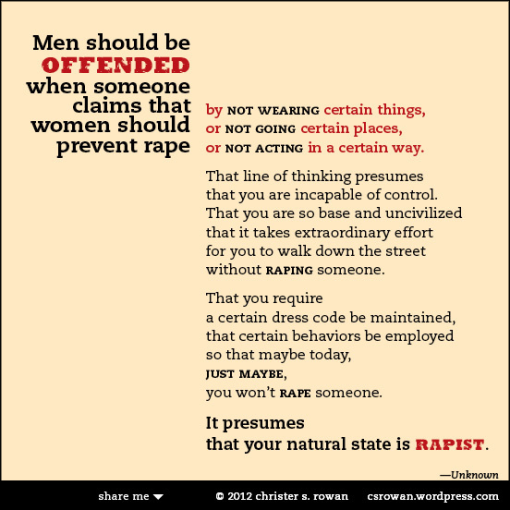
The struggle for women’s rights is never over. Let us commemorate those who fought for our freedom and that are still fighting to preserve it.

Oh hey there. Nothing like rape statistics to darken your day. However if you don’t know, you can’t fix it. So read up and get cracking to make your little part of the world safer for everyone.
Women

1 out of every 6 American women has been the victim of an attempted or completed rape in her lifetime (14.8% completed rape; 2.8% attempted rape).1
17.7 million American women have been victims of attempted or completed rape.1
9 of every 10 rape victims were female in 2003.2
Lifetime rate of rape /attempted rape for women by race:1
- All women: 17.6%
- White women: 17.7%
- Black women: 18.8%
- Asian Pacific Islander women: 6.8%
- American Indian/Alaskan women: 34.1%
- Mixed race women: 24.4%
Men
About 3% of American men — or 1 in 33 — have experienced an attempted or completed rape in their lifetime.1
- In 2003, 1 in every ten rape victims were male.2
- 2.78 million men in the U.S. have been victims of sexual assault or rape.1
Children
15% of sexual assault and rape victims are under age 12.3
- 29% are age 12-17.
- 44% are under age 18.3
- 80% are under age 30.3
- 12-34 are the highest risk years.
- Girls ages 16-19 are 4 times more likely than the general population to be victims of rape, attempted rape, or sexual assault.
7% of girls in grades 5-8 and 12% of girls in grades 9-12 said they had been sexually abused.4
- 3% of boys grades 5-8 and 5% of boys in grades 9-12 said they had been sexually abused.
In 1995, local child protection service agencies identified 126,000 children who were victims of either substantiated or indicated sexual abuse.5
- Of these, 75% were girls.
- Nearly 30% of child victims were between the age of 4 and 7.
93% of juvenile sexual assault victims know their attacker.6
- 34.2% of attackers were family members.
- 58.7% were acquaintances.
- Only 7% of the perpetrators were strangers to the victim.
Effects of Rape
Victims of sexual assault are:7
3 times more likely to suffer from depression.
6 times more likely to suffer from post-traumatic stress disorder.
13 times more likely to abuse alcohol.
26 times more likely to abuse drugs.
4 times more likely to contemplate suicide.
Pregnancies Resulting from Rape
In 2004-2005, 64,080 women were raped.8 According to medical reports, the incidence of pregnancy for one-time unprotected sexual intercourse is 5%. By applying the pregnancy rate to 64,080 women, RAINN estimates that there were 3,204 pregnancies as a result of rape during that period.
This calculation does not account for the following factors which could lower the actual number of pregnancies:
- Rape, as defined by the NCVS, is forced sexual intercourse. Forced sexual intercourse means vaginal, oral, or anal penetration by offender(s). This category includes incidents where the penetration is from a foreign object such as a bottle. Certain types of rape under this definition cannot cause pregnancy.
- Some victims of rape may be utilizing birth control methods, such as the pill, which will prevent pregnancy.
- Some rapists may wear condoms in an effort to avoid DNA detection.
- Vicims of rape may not be able to become pregnant for medical or age-related reasons.
This calculation does not account for the following factors which could raise the actual number of pregnancies:
- Medical estimates of a 5% pregnancy rate are for one-time, unprotected sexual intercourse. Some victimizations may include multiple incidents of intercourse.
- Because of methodology, NCVS does not measure the victimization of Americans age 12 or younger. Rapes of these young people could results in pregnancies not accounted for in RAINN’s estimates.
References
- National Institute of Justice & Centers for Disease Control & Prevention. Prevalence, Incidence and Consequences of Violence Against Women Survey. 1998.
- U.S. Department of Justice. 2003 National Crime Victimization Survey. 2003.
- U.S. Bureau of Justice Statistics, Sex Offenses and Offenders. 1997.
- 1998 Commonwealth Fund Survey of the Health of Adolescent Girls. 1998.
- U.S. Department of Health & Human Services, Administration for Children and Families. 1995 Child Maltreatment Survey. 1995.
- U.S. Bureau of Justice Statistics. 2000 Sexual Assault of Young Children as Reported to Law Enforcement. 2000.
- World Health Organization. 2002.
- U.S. Department of Justice. 2005 National Crime Victimization Survey. 2005.











 bleatmop
 Mystro


 Dead Wild Roses
Your opinions…