
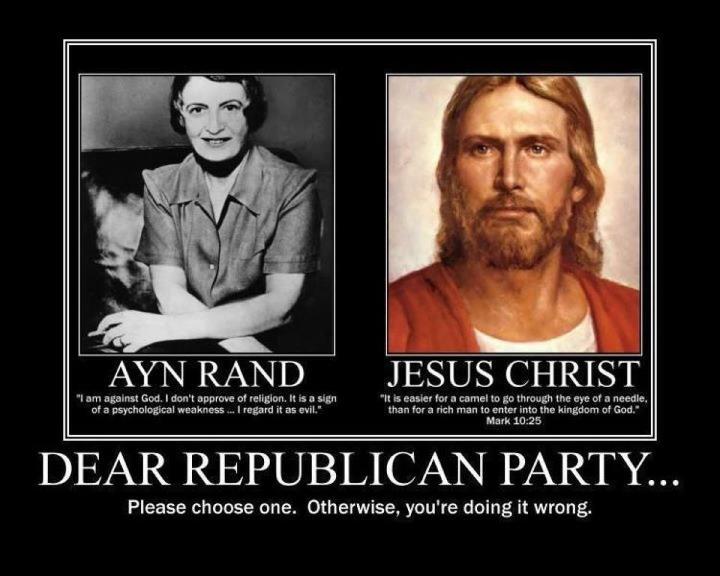
 Most of what Rand has to say about economics and politics is complete bunk. The idea that we should not restrict the wealthy classes in their endeavours strikes me as the fast forward button on the decline of Western Civilization. Altruism and empathy are the qualities that will save our civilization, their antithesis, aka much of what Rand proposes, will not. Alter.net has a great article about Rand and what it is doing to our societies, I reproduce the section dealing with corporations and what they are actually mandated to do, as opposed to what they do now.
“Ayn Rand envisioned a world without governments – a world where the super-rich are free to do as they wish.
We tried that during the so-called Gilded Age of the late 19th Century – before Ayn Rand was alive. If she’d watched the ruthlessness of the Robber Barons like she did the Bolsheviks, she may have reached different conclusions.
She may have realized that American Presidents like Teddy Roosevelt, Franklin Roosevelt, and Dwight Eisenhower were right when they made sure that wealth was more evenly distributed and the Billionaire Class was held in check.
Or she may have come to understand that corporations and billionaires owe their wealth to the state and not the other way around. Without favorable patent and copyright laws, a court system, an educated workforce, and an infrastructure to move goods about the country, then no one would be able to get rich in America. We’d be like the Libertarian paradise of Somalia.
As Harry Moser, the founder of the Reshoring Initiative, argued in The Economist, “Corporations are not created by the shareholders or the management. Rather they are created by the state. They are granted important privileges by the state (limited liability, eternal life, etc). They are granted these privileges because the state expects them to do something beneficial for the society that makes the grant. They may well provide benefits to other societies, but their main purpose is to provide benefits to the societies (not to the shareholders, not to management, but to the societies) that create them.”











 bleatmop
 Mystro
 The Arbourist


 Dead Wild Roses
12 comments
February 9, 2013 at 9:16 am
MoS
Yes we are returning to a form of feudalism, one marked by the loss of political franchise, basic rights and the return to a form of indentured servitude. Corporatism has captured our political institutions. Even today’s New Democrats, Latter-Day Liberals, are in league. The Liberals, now Conservative-Lite, follow in the wake of Steve Harper’s neo-conservatives.
In just 20-years we have lost our rights of privacy to the utter indifference of our internet and social media-savvy younger generations. We’re tracked and observed and analyzed in the CCTV and massive computers of the surveillance state. This message I’m leaving you will unquestionably be taken into the mix. We no longer understand that our privacy is one of the key rights that anchors all the others. Without it the whole thing can be unraveled like a second-hand sweater.
The signs of the faltering of our democracy and rise of corporatist oligarchy are plentiful: the rise of inequality (of wealth, income and opportunity) and the associated decline in our health and educational institutions and our access to them; our government’s heedless embrace of environmental catastrophe and its fearsome efforts to accelerate the export of the most carbon-intensive fossil fuels on the planet; the decay of essential infrastructure across the country; the government’s relentless assault on organized labour and collective bargaining; the demise of a free press, the watchdog of government, and its replacement by a powerful and concentrated corporate media cartel, the lapdog of a collaborative government; the supremacy of globalization and the commensurate decline of our once robust middle class. The commercial sector no longer serves the country. Those positions are now sharply reversed.
Feudalism for the 21st century and, if left unchecked, it will lead to revolt. Some have called the 21st, the Century of Revolution. What is by no means clear is whether revolution will succeed, will achieve its aims, or will actually worsen our condition and hasten the decline of democratic societies.
LikeLike
February 9, 2013 at 9:37 am
The Arbourist
@MoS
It is sad when really the choice of political party represents how fast you want to sell democracy and your rights down the river.
Agreed. Many of the younger generation are unaware of the history of our nation and the struggles people undertook to ensure the rights we have today. Not having to fight for many of the rights we enjoy today has bred meek acceptance when these rights are rolled back.
Politics, culture and the economy are the three legs of stable democratic societies. For too long we have been ignoring the cultural leg and much of the poltical leg in favour of keeping the economic leg happy. The corporatism we see today is partially a result of this exaggerated attention given to the economy.
Sadly, most likely within our lifetimes. The future road is very bleak indeed.
LikeLike
February 9, 2013 at 12:05 pm
VR Kaine
I believe Rand lived in an era where true wealth was earned. She wasn’t about entitlement based upon class, so I think to say that she believed in a world where billionaires “should just be able to do what they want” is cherry-picking and ultimately not true.
One can look at her characters, particularly her heroes and heroines, for proof. Her characters have been consistently those who bucked government or government+business interests that were trying to steal private ideas under the guise of the “greater good”. Her heroes were those who “screwed over” the fat cats who would invest money blindly seeking simply profit and returns rather than seeking value that would create those returns. Huge difference.
Across the board in any of Rand’s books, Rand’s characters took business risks and were either rewarded for them or punished based solely upon how well these people delivered value to the individual or the marketplace, without government adding to, or softening, either the blow or the reward. Furthermore, I don’t find one hero/heroine in her literature that didn’t earn their wealth honestly through innovation, work, and a fair exchange of value with whomever they transacted with. They were just as fair with their employees as they were with their vendors or customers.
Take Atlas Shrugged, for instance, and some examples of Rand’s characters:
Dagney Taggert – a woman who takes over for the incompetence of her brother who prefers to trade growth and innovation for the “safety” of being in bed with government (btw, how many female CEO’s existed in Rand’s time? I think this was a bold and great move on her part that should be applauded).
Hank Rearden – a “self made” man like many of the businessmen in Rand’s novels. Has an idea for a new kind of metal that would improve society across the board, but is held back because it competes with the business (or could destroy the business) of those who are in bed with the government and have their industries protected by them..
Francisco d’Anconia – a character who traps “looters” into worthless ventures as a lesson to corporate freeloaders who follow animalistic instincts of greed without thinking. Even though Anconia could have likely been successful in any pursuit, his current wealth has no value to him because it was inherited. Right here you see an example of Rand’s disdain for social classes. Investors flock to Anconia’s ventures based simply upon his name and his image, not that he creates any value, and Rand shows how foolish she believes this to be.
I believe if Rand would read any of these far-left criticisms of her philosophy, for the most part she would slam the authors for not having a clue as to what she’s talking about. Furthermore, however, I believe if Rand were to look at things today with the unearned (“instant” electronic) and unfair (government in bed with business) wealth being generated, she’d also be slamming many of the big businesses as well as many Republicans who are so quick to selectively quote her for the same reasons – not having a clue as to what she’s talking about.
Her warnings to people were:
1) Use your brain and THINK, lest you be no different than an animal
2) Don’t feel guilty about pursuing wealth through thinking (innovation) that is morally just and has a true exchange of value
3) Beware those trying to steal that innovation and earned wealth away through guilt and the guise of service to the “greater good”.
To me, Rand’s choice of protagonists (and the fact that she makes them protagonists) are the best examples of her philosophy, and I think they are characters that people both on the left and the right would admire if they knew anything about them.
Instead, however, you get people cherry-picking her ideas from either the right or the left and ending up creating conclusions that don’t match up to her characters, which leads me to believe these people are simply talking out their ass when they want to either praise or vilify her.
Lastly, nowhere in her literature does Rand say a “Billionaire Class” should be “free to do as they wish”. She does say that a government is inept to keep them in check, and on that basis proposes smaller government (not zero government as hard lefties like to pretend), but ending there is still cherry-picking and out of context.
For one, it ignores the main part of Rand’s equation for balance, which is that there would be a bulk of free-thinking people in morally-just pursuits that would create a free-market to freely exchange products, services, and even labor of equal value. This, in turn, would keep ANY class – government, royalty, or otherwise in check – including the class of “looters” on the far left who want to take more than they’ve earned.
I’m not a dogmatic follower of Rand, but once again Alter.net appears to be way off when it comes to having a clue what’s she’s saying.
Fun to discuss, though, and sorry for the long response! :)
LikeLike
February 9, 2013 at 12:08 pm
Rob F
In one of US politics’ great ironies, Ayn Rand was an atheist and pro-choice (credit’s due where credit is due!), in contrast to the vast majority of her followers.
LikeLike
February 9, 2013 at 12:23 pm
Rob F
Noah Smith, an economist, argues that libertarian increases the ability of “local bullies” to oppress others. His entire post on this is very much worth reading.
LikeLike
February 9, 2013 at 1:03 pm
MoS
Rob, that was an excellent link, thank you. He does point out a great omission in Rand’s and other libertarians’ ideology. Theirs is a near-religions belief structure that is based on incomplete, hence unrealistic structures. That actually runs true to course of this sort of thing.
LikeLike
February 9, 2013 at 1:06 pm
The Arbourist
@Vern
I’m pretty much in agreement with 1 and 2. The third premise is somewhat less satisfying as it speaks greatly to Rand’s experience with communism. The greater good, or altruism is not a force to be feared and through much of her work Rand wrongly characterizes the altruistic impulse as banal, evil and an anathema to modern society.
The other problem with ideas such as these are the necessary preconditions required to make the idea work – namely we have enabled free thinkers in a market that is actually free. The term “free market” is one of those platonic ideals that makes for good debate and good rhetoric, but bad policy once the rubber hits the road.
Theorycraft is great. :) Socialism also keeps the elites in line since the workers are in control of the means of production…
LikeLike
February 9, 2013 at 3:23 pm
VR Kaine
Hi Arb,
“The greater good, or altruism is not a force to be feared and through much of her work Rand wrongly characterizes the altruistic impulse as banal, evil and an anathema to modern society.”
Yes, where I disagree with Rand as well. It’s a risky impulse if underlying it is some guilt laid upon them by an oppressor which Rand explores at length, but I don’t find she does much to discuss the other side of that. I think there’s a part of all of us that wants to give out of the sheer sake of giving, which has nothing but a spiritual explanation (not saying religious). I don’t think that can be explained through Objectivism.
“The other problem with ideas such as these are the necessary preconditions required to make the idea work – namely we have enabled free thinkers in a market that is actually free. The term “free market” is one of those platonic ideals that makes for good debate and good rhetoric, but bad policy once the rubber hits the road.
Bad policy only because I believe the definition of a free market has been twisted. I don’t believe in Rand’s world she envisioned a market without court protection for patents, or lawyers to advocate trade disputes, for instance. She objected to courts protecting particular businesses and government stacking the deck for some companies and not others.
“Socialism also keeps the elites in line since the workers are in control of the means of production”
Back when the world was all about manufacturing, perhaps, but not now in my opinion. Workers today are hardly in control of the means of production. In most cases they’re nowhere near it except in fringe areas of the economy. In my opinion the only way the “elites” stay in line now is if “average” people think and outsmart them, or beat them at their own game either economically, or politically.
.
LikeLike
February 9, 2013 at 3:38 pm
VR Kaine
@ Rob,
At the end of the day Libertarianism will always remain a theory to me that will never work in practice. Populations are too large, capital flows too quickly, and people of all stripes are too greedy and entitlement-expecting for it to work.
Sure, a bunch of capitalists could buy up a beach and sell admission to it. In theory, the rights to that beach being community/public land could be challenged in a court of law. Reality, however, says that those planning to buy up the beach would have armies of lawyers, lobbyists, and tons of political donations and backroom deals already in place. The courts would already be full and it would take years for the peoples’ challenge to ever be heard.
Libertarianism would suggest that a group of people would have the same opportunity to make their case that the capitalists would, and that’s simply not true.
LikeLike
February 24, 2013 at 9:49 am
VR Kaine
Watched Atlas Shrugged Part II this morning. Um… well… still nice to see a movie like this out there and looking forward to Part III, even if it’s in the same way I looked forward to Star Wars episode III after I trudged through I and II.
Anyways, I found an interesting article on HuffPo that seemed to fit the discussion here.
http://www.huffingtonpost.com/michael-shermer/why-ayn-rand-wont-go-away_b_1961288.html
LikeLike
February 24, 2013 at 10:03 am
The Arbourist
Interesting article Vern. I’m more curious as to the reasons why the split in American politics. If any country could use a third party, it would be the US.
At least with 3 here in Canada, if one self-destructs, the other can fill the void and provide the stability our system needs to work properly.
LikeLike
February 25, 2013 at 5:23 am
VR Kaine
There are many conservatives who wish for this very thing. David Frum is one of them. Of course leaders can run as Independents a la Ross Perot and Ralph Nader, but with the money it now requires I can’t see anyone even trying to get in the race to compete with the Dems or Repubs right now.
LikeLike