
You are currently browsing the monthly archive for April 2013.

Jesu, meine Freude is a motet composed by Johann Sebastian Bach. The work, which takes its title from the chorale by Johann Franck on which it is based, is also known as Motet No. 3 in E minor, BWV 227. The stanzas of the chorale are interspersed with passages from the Epistle to the Romans.
Bach’s organ piece, chorale prelude BWV 610, bears the same title. This work, which is earlier and shorter than the motet, is based on the same chorale melody by Johann Crüger.
There are six authenticated funeral motets (BWV 225–230) written for St Thomas’s Church, Leipzig, between 1723 and 1727. A seventh has only recently been subjected to some scholarly doubt as to its authorship. This third is the earliest, longest, most musically complex and justifiably the most popular of the six, and was written in Leipzig in 1723 for the funeral (on 18 July 1723) of Johanna Maria Käsin, the wife of that city’s postmaster. The 5th voice of the chorus is a second soprano part of harmonic richness, adding considerably to the tonal palette of the work as a whole.
The chorale melody on which it is based was by Johann Crüger (1653), and it first appeared in his Praxis pietatis melica. The German text is by Johann Franck, and dates from c. 1650. The words of the movement nos. 2, 4, 6, 8, and 10 are based on the Epistle to the Romans 8:1–2, 9–11. The scriptures here speak of Jesus Christ freeing man from sin and death. The chorale text is from the believer’s point of view and praises the gifts of Jesus Christ as well as longing for his comforting spirit. It also abounds with stark contrasts between images of heaven and hell, often within a single section. Bach’s vivid setting of the words heightens these dramatic contrasts resulting in a motet with an uncommonly wide dramatic range.
Movements
- Jesu, meine Freude (1st stanza)
- Es ist nun nichts Verdammliches (based on Romans 8:1,4)
- Unter deinem Schirmen (2nd stanza)
- Denn das Gesetz (à 3, based on Romans 8:2)
- Trotz dem alten Drachen (3rd stanza)
- Ihr aber seid nicht fleischlich (fugue, based on Romans 8:9)
- Weg mit allen Schätzen (4th stanza)
- So aber Christus in euch ist (à 3, based on Romans 8:10)
- Gute Nacht, o Wesen (à 4, 5th stanza)
- So nun der Geist (based on Romans 8:11)
- Weicht, ihr Trauergeister (6th stanza)
A brief guide to the eleven movements follows:
- Chorale setting, four-part
- Five-part dramatic chorus, florid variations on the chorale, in the manner of an instrumental ripieno
- Chorale, with flourishes
- Setting in the manner of a trio sonata (soprano, soprano, alto).
- Five-part dramatic chorus, florid variations on the chorale, in the manner of an instrumental ripieno.
- Five-part double fugue
- Chorale, with florid variations.
- Setting in the manner of a trio sonata (alto, tenor, bass)
- Chorale prelude (soprano, soprano, alto, tenor. The cantus firmus is in the alto).
- Five-part dramatic chorus (repeats much of #2 with different text)
- Chorale setting (repeats #1 with different text)
An analysis would reveal a balanced musical symmetry around the 6th movement double fugue, with both #3–5 and #7–9 containing a chorale, a trio and a quasi-aria movement, and the work beginning and ending with the identical chorale, albeit to different words.
Now we get to play catch the subtext… :)

Inequality is going to kick our ass if we don’t take measures to rectify the imbalances in your societies. The topic of this video is interesting; the presenter not so much. I recommend watching the video if you have a keen interest in how our world is working, but do not expect to be actively ‘entertained’. :)
Such interesting fuss over how we measure our world. :) Just play the video before I make a mass of myself.
 If you missed out of what Rape Culture is, I suggest you go back and look at yesterdays post. Today, lets enumerate a small sample of what is going on in our society. Specifically, lets look at some of posts from the tumblr “I Once Had A Guy Tell Me...” Liberal White Dudes I thought I would provide some evidence that your experiences are NOT some sort of platonic baseline that everyone shares. It is a touch different for others: (be aware these posts contain triggering material about rape, violence against women and sexual abuse)
[TW: Rape]
I once had a guy (friend, artistic collaborator) tell me, after “snuggling during a movie” turned into him holding me down with his forearm across the back of my neck while I nearly suffocated and he raped me so roughly it dislocated my lower back, that *I* had actually raped *him* — since I had known he was too drunk to stop himself from ‘fucking’ me. He considered himself a progressive and knew I was only interested in women; also, I had done nothing except lean my head against his shoulder.
(submitted by paleotrees)
[TW: Sexual Abuse]
I once had a guy tell me not to tell my mom he was trying to see me naked. Then my counselor (male) told me what my stepdad did was just human nature and I should forgive him.
(submitted by sarahlikescatsandcigarettes)
I once had a guy grab my stomach at a party, shake it in front of everyone in the room, then loudly chastise me for not eating healthy & working out so I could “be more attractive”.
(submitted by frostbiiite)
[TW: Rape]
I once overheard two middle aged men at a coffeeshop talk about how it’s teenage girls own faults that they get raped and sexually harrassed because they all post flattering selfies on facebook. “They’re trying to look so sexy, well what do they expect that gets you”
(submitted by anonymous)
[TW Abuse]
A guy once told me that he only hits me when he’s angry, and that I need only not piss to him off, and he will never hit me again. He’s my husband, and he tells me it’s my fault.
(submitted by anonymous)
Mod note* –
It is NOT your fault. Your husband has NO RIGHT to hit you, or hurt you in any way. Please seek help – YOU DO NOT DESERVE THIS.
[TW Rape]
I once had a guy tell me that I should stop complaining about the media coverage of the Steubenville Rape Case because “at least rape gets national attention,” and “violent crimes in which men are victimized are completely ignored.”
(submitted by bibulous)
[TW-rape]
My ex-boyfriend at the time told me, “This is why I can’t drink around you,” after I woke up to him inside of me and begged/fought him to stop. He only stopped to throw up, fall down, and pass out unconcious half way through.
(submitted by anonymous)
The tumblr goes on and… this is shameful commentary on so called Civilized Western Society.
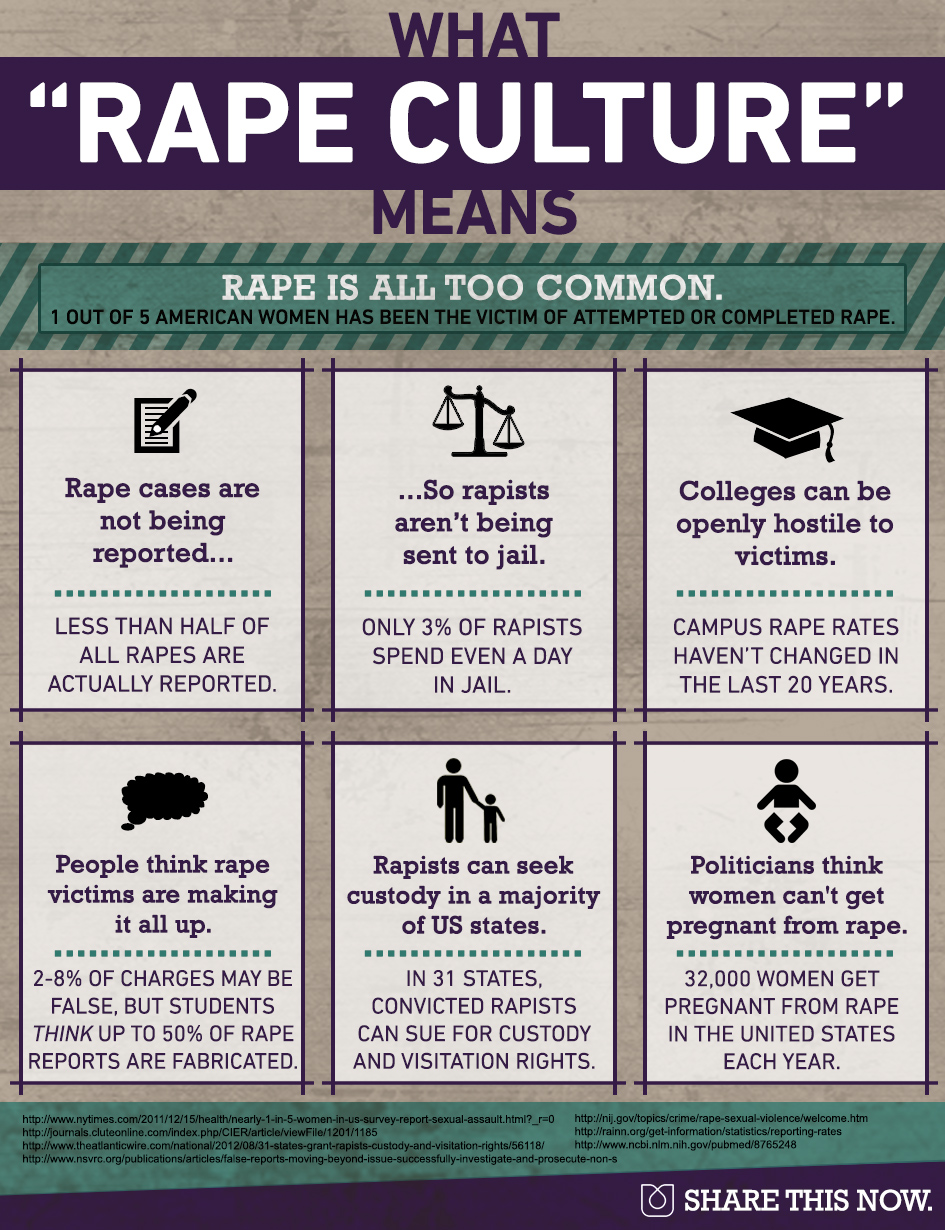 Oh pish-posh! What is Arb going on about now? You see bro’s it kinda goes like this. You dudes, especially the liberal progressive privileged ones, often don’t have a fucking clue about what feminism is or why it has come about or some of the neat things that LWD never get to experience. Yes, believe it or not, your experience is not the same experience as everyone else in society(pro-tip: Think in terms of your experience being ‘easy mode‘). Let’s start with a nifty one, and that is the culture of violence rape that is tacitly sanctioned by our society, otherwise known as Rape Culture. The preceding article is lifted directly from the Finally Feminism 101 website, and is also linked on the side bar of this blog. This is mandatory reading for LWD (liberal white dudes) because you of all people, should not have to be smacked so damn hard with the clue-by-four to start to ‘get it’.
No page breaks either, this is all important stuff and nothing should be below the fold. The definition of Rape culture needs to be out there and available for people to refer to because you can’t fix the problem you don’t know about or can identify.
“A rape culture is a complex of beliefs that encourages male sexual aggression and supports violence against women. It is a society where violence is seen as sexy and sexuality as violent. In a rape culture, women perceive a continuum of threatened violence that ranges from sexual remarks to sexual touching to rape itself. A rape culture condones physical and emotional terrorism against women as the norm.
In a rape culture both men and women assume that sexual violence is a fact of life, inevitable as death or taxes. This violence, however, is neither biologically nor divinely ordained. Much of what we accept as inevitable is in fact the expression of values and attitudes that can change.”
But my correspondents—whether they are dewy noobs just coming to feminism, advanced feminists looking for a source, or disbelievers in the existence of the rape culture—always seem to be looking for something more comprehensive and less abstract: What is the rape culture? What are its borders? What does it look like and sound like and feel like?
It is not a definition for which they’re looking; not really. It’s a description. It’s something substantive enough to reach out and touch, in all its ugly, heaving, menacing grotesquery.
Rape culture is encouraging male sexual aggression. Rape culture is regarding violence as sexy and sexuality as violent. Rape culture is treating rape as a compliment, as the unbridled passion stirred in a healthy man by a beautiful woman, making irresistible the urge to rip open her bodice or slam her against a wall, or a wrought-iron fence, or a car hood, or pull her by her hair, or shove her onto a bed, or any one of a million other images of fight-fucking in movies and television shows and on the covers of romance novels that convey violent urges are inextricably linked with (straight) sexuality.
Rape culture is treating straight sexuality as the norm. Rape culture is lumping queer sexuality into nonconsensual sexual practices like pedophilia and bestiality. Rape culture is privileging heterosexuality because ubiquitous imagery of two adults of the same-sex engaging in egalitarian partnerships without gender-based dominance and submission undermines (erroneous) biological rationales for the rape culture’s existence.
Rape culture is rape being used as a weapon, a tool of war and genocide and oppression. Rape culture is rape being used as a corrective to “cure” queer women. Rape culture is a militarized culture and “the natural product of all wars, everywhere, at all times, in all forms.”
Rape culture is 1 in 33 men being sexually assaulted in their lifetimes. Rape culture is encouraging men to use the language of rape to establish dominance over one another (“I’ll make you my bitch”). Rape culture is making rape a ubiquitous part of male-exclusive bonding. Rape culture is ignoring the cavernous need for men’s prison reform in part because the threat of being raped in prison is considered an acceptable deterrent to committing crime, and the threat only works if actual men are actually being raped.
Rape culture is 1 in 6 women being sexually assaulted in their lifetimes. Rape culture is not even talking about the reality that many women are sexually assaulted multiple times in their lives. Rape culture is the way in which the constant threat of sexual assault affects women’s daily movements. Rape culture is telling girls and women to be careful about what you wear, how you wear it, how you carry yourself, where you walk, when you walk there, with whom you walk, whom you trust, what you do, where you do it, with whom you do it, what you drink, how much you drink, whether you make eye contact, if you’re alone, if you’re with a stranger, if you’re in a group, if you’re in a group of strangers, if it’s dark, if the area is unfamiliar, if you’re carrying something, how you carry it, what kind of shoes you’re wearing in case you have to run, what kind of purse you carry, what jewelry you wear, what time it is, what street it is, what environment it is, how many people you sleep with, what kind of people you sleep with, who your friends are, to whom you give your number, who’s around when the delivery guy comes, to get an apartment where you can see who’s at the door before they can see you, to check before you open the door to the delivery guy, to own a dog or a dog-sound-making machine, to get a roommate, to take self-defense, to always be alert always pay attention always watch your back always be aware of your surroundings and never let your guard down for a moment lest you be sexually assaulted and if you are and didn’t follow all the rules it’s your fault.
Rape culture is victim-blaming. Rape culture is a judge blaming a child for her own rape. Rape culture is a minister blaming his child victims. Rape culture is accusing a child of enjoying being held hostage, raped, and tortured. Rape culture is spending enormous amounts of time finding any reason at all that a victim can be blamed for hir own rape.
Rape culture is judges banning the use of the word rape in the courtroom. Rape culture is the media using euphemisms for sexual assault. Rape culture is stories about rape being featured in the Odd News.
Rape culture is tasking victims with the burden of rape prevention. Rape culture is encouraging women to take self-defense as though that is the only solution required to preventing rape. Rape culture is admonishing women to “learn common sense” or “be more responsible” or “be aware of barroom risks” or “avoid these places” or “don’t dress this way,” and failing to admonish men to not rape.
Rape culture is “nothing” being the most frequent answer to a question about what people have been formally taught about rape.
Rape culture is boys under 10 years old knowing how to rape.
Rape culture is the idea that only certain people rape—and only certain people get raped. Rape culture is ignoring that the thing about rapists is that they rape people. They rape people who are strong and people who are weak, people who are smart and people who are dumb, people who fight back and people who submit just to get it over with, people who are sluts and people who are prudes, people who rich and people who are poor, people who are tall and people who are short, people who are fat and people who are thin, people who are blind and people who are sighted, people who are deaf and people who can hear, people of every race and shape and size and ability and circumstance.
Rape culture is the narrative that sex workers can’t be raped. Rape culture is the assertion that wives can’t be raped. Rape culture is the contention that only nice girls can be raped.
Rape culture is refusing to acknowledge that the only thing that the victim of every rapist shares in common is bad fucking luck. Rape culture is refusing to acknowledge that the only thing a person can do to avoid being raped is never be in the same room as a rapist. Rape culture is avoiding talking about what an absurdly unreasonable expectation that is, since rapists don’t announce themselves or wear signs or glow purple.
Rape culture is people meant to protect you raping you instead—like parents, teachers, doctors, ministers, cops, soldiers, self-defense instructors.
Rape culture is a serial rapist being appointed to a federal panel that makes decisions regarding women’s health.
Rape culture is a ruling that says women cannot withdraw consent once sex commences.
Rape culture is a collective understanding about classifications of rapists: The “normal” rapist (whose crime is most likely to be dismissed with a “boys will be boys” sort of jocular apologia) is the man who forces himself on attractive women, women his age in fine health and form, whose crime is disturbingly understandable to his male defenders. The “real sickos” are the men who go after children, old ladies, the disabled, accident victims languishing in comas—the sort of people who can’t fight back, whose rape is difficult to imagine as titillating, unlike the rape of “pretty girls,” so easily cast in a fight-fuck fantasy of squealing and squirming and eventual relenting to the “flattery” of being raped.
Rape culture is the insistence on trying to distinguish between different kinds of rape via the use of terms like “gray rape” or “date rape.”
Rape culture is pervasive narratives about rape that exist despite evidence to the contrary. Rape culture is pervasive imagery of stranger rape, even though women are three times more likely to be raped by someone they know than a stranger, and nine times more likely to be raped in their home, the home of someone they know, or anywhere else than being raped on the street, making what is commonly referred to as “date rape” by far the most prevalent type of rape. Rape culture is pervasive insistence that false reports are common, although they are less common (1.6%) than false reports of auto theft (2.6%). Rape culture is pervasive claims that women make rape accusations willy-nilly, when 61% of rapes remain unreported.
Rape culture is the pervasive narrative that there is a “typical” way to behave after being raped, instead of the acknowledgment that responses to rape are as varied as its victims, that, immediately following a rape, some women go into shock; some are lucid; some are angry; some are ashamed; some are stoic; some are erratic; some want to report it; some don’t; some will act out; some will crawl inside themselves; some will have healthy sex lives; some never will again.
Rape culture is the pervasive narrative that a rape victim who reports hir rape is readily believed and well-supported, instead of acknowledging that reporting a rape is a huge personal investment, a difficult process that can be embarrassing, shameful, hurtful, frustrating, and too often unfulfilling. Rape culture is ignoring that there is very little incentive to report a rape; it’s a terrible experience with a small likelihood of seeing justice served.
Rape culture is hospitals that won’t do rape kits, disbelieving law enforcement, unmotivated prosecutors, hostile judges, victim-blaming juries, and paltry sentencing.
Rape culture is the fact that higher incidents of rape tend to correlate with lower conviction rates.
Rape culture is silence around rape in the national discourse, and in rape victims’ homes. Rape culture is treating surviving rape as something of which to be ashamed. Rape culture is families torn apart because of rape allegations that are disbelieved or ignored or sunk to the bottom of a deep, dark sea in an iron vault of secrecy and silence.
Rape culture is the objectification of women, which is part of a dehumanizing process that renders consent irrelevant. Rape culture is treating women’s bodies like public property. Rape culture is street harassment and groping on public transportation and equating raped women’s bodies to a man walking around with valuables hanging out of his pockets. Rape culture is most men being so far removed from the threat of rape that invoking property theft is evidently the closest thing many of them can imagine to being forcibly subjected to a sexual assault.
Rape culture is treating 13-year-old girls like trophies for men regarded as great artists.
Rape culture is ignoring the way in which professional environments that treat sexual access to female subordinates as entitlements of successful men can be coercive and compromise enthusiastic consent.
Rape culture is a convicted rapist getting a standing ovation at Cannes, a cameo in a hit movie, and a career resurgence in which he can joke about how he hates seeing people get hurt.
Rape culture is when running dogfights is said to elicit more outrage than raping a woman would.
Rape culture is blurred lines between persistence and coercion. Rape culture is treating diminished capacity to consent as the natural path to sexual activity.
Rape culture is pretending that non-physical sexual assaults, like peeping tomming, is totally unrelated to brutal and physical sexual assaults, rather than viewing them on a continuum of sexual assault.
Rape culture is diminishing the gravity of any sexual assault, attempted sexual assault, or culture of actual or potential coercion in any way.
Rape culture is using the word “rape” to describe something that has been done to you other than a forced or coerced sex act. Rape culture is saying things like “That ATM raped me with a huge fee” or “The IRS raped me on my taxes.”
Rape culture is rape being used as entertainment, in movies and television shows and books and in video games.
Rape culture is television shows and movies leaving rape out of situations where it would be a present and significant threat in real life.
Rape culture is Amazon offering to locate “rape” products for you.
Rape culture is rape jokes. Rape culture is rape jokes on t-shirts, rape jokes in college newspapers, rape jokes in soldiers’ home videos, rape jokes on the radio, rape jokes on news broadcasts, rape jokes in magazines, rape jokes in viral videos, rape jokes in promotions for children’s movies, rape jokes on Page Six (and again!), rape jokes on the funny pages, rape jokes on TV shows, rape jokes on the campaign trail, rape jokes on Halloween, rape jokes in online content by famous people, rape jokes in online content by non-famous people, rape jokes in headlines, rape jokes onstage at clubs, rape jokes in politics, rape jokes in one-woman shows, rape jokes in print campaigns, rape jokes in movies, rape jokes in cartoons, rape jokes in nightclubs, rape jokes on MTV, rape jokes on late-night chat shows, rape jokes in tattoos, rape jokes in stand-up comedy, rape jokes on websites, rape jokes at awards shows, rape jokes in online contests, rape jokes in movie trailers, rape jokes on the sides of buses, rape jokes on cultural institutions…
Rape culture is people objecting to the detritus of the rape culture being called oversensitive, rather than people who perpetuate the rape culture being regarded as not sensitive enough.
Rape culture is the myriad ways in which rape is tacitly and overtly abetted and encouraged having saturated every corner of our culture so thoroughly that people can’t easily wrap their heads around what the rape culture actually is.
That’s hardly everything. It’s merely the tip of an unfathomable iceberg.











 bleatmop
 Mystro
 The Arbourist


 Dead Wild Roses
Your opinions…