
You are currently browsing the daily archive for August 24, 2013.
‘Nuff Said.


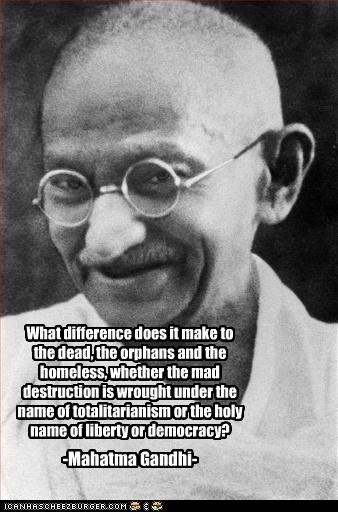 Currently reading Democracy Incorporated by Sheldon Wolin. He speaks of totalitarianism in a different form as opposed to that described by Hannah Arendt, but of what he terms inverted totalitarianism in which the state is hollowed out to serve corporate interests rather than those of the public. Thus quote originates from chapter 4 in which two ways in which nations can slip into autocratic rule.
“Tocqueville democrat comfortable with despotism and Hobbes’s free rationalist who opts for absolutism share an elective affinity. Tocqueville imagines a despotism made possible because citizens have chosen to relinquish participatory politics, which he and singled out as the most remarkable, widespread, and essential element of American political life. By abandoning their intense involvement with the common affairs of their communities in favor of personal ends, they, like signatories to Hobbes’s contract, have chosen to be apolitical subjects rather than citizens.
The contemporary moral to be drawn from our detour through Hobbes and Tocqueville is this: while it may prove possible to mobilize voters around the slogan “Anything to beat Bush!” it take more persistence, more thoughtfulness to dismantle Superpower and to nurture a democratic citizenry. The lesson of Hobbes and Tocqueville can be boiled down to a brief but chilling dictum: concentrated power, whether of a Leviathan, a benevolent despotism, or a superpower, is impossible without the support of a complicitous citizenry that willingly signs on to the covenant, or acquiesces, or clicks the “mute button.”
– Sheldon S. Wolin, Democracy Incorporated p.80-81.
“
Pain is an essential part of the grooming process, and that is not accidental. Plucking the eyebrows, shaving under the arms, wearing a girdle, learning to walk in high-heeled shoes, having one’s nose fixed, straightening or curling one’s hair —these things hurt. The pain, of course, teaches an important lesson: no price is too great, no process too repulsive, no operation too painful for the woman who would be beautiful. The tolerance of pain and the romanticization of that tolerance begins here, in preadolescence, in socialization, and serves to prepare women for lives of childbearing, self-abnegation, and husband-pleasing. The adolescent experience of the “pain of being a woman” casts the feminine psyche into a masochistic mold and forces the adolescent to conform to a self-image which bases itself on mutilation of the body, pain happily suffered, and restricted physical mobility. It creates the masochistic personalities generally found in adult women: subservient, materialistic (since all value is placed on the body and its ornamentation), intellectually restricted, creatively impoverished. It forces women to be a sex of lesser accomplishment, weaker, as underdeveloped as any backward nation. Indeed, the effects of that prescribed relationship between women and their bodies are so extreme, so deep, so extensive, that scarcely any area of human possibility is left untouched by it.”

— Andrea Dworkin, Woman Hating
Link.











 bleatmop
 Mystro
 The Arbourist


 Dead Wild Roses
Your opinions…