
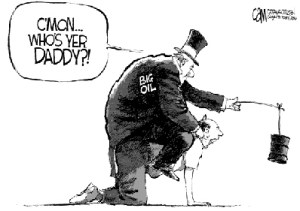
 It sucks when your government is an entity devoid of anything resembling a spine. *sigh*
The Alberta government is so deeply in bed with big oil its shite and piss are black. So, rather than looking at an example of how to screw your citizens over, take a look at a country that got it, and continues to get it right; Norway. It makes me spitting mad that we couldn’t even get a fractional raise in revenue for the people of Alberta (The Royalty Review), all the while Norway has 165,000 thousand dollars socked away per person for its retiring population. You fucking old people (and you fucking young greedy capitalists) who can’t vote anything other than Tory in Alberta, enjoy working past 65 and as an extra sweet bonus we’ll save you a spot working at McDonald’s until your body and mind are well and truly done. Savour the sweet capitalist freedom to work yourself to death, I know I will.
My bitter vitriol aside, onward to the article that got this party started:
“Like parts of Canada and the United States, Norway has a very lucrative oil and gas industry. But unlike Alberta and Alaska, Norway chose not to use its resource wealth immediately to pay for hefty tax cuts or social programs. Instead, the Scandinavian country squirrelled its money away in a fund for future generations, a decision that is paying enormous social dividends.
Today, less than 25 years since its inception, that nest egg has grown into the world’s most valuable sovereign wealth fund, worth about $850 billion – more than $165,000 per Norwegian citizen, according to an SWF Institute report. It is the envy of the world, funding initiatives ranging from infrastructure improvements and green energy projects to public pensions.
Meanwhile, the Alberta Heritage Fund, which is 14 years older, is worth about $17 billion. The Alaska Permanent Fund sits at $50 billion. Even combined, they represent a fraction of the wealth Norway has amassed, and which it will be able to draw on long after its oilfields run dry.
Farouk al-Kasim on Norway’s Oil Policy and Wealth.:
“They did not have a clear enough policy for how to manage petroleum resources when they were starting out,” he said. “Norway concluded that if you don’t have a policy up front, and if you don’t have a consensus on that policy, that human nature would tend to favour individual interests rather than coherent national interests.”
In 1971, shortly after the Ekofisk discovery, the Norwegian parliament drafted legislation that came to be known as the country’s “10 Oil Commandments.”
“These 10 Oil Commandments form the basic policy on which Norway has managed its petroleum resources ever since,” al-Kasim said. “And the politicians not only agreed on this document, but they agreed not to debate it in elections and the third miracle … that they kept their promise.”
He was an instrumental force behind the Norwegian government’s decision to establish a national oil company, StatOil, and an independent industry regulator.
The government also legislated that Norway’s participation, through Statoil, in all future discoveries should be no less than 50 per cent. Al-Kasim says that stipulation was actually welcomed by international oil companies, who remained keen to partner with Statoil.
“They were guaranteed recovery of their investment,” he explained. “And on top of that, they received a very reasonable interest on their investment …. There was virtually no risk at all, so the oil companies were quite happy going along with this formula.” (Source CBC.ca)
Gaa! It’s so awesome my province is so frakking high on capitalism. I found the 10 Oil Commandments from the Norwegian Governments website. So get a pencil and paper you feckless-amoral-conservative-corporate-bootlicking-lickspittles and look at how you establish resource policy that benefits the people of nation and not just corporate coffers.

The standing committee on industry in the Storting (parliament) produced what has since been known as the “10 oil commandments” in 1971. These principles have subsequently been significant for the direction and shape of Norwegian petroleum policy. Veteran industry observer Bjørn Vidar Lerøen checks out their impact.

The committee framed its commandments in keeping with a government desire to develop an oil policy which ensured that the natural resources on the NCS benefited the whole community.
First commandment
National supervision and control must be ensured for all operations on the NCS.
Coment
This principle can be regarded as fulfilled. The government wanted to manage and control the business. When creating Statoil and the NPD in 1972, the Storting established a tripartite model comprising central management, administrative and commercial functions.
These three instruments of this model were the Ministry of Industry – replaced by the Ministry of Petroleum and Energy in 1978 – the NPD and Statoil respectively.
In 1984, the Storting resolved to split Statoil’s cash flow through the creation of the state’s direct financial interest (SDFI) in the petroleum industry. The company kept the job of managing the state’s licence holdings and selling its oil and gas.
Two new state-owned companies were founded when Statoil was listed in 2001 – Petoro to manage the SDFI portfolio and Gassco to operate the gas transport network from fields on the NCS. Statoil is the main technical service provider to the latter.
Changes have also happened to the NPD, with the Storting voting in 2004 to separate off the safety department as the Petroleum Safety Authority Norway (PSA).
The audits conducted by this agency take full care of the desire for national management and control of all operations on the NCS.
Second commandment
Petroleum discoveries must be exploited in a way which makes Norway as independent as possible of others for its supplies of crude oil.
Coment
When Ekofisk was discovered in late 1969, most Norwegians thought it would make them selfsufficient in oil for 15-20 years. But it soon became apparent that resources on the NCS far exceeded Norway’s own needs.
The country accordingly became a major exporter of crude oil, and is now in the process of becoming an even bigger source of gas exports. Norway will be independent of oil imports for the foreseeable future.
Third commandment
New industry will be developed on the basis of petroleum.
Coment
Offshore operations on the NCS have led to the development of a large and strong Norwegian petroleum industry, which currently employs some 200 000 people.
Norway has secured a position among the world leaders in important technologies such as drilling, major offshore projects, subsea solutions and multiphase flow in pipelines.
Norwegian oil and gas technology has also become a substantial export commodity.
Fourth commandment
The development of an oil industry must take necessary account of existing industrial activities and the protection of nature and the environment.
Coment
Oil and gas have made Norway one of the world’s richest countries. This wealth has been counterbalanced by a high level of domestic costs. Through 40 years as an oil nation, its industrial structure has also undergone profound changes.
Petroleum revenues have allowed Norway at times to pursue a counter-cyclical economic policy which has made the country unique in relation to comparable nations.
Reserves of more than NOK 3 000 billion have been accumulated in the government pension fund – global, and Norway has also been able to respond to the recent world financial crisis with measures which have ensured low unemployment and reasonable income growth.
During Norway’s years as a petroleum producer, climate and the environment have come to attract much greater attention. Being a major oil and gas nation while also seeking to lead work on improving climate and the environment has often proved a demanding combination.
On the other hand, Norwegian petroleum production can be described as among the cleanest in a global context.
Fifth commandment
Flaring of exploitable gas on the NCS must not be accepted except during brief periods of testing.
Coment
This principle has been indicative for resource management, and complying with it has meant that environmental concerns are met while creating substantial value.
Sixth commandment
Petroleum from the NCS must as a general rule be landed in Norway, except in those cases where socio-political considerations dictate a different solution.
Coment
This proved a difficult commandment to fulfil. The oil and gas pipelines for first two developments on the NCS, Ekofisk and Frigg, had to go to Germany and the UK, with landfalls at Emden, Teesside and St Fergus.
This was because the deepwater Norwegian Trench lies between the fields and mainland Norway. So crossing this feature in 360 metres of water with the Statpipe gas line during the early 1980s marked a major breakthrough.
That installation went to Kårstø north of Stavanger. Later gas pipelines have come ashore at Kollsnes, Nyhamna, Tjeldbergodden and Melkøya, while oil lines run to Sture and Mongstad.
A network more than 7 000 kilometres long gives Norway the world’s largest underwater gas transport system.
Seventh commandment
The state must become involved at all appropriate levels and contribute to a coordination of Norwegian interests in Norway’s petroleum industry as well as the creation of an integrated oil community which sets its sights both nationally and internationally.
Coment
This principle is perhaps the one which has been most fully implemented, as confirmed by Norway’s role as a leading oil and gas nation. (See under the first commandment above.)
Eighth commandment
A state oil company will be established which can look after the government’s commercial interests and pursue appropriate collaboration with domestic and foreign oil interests.
Coment
This commandment was complied with immediately through the creation of Statoil, which became an important element in the Norwegian model of oil industry governance. However, major revisions have occurred along the way (see under the first commandment above).
Unlike a number of other oil nations, Norway was never tempted to pure nationalisation. Competition on the NCS ensured the participation of the world’s leading technology specialists.
Ninth commandment
A pattern of activities must be selected north of the 62nd parallel which reflects the special socio-political conditions prevailing in that part of the country.
Coment
“Special socio-political conditions” were interpreted as both domestic and foreign policy concerns. From the start, Norwegian politicians appreciated that petroleum operations in the far north could be sensitive, primarily in relation to Russia.
A number of commentators argued that the far northern NCS should be reserved for Norwegian oil companies.
After four decades of negotiation, the biggest issue – the boundary between Norway and Russia in the Barents Sea – is now heading for a resolution.
The domestic policy dimension related to the desire that northern Norway should share in the value creation provided by its own resources. Development of the Snøhvit gas field with a pipeline to Melkøya outside Hammerfest represents a paradigm shift for the region.
Debate on opening areas of the Norwegian Sea off Lofoten and Vesterålen to oil activity has exposed something of the vulnerability of these northern waters to pollution threats.
The environmental movement has warned of a tougher fight against petroleum operations in these areas than they pursued earlier over the activities further south on the NCS.
Tenth commandment
Large Norwegian petroleum discoveries could present new tasks for Norway’s foreign policy.
Coment
Former foreign minister Thorvald Stoltenberg – father of current premier Jens Stoltenberg – once formulated the challenge as follows: “We must ensure that oil policy is given a foreign policy dimension, and [vice versa].”
That might sound like something which goes without saying, but nevertheless represented an important acknowledgement of the position.











 bleatmop
 Mystro


 Dead Wild Roses
7 comments
April 14, 2014 at 9:28 am
VR Kaine
1. Norway has almost three times the oil production per capita than Canada.
2. Their oil producing infrastructure has been in place for years, and only requires maintenance…..and the oil that comes out of the sea floor is a much higher grade than oil sands oil. In other words, it has a much higher profit margin…….easier to extract a much higher grade of oil.
Using those two points as a basis, some may argue that Norway vs. Alberta isn’t apples to apples, but I don’t give a $hit. Alberta has been unable to balance the books since 2007, burning through $17.7 billion of past oil wealth, with another $3 billion deficit forecast for the coming budget. Clearly we need to get our $hit together and it isn’t getting done the way we’re doing it now.
I was a Lougheed and Klein fan which made me a Tory supporter for a number of elections, but I’ve sat out the past 3 because I was largely withdrawn from Alberta politics and didn’t want to vote completely blind. Would not vote NDP, but have a friend in the Alberta Liberals who has made a very strong case for why they should be the next government and the more I read about the mess the Tories have made here, the madder I get.
As Capitalist as I am, the conservative parties both in the US and in Canada are going too far to the right for my comfort level, and the waste, shenanigans (AHS, Redford, etc.) and the squander (deficits) that’s happened in Alberta since I’ve been away only make it worse.
LikeLike
April 14, 2014 at 10:38 am
The Arbourist
@Vern
Hiya Vern.
1. On point one, but Alberta also 14 more years to sock away enough per capita to to achieve similar results.
The Norwegians put this policy together before the necessary infrastructure was in place – so they, like us had to build the shit necessary to get to the oil. Offshore drilling and underwater pipelines I’m guessing is as capital intensive or more so that tar-sands production.
Yet, they did so with a 50/50 split and said Oil company’s where happy to get said oil.
Straight across comparisons are hard to find in the real world, I think we may have (for once) nothing more than minor quibbles on this point.
I suspect we’ll have different methodologies for changing things for the better. :)
But perhaps we can agree that this is one of the consequences of unchecked one party rule – sloppy policy, gravy-trains everywhere in government, and a political vision for the povince about as clear as mud.
We shan’t go there today. :)
Oh, so you’re contemplating joining the pissing up a rope ordeal that passes for voting in this FPP system when not voting for the Tories? :)
We draw our lines at different spots, but the slide toward unfettered robber-baron style capitalism seems to be increasing. And that is not good for most of society.
Most likely soon to be replaced by the WRP of alberta with even closer ties to Oil and with all the racism and bigotry we come to know and love from the GOP down south. Woo!
LikeLike
April 14, 2014 at 10:57 am
tnt666
Excellent piece!
LikeLike
April 14, 2014 at 12:06 pm
syrbal-labrys
One reason why my son briefly entertained hopes of emigrating to Norway — he doubts it will be possible, he cannot save up the requisite start-up funds with no job, AND Norway may soon slam doors on immigrants in any case. But yes, they are doing a LOT of things right there.
LikeLike
April 14, 2014 at 1:46 pm
VR Kaine
” I suspect we’ll have different methodologies for changing things for the better. :)
But perhaps we can agree that this is one of the consequences of unchecked one party rule – sloppy policy, gravy-trains everywhere in government, and a political vision for the povince about as clear as mud.”
Hi Arb. Yes, we likely would have different methodologies, but at the same I’m confident that we’d share the same disgust for the crony capitalism that exists between our political figures and big business nonetheless. I don’t believe it’s more with one party or another, either – I think it just depends on who’s longest in power. Look at how much cronyism there was with the Liberals federally during their dynasty, since we’re on the topic of unchecked one party rule.
As for my two initial points, I was curious whether you’d jump on them before seeing the part about me not caring for those two as a retort. :) We’ve had sweetheart deals in this problems set up by politicians who had their eyes on positions with big oil – either directly or indirectly – in the first place.
I have a friend in Alberta with two degrees that can’t find work in his field right now with all the healthcare mess going on. His UI doesn’t cover basic living so he’s having to consider a job in O&G to make ends meet which he’s hardly qualified for. He told me UI is $300/wk – that’s it? Those oil royalties could have been pumped into health care and particularly mental health, which he works in.
Plus, I think of all the help not just with social services, but entrepreneurship that a fund like that could produce for our province. That same friend wants to start a viable business – if they made even 10% of those Norway funds available to guys like him that would do wonders for the province in so many ways. Not even a new business – put towards tuition, a new house, etc..
I’ve been invested in those companies for awhile so I’m not as hard hit financially, but at the same time those companies do take a crap in our backyards before they’ll eventually pick up and leave. Government’s supposed to protect against that both financially and environmentally, and instead they’ve just been bowing to them. Check out the studies on air quality near Ft Saskatchewan, btw. http://thetyee.ca/News/2013/10/24/Alberta-Bad-Air/
Anyways, suffice it to say that this is one of those areas where you and I would probably more agree than disagree (for a change). :)
LikeLike
April 22, 2014 at 8:11 am
Another Week of Climate Disruption News, April 20, 2014 – A Few Things Ill Considered
[…] 2014/04/14: DWR: Hey Alberta, Look What Norway Did. WTF? […]
LikeLike
April 22, 2014 at 1:26 pm
Another Week of Climate Disruption News, April 20, 2014 [A Few Things Ill Considered] | Gaia Gazette
[…] 2014/04/14: DWR: Hey Alberta, Look What Norway Did. WTF? […]
LikeLike