
I really like this song. Here’s the problem though, try singing it in the same key that JBJ does. Here is the lead sheet and let’s observe the melodic patterns that are going on in this song.
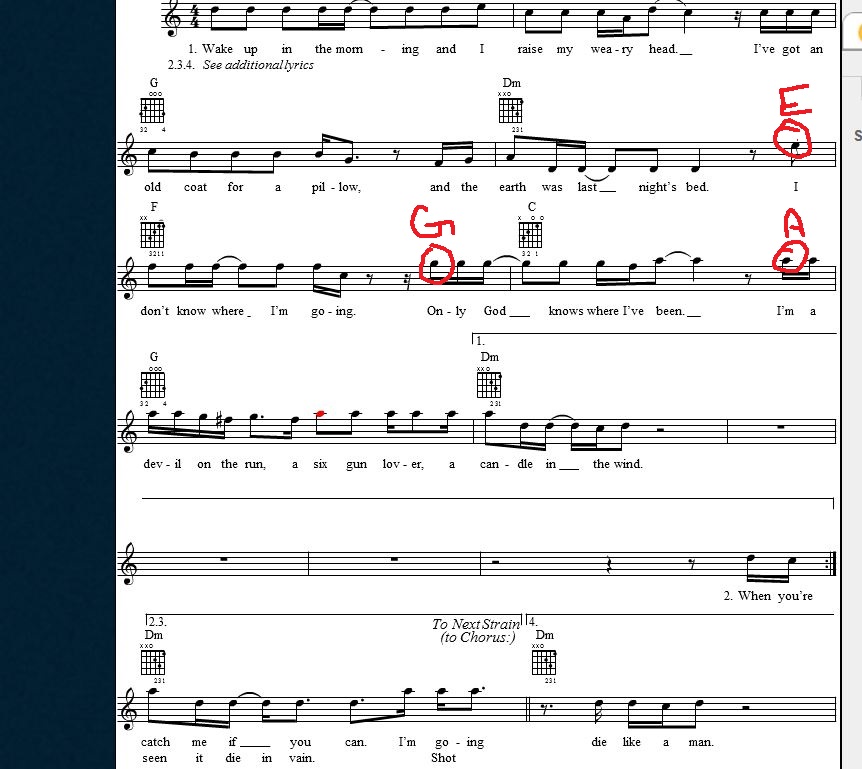
Those black dots keep going up higher on the staff. Damn you JBJ
Male vocal singing comes roughly in three flavours, Bass, Baritone and Tenor. The first highlighted note (E) will raise the eyebrows of most bases. It lies near the upper limit of where they can beautifully sing. Baritones (lazy tenors) are still well within their zone of comfort, however even they are pressed to produce the next series of notes (G). Of course JBJ doesn’t stop there and goes well into tenor territory with long passage of high notes (A’s). The general melodic tendency in this song is a ever increasing ascension of the C major scale. But wait, it get’s better.
If you listen to the song, you’ll notice the music presented here is only the intro and the intro builds into even a higher chorus. We’re now in the famously high C territory of Pavarotti and other classical singing masters. Let me assure you, gentle readers, High C territory is the undiscovered country for many tenors – as a amateur singing I have only once ventured into this land – it was rough and harsh encounter, let me assure you. Yet JBJ bashes out high notes like no ones business.
You may not like Bon Jovi, but one should at least appreciate the musicianship that goes into vocal production of this calibre.











 bleatmop
 Mystro
 The Arbourist


 Dead Wild Roses
7 comments
October 2, 2015 at 7:53 am
tildeb
Usually, developed singers have about a 3 octave range where their tone is good. Some are lower in register, some are higher, and some – like Axl Rose and Mariah Carey – have an unbelievable 5 and 6 octave range. It is almost impossible for choirs to replicate what these singers do except through clever arrangements that utilize male/female bass/soprano singers and ways to transition between the voices while carry these challenging melody.
Of course, as a trumpet player, I am well aware of the challenges of playing with good tone and articulation in the upper ranges and the technical difficulty this entails (casting doubt on the meme of 10,000 hours for mastery)… and why there are very few singers and players who can pull this off and make it seem easy. It’s not.
LikeLiked by 1 person
October 2, 2015 at 8:47 am
The Intransigent One
@tildeb – I don’t think I’d read before that you’re a trumpet player – cool!
LikeLike
October 2, 2015 at 9:57 am
tildeb
And in different groups and styles, playing principle, lead, 2nd, 3rd, and occasionally 4th, and doing my bit on an executive. as well as some teaching, so yes, it’s cool… and fun… and very hard work with a huge time commitment, quite social, and deeply rewarding on many levels… especially when everything comes together and you make a unique musical experience. We finished one magnificent piece in performance last year where the audience waited for my last high note to recede into silence and then faced no other sound for 11 seconds before the first stirrings of applause. Kind of spooky, actually. That’s why I know the 10,000 hour meme might be a good indicator but hardly a guarantee for mastery like some of the singers Arb presents. Or maybe I’m just good enough musically to know how far I still have to go. All I do know is I get a real kick out of other players who attribute to me the kind of playing they want to achieve for themselves. It’s flattering but the path is in the work and not something one can buy or rent.
I think I’ve learned more from performance music about real life than all the reading I’ve ever done.
LikeLike
October 2, 2015 at 11:56 am
The Intransigent One
That silence sounds amazing – wish I’d been there! What piece was it?
My dad’s a (retired) pro trumpet player; my brother’s a pro trombone and tuba player; and Arb and I have both played French horn, though not in years.
LikeLike
October 2, 2015 at 12:59 pm
tildeb
Deep River by Swearingen, a lovely little chorale prelude.
I see the Force is strong in your family!
And I sometimes think more trumpet players should switch to French horn early in their musical training and bring the necessary ferocious attitude to play the thing as it needs to be played… as so much music is written with this in mind (same for oboe).
It’s pretty easy to find good trumpet players (and one of my bands has an awesome trombone section of four outstanding players) but good horn players are a rarity and a good section a critically endangered species last reported sighting sometime in the early 80s, I think. Also, I never met a piece with a tuba solo (or triangle solo for that matter) I didn’t love to play.
Ever thought of getting back into playing horn again?
LikeLike
October 2, 2015 at 1:34 pm
The Intransigent One
I was really not a very good horn player. I have the ear for playing with good intonation, but that’s about it. I never practiced enough to develop much endurance, and there’s something about either my physiology or else something I was doing wrong that even the best teacher in town couldn’t diagnose, that made me unable to play higher than concert B-flat/horn top-line F, without bringing on a vicious cluster headache. So I don’t really miss it. Singing is doing the job of bringing music into my life, very happily, and bonus, it doesn’t hurt.
LikeLike
October 2, 2015 at 2:29 pm
tildeb
My military exercise mantra was “No pain, no gain” but that doesn’t translate very well into music. Range playing is a learned technique that works for you and doesn’t cause damage. It’s usually a combination of developing embouchure strength to narrow the blowing-on-soup opening with good diaphragm control and, if learned early, can produce wonderful players who seem to increase their range almost effortlessly and without the kind of pressure that can bring on headaches. Of course, your dad would know all about that, versus your brother whereas my experience playing on trombone has more to do with where and in what quantity the air is aimed in the mouthpieces.
I found the greatest challenge on horn was correct pitching, which is far narrower than on the trumpet. I still have to hear the note before I can play it on any brass instrument and I think this is true for most brass players (which may explain why those who are terrible players remain terrible). This interior pitching has served me very well in choirs (especially in sight reading) and allowed me – by far the least talented out of a very large musical cast – to be relied upon to always sing the correct introductory note to the next song (in Titanic) even in vastly different keys and sometimes interrupted by dialogue. I suspect you and Arb do the same interior pitching especially from having to do so to play the horn in bygone days. The important point is to always have performance music in one’s life in order to gain all the benefits from it… not least of which is slowing down the onset of dementia!
LikeLiked by 1 person